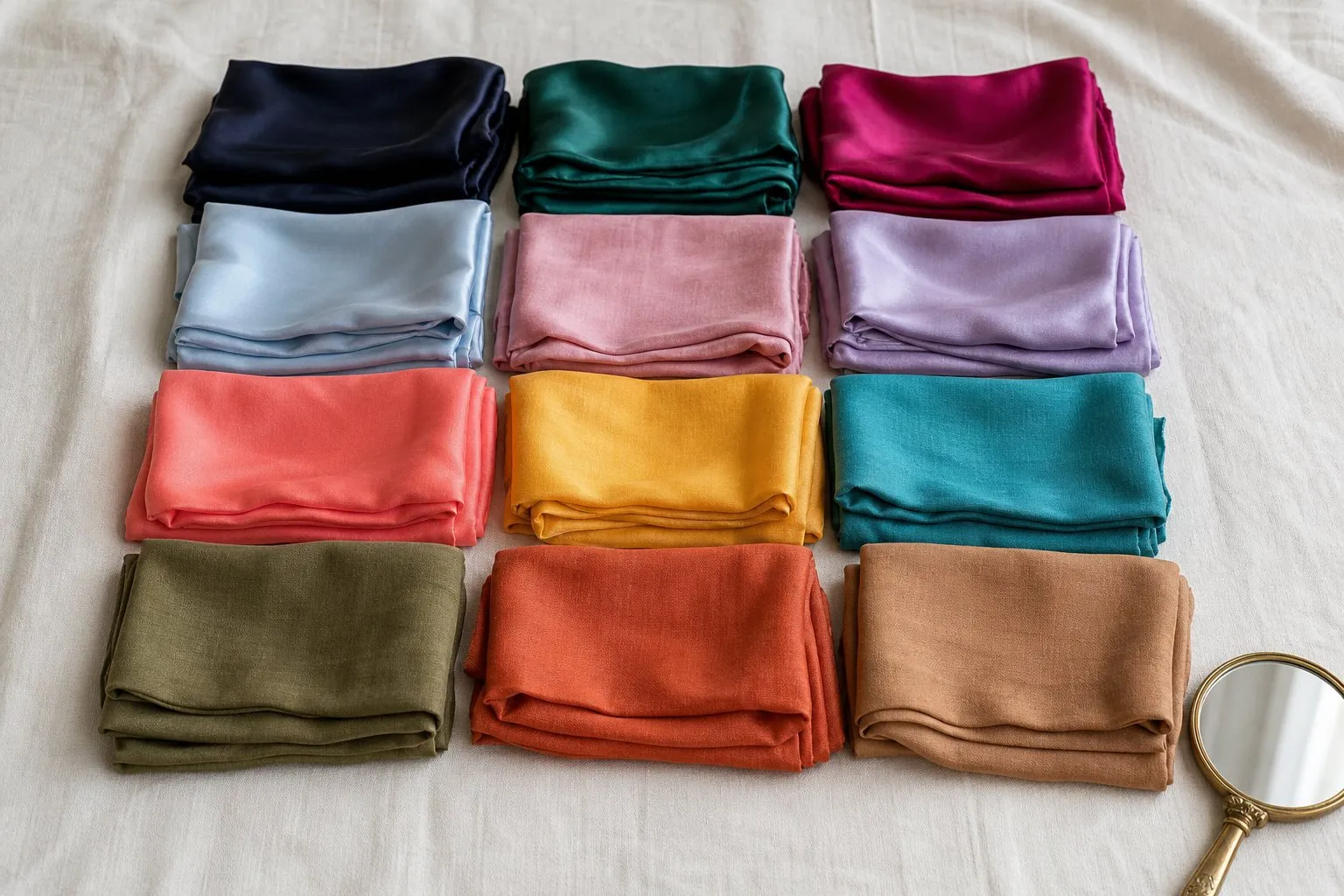
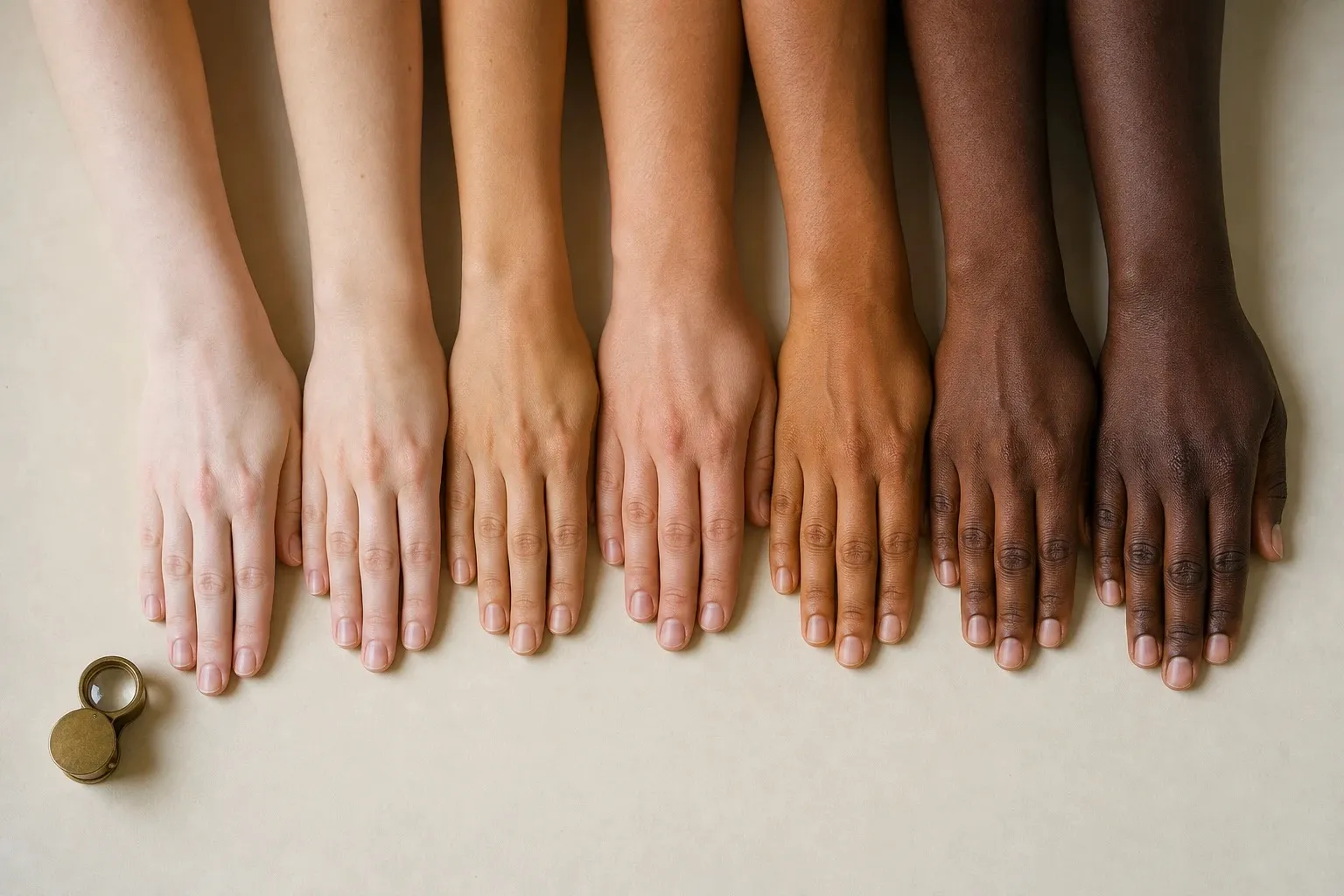
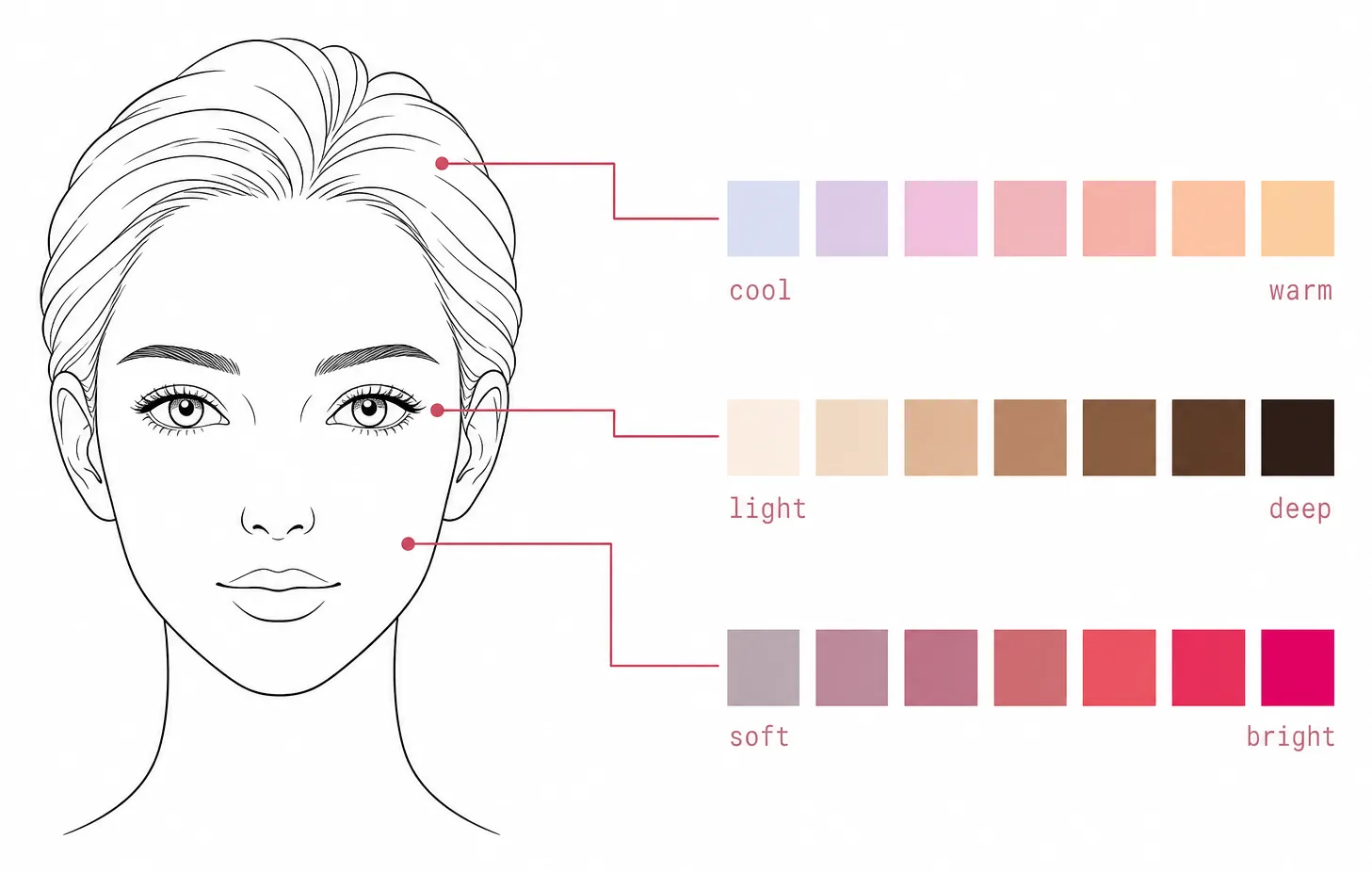
The Color Season Quiz turns your twelve answers into three numbers: temperature (cool to warm), value (light to deep) and chroma (soft to bright). The number furthest from the middle names your season, temperature usually picks the warm or cool side, and the second-strongest number names the runner-up. Treat the result as a shortlist of two seasons to confirm with fabric in daylight: the quiz cannot see you, and a photo app sees what your camera did to your skin.
How the quiz reads your answers
Each answer adds a fixed amount to one or two axes; some, such as “Both look fine” for metals, add nothing.
| Question | Moves |
|---|---|
| Veins, metal, hair glints | Temperature |
| White under the chin | Temperature and chroma |
| Skin without makeup | Temperature; the olive answer also chroma |
| Sun, pastels near the face | Value |
| Natural hair color | Value; black also chroma; red or copper only temperature |
| Eyes | Chroma, temperature or value, depending on the answer |
| Contrast between hair, skin and eyes | Chroma; strong contrast also value |
| Black top under the face | Value and chroma |
| Vivid against dusty colors | Chroma |
Each total is divided by the most that axis could collect over all twelve questions, so it lands between -1 and +1, zero in the middle; the three dots under your result show those positions. A skipped question counts as zero against an unchanged divisor, so skipping weakens its axis. Fewer than six answers give no result.
From three numbers to a season
The axis furthest from zero, in either direction, is your strongest trait and names the season’s first word: value gives Light or Deep, chroma gives Bright or Soft (Munsell’s terms for lightness and for distance from gray), and temperature gives True.
For the eight Light, Deep, Bright and Soft seasons, temperature picks the side: zero or above gives Spring or Autumn, below zero gives Summer or Winter. For the four True seasons, chroma picks the side instead. Warm and bright is True Spring, warm and soft True Autumn, cool and bright True Winter, cool and soft True Summer.
Winter
Summer
Spring
Autumn
Undertones and color seasons are a styling framework, not a measurement of your skin. The tests here compare colors side by side, which anyone can repeat in daylight.
A worked example
One example, with olive skin, dark brown hair and soft hazel eyes:
| Answer | Points |
|---|---|
| Veins a mix; both metals fine; hair glints neither | None |
| Soft off-white or oatmeal under the chin | Chroma -1 |
| Olive, slightly green-gray skin | Temperature +0.3, chroma -0.5 |
| Tans easily, rarely burns | Value +1 |
| Medium to dark brown hair | Value +0.6 |
| Gray-green or soft hazel eyes | Chroma -1 |
| Medium contrast; black top is fine | None |
| Pastels wash her out | Value +1 |
| Vivid colors wear her | Chroma -1 |
Totals: temperature +0.3 of a possible 6.5, value +2.6 of 5.3, chroma -3.5 of 5.4, which gives +0.05, +0.49 and -0.65. Chroma is furthest from zero and negative: Soft. Temperature is just above zero: Autumn. The result is Soft Autumn. Value comes second and is positive, so the runner-up is Deep Autumn. Chroma leads by 0.16, and the undertone reads neutral.
- camel
- salmon
- terracotta
- sage
- olive
- muted teal
- mushroom
- warm taupe
- cream
- dark mustard
- brick
- aubergine
- forest
- dark olive
- dark teal
- chocolate
One answer moves it. If vivid and dusty colors “both work about the same”, or she skips that question, chroma drops to -0.46, value leads at 0.49, and she gets Deep Autumn with Soft Autumn as runner-up, plus the line “It is a close call, so try Soft Autumn colors too.” If she picks silver over “both look fine”, temperature falls to -0.11: Soft Summer, runner-up Deep Winter, undertone still neutral.
What the runner-up means
The runner-up is the season your second-strongest axis would name, with the same side rules, so its first word always differs from your result’s. It is never your sister season, the same first word on the other side of the temperature line (Soft Summer for Soft Autumn), because your sister shares your strongest axis.
When your strongest axis leads the second by 0.08 or less, the close-call line appears, and the runner-up deserves the same drape test as your result. Without it, the runner-up shows which way to borrow when your own palette lacks a color.
When your undertone reads neutral
The undertone line reads warm above +0.15, cool below -0.15 and neutral in between, but the season’s side flips at zero. A neutral reading therefore means one temperature answer could move you across, as silver did in the example. Test your sister season alongside the runner-up: Soft Autumn against Soft Summer, Deep Autumn against Deep Winter, Light Spring against Light Summer, Bright Spring against Bright Winter. For a True result, watch the chroma dot instead; near the middle, the True season on the other side is close.
What a photo app sees
A photo app sees pixel values your phone produced after several automatic decisions, not your skin, and no algorithm can recover color the photo no longer holds.
| What happens | Effect on your skin in the photo |
|---|---|
| Auto white balance | Neutralizes the light’s color, often pulling skin toward neutral too |
| Auto exposure | A bright background darkens your face; a dark one lightens it |
| Processing and beauty modes | Smoothing removes redness and shadows, the signs draping looks for |
| Mixed light | A window on one side and a bulb on the other give each half of the face a different cast |
| Makeup, tan and hair dye | The app reads them as your natural coloring |
Compression discards fine color detail, and your screen adds its own tint; night mode warms every swatch. Relative lightness survives best: a photo can show whether your features are all light, all deep or far apart, especially in black and white. It is also fair for comparing two drapes shot a second apart in the same light, because both pictures share the same errors.
A less misleading photo
- Face a window around midday, out of direct sun, with every lamp off.
- Stand in front of a plain white or light gray wall.
- Remove makeup and tinted sunscreen; pull back or cover dyed hair.
- Wear a white or gray top, or a towel over your shoulders.
- Hold a sheet of white paper next to your face.
- Use the rear camera with beauty modes, filters and flash off.
- Take three photos and run them all. If they disagree, the app is reading the photo, not you.
Quiz, photo app or drape
| Method | What it reads | Where it goes wrong | Best use |
|---|---|---|---|
| This quiz | What you have noticed about your coloring | Guesses, dyed hair answered as natural | Three positions and two seasons to test |
| Photo app | Pixels after the camera’s corrections | Undertone and borders between neighbors | Depth and contrast |
| Drape in daylight | Your skin next to real fabric | The room’s light and your own eye | Choosing between two named seasons |
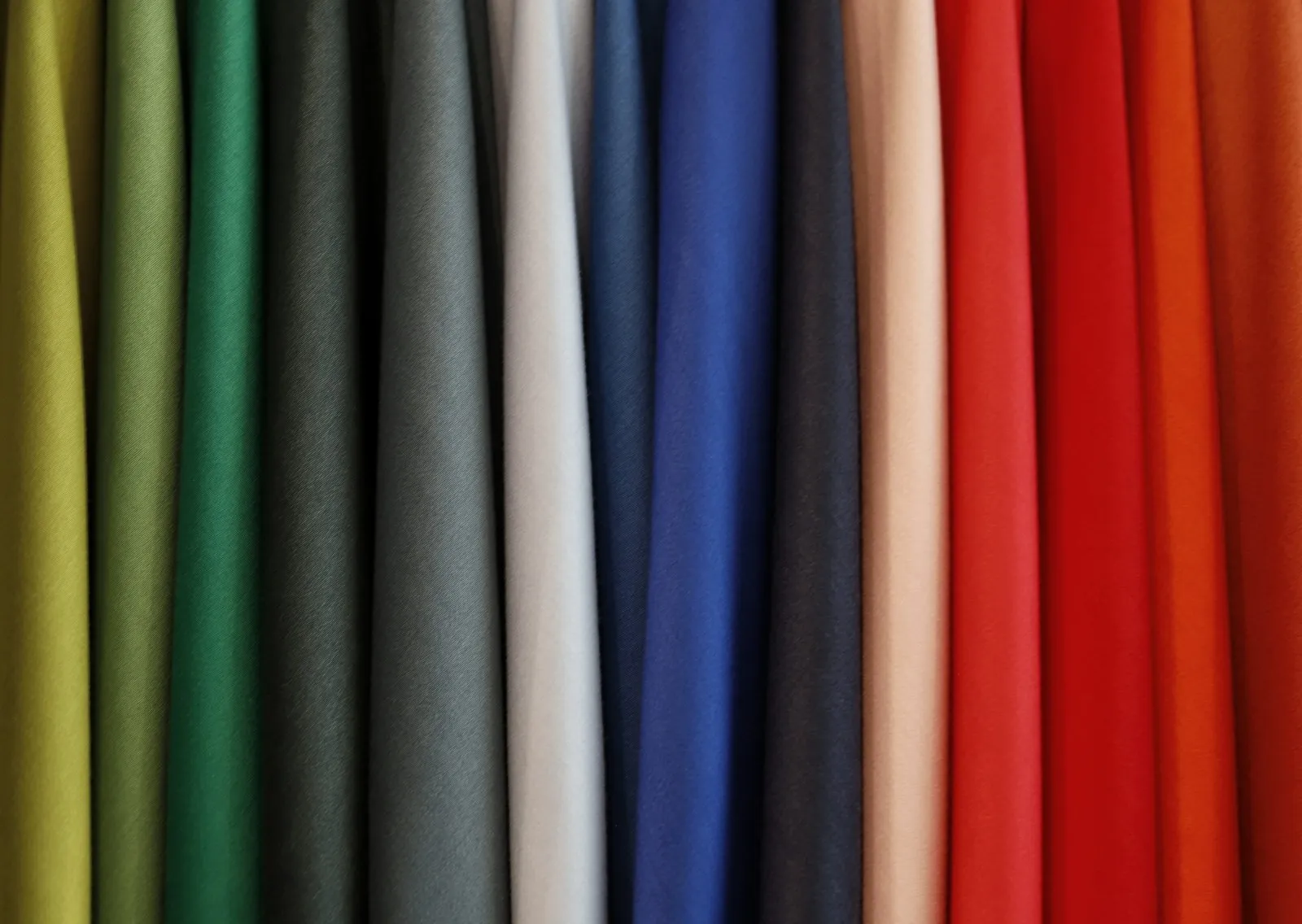
Each method has a different weak spot, so two that agree beat any one. For the drape check, sit at a window at midday, bare-faced, and hold colors from your result and your runner-up under your chin in turn: the better one evens your skin, the worse one adds shadow or a gray or yellow cast. The home drape test with all eight pairs is in seasonal color analysis explained.
When to trust the quiz
Trust the result more when there is no close-call line, your undertone reads clearly warm or cool, and you answered all twelve from your natural coloring: hair before dye or gray, bare skin, your sun reaction rather than this summer’s tan. A drape check that agrees settles it.
Be careful when the close-call line appears, when the undertone reads neutral, or when veins, the least reliable undertone test, are all that push your temperature. If you guessed at the white, black-top, pastel or vivid questions, hold real fabric under your chin and answer again. The skin tone chart has the undertone tests in full, and olive skin tone covers the skin answer the quiz reads as slightly warm and soft.