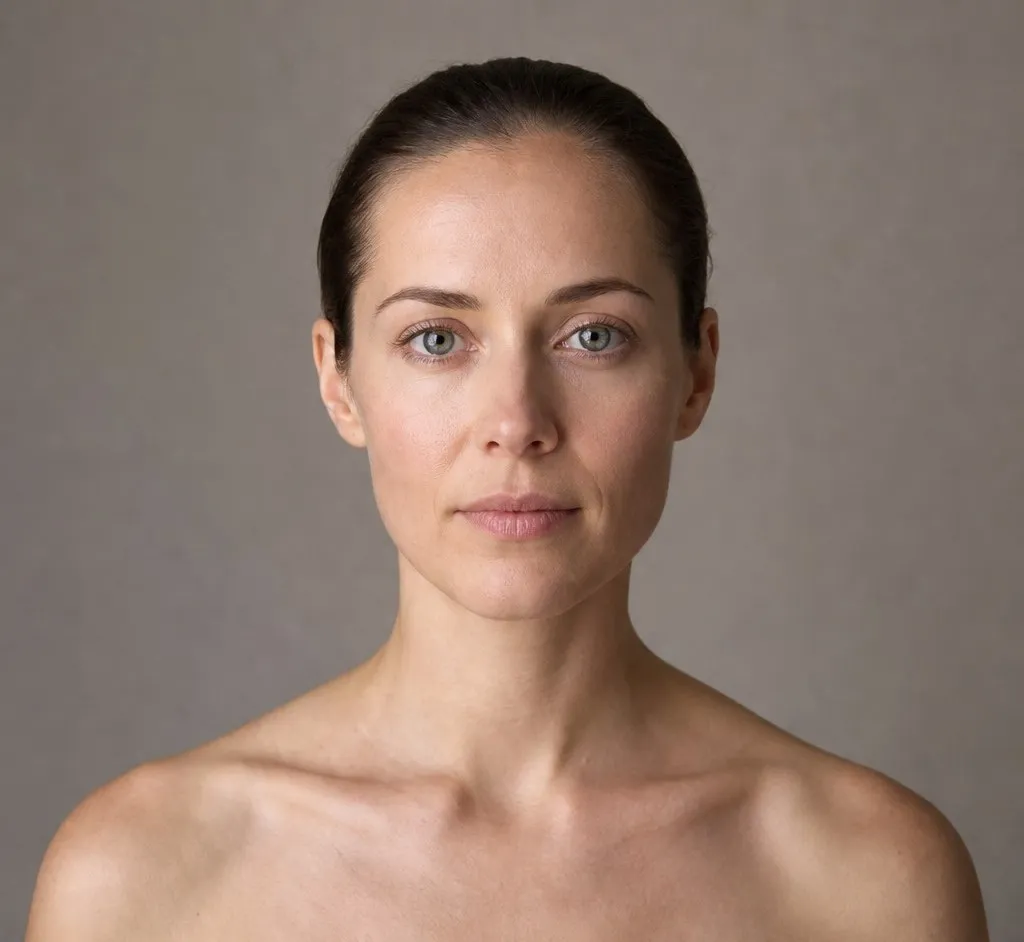
What suits your face shape comes down to one idea, and it works the same for a bob, a pair of frames or a necklace. A line across your face makes it read wider at that height. A line down or on a diagonal makes it read longer, and the eye stops wherever a line ends. So you counter your outline, adding width where your face is narrow and length where it’s short, or you echo it on purpose.
Face shapes are a styling framework, not an anatomical classification. The calculator compares three ratios with seven reference windows, and many faces sit between two shapes.
To find your row, measure forehead (A), cheekbones (B), jaw (C) and face length (D) with a ruler in a mirror. Six shapes have their own article, and this page holds the tables that compare all seven.
One principle for every face shape
Every table below pulls the same three levers: width at height (a hem, a fringe, a top rim or a wide earring adds width where it sits), direction (horizontals widen, verticals and diagonals lengthen) and the endpoint, where the eye stops. Countering also sets curves against corners. Echoing, such as round hoops on a round face, reads soft and deliberate. The tables lean toward balance, but both approaches are legitimate.
| Face shape | Forehead : B | Jaw : B | Length : B |
|---|---|---|---|
| Oval | 0.88 – 1.00 | 0.75 – 0.88 | 1.30 – 1.50 |
| Round | 0.86 – 0.98 | 0.80 – 0.92 | 1.10 – 1.30 |
| Square | 0.92 – 1.04 | 0.90 – 1.00 | 1.10 – 1.30 |
| Oblong | 0.90 – 1.02 | 0.85 – 1.00 | 1.50 – 1.75 |
| Heart | 1.00 – 1.12 | 0.65 – 0.80 | 1.25 – 1.50 |
| Diamond | 0.75 – 0.88 | 0.70 – 0.85 | 1.30 – 1.55 |
| Triangle | 0.78 – 0.90 | 0.95 – 1.08 | 1.20 – 1.45 |
The ratios name your shape, and the aim follows from where it’s widest.
| Shape | The usual aim | In depth |
|---|---|---|
| Oval | Keep the balance | Oval face shape |
| Round | Add length and angle | Round face shape |
| Square | Soften the corners | Square face shape |
| Oblong | Add width, shorten | Oblong face shape |
| Heart | Light on top, width low | Heart face shape |
| Diamond | Width at forehead and jaw | Diamond face shape |
| Triangle | Width on top, a quiet jaw | Face Shape Calculator |
Here’s a worked example. Forehead 14 cm, cheekbones 13.5 cm, jaw 10 cm and length 18.5 cm give A/B 1.04, C/B 0.74 and D/B 1.37. The calculator scores that face 97 for heart, with diamond a distant second at 68. Read down the heart rows and you get one consistent look: a hem at or just below the chin, curtain or side-swept bangs, frames light on top and 135 to 140 mm wide, contour at the temples, earrings that widen near the jaw and a short chain under the narrow chin. What if your result sits between two shapes? Use what both rows agree on.
Length and the bob
A bob ends in a horizontal line, so the hem widens the face where it lands, and fullness at the ends counts as width too. The hem sits above the jaw, at it, or a few centimeters below. Faces narrow at the jaw (heart, diamond, a tapering oval) can take a hem right there, while faces wide at the jaw (square, triangle) do better above or below. To find the level, pinch a strand at the corner of your jaw in a mirror.
| Face shape | Where the hem lands | Handle with care |
|---|---|---|
| Oval | Anywhere from earlobes to collarbones | A heavy line at the cheekbones |
| Round | Below the chin, angled longer at the front | Blunt at chin level with full sides |
| Square | Just below the jaw or well above it, ends angled or textured | A blunt hem exactly at the jaw |
| Oblong | At the chin, full at the sides | A long, sleek bob with flat sides |
| Heart | At or just below the chin, full at the ends | Crown height with flat sides |
| Diamond | At the chin, fuller ends, ideally with bangs | A hem at cheekbone level |
| Triangle | Below the jaw, volume on top | Chin length, full at the jaw |
Round is the surprise. A short, rounded bob looks like a match, but a hem at chin level widens a face that’s already short and wide.
Bob or lob? A bob ends between the ears and the jaw. A lob, or long bob, ends between the jaw and the collarbones. The lob is the easier choice for round, square and triangle faces. The classic bob suits faces whose lower half needs a horizontal: oblong, heart and diamond.
Bangs by face shape
Bangs work twice. They cover part of the forehead, which moves the visible top of the face down so it reads shorter. And they draw a line. A straight edge is a horizontal that widens, and a parted or angled edge is a diagonal that lengthens. Full, blunt bangs give the most coverage and the strongest horizontal. Wispy ones are thinned and see-through. Curtain bangs part in the middle and open toward the cheekbones, side-swept bangs cross the forehead in one diagonal, and micro bangs stop well above the brows.
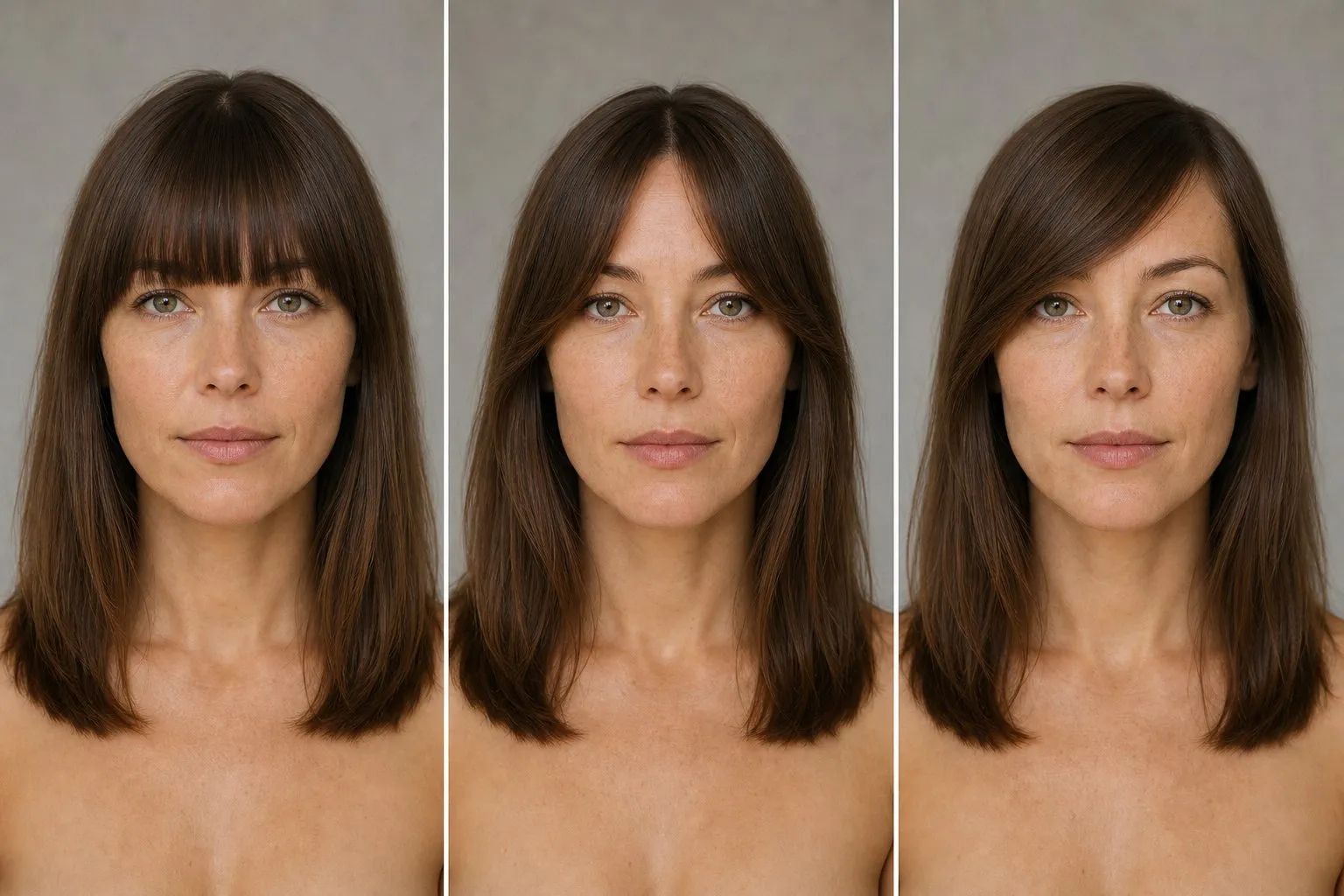
| Face shape | Full, blunt | Wispy | Curtain | Side-swept | Micro |
|---|---|---|---|---|---|
| Oval | Works | Works | Works | Works | Works |
| Round | Avoid | If long | Very good | Very good | Avoid |
| Square | Avoid | Works | Very good | Very good | Avoid |
| Oblong | Very good | Weak | Good if full | Works | Avoid |
| Heart | Avoid | Very good | Very good | Very good | Avoid |
| Diamond | Good | Works | Good | Very good | Possible |
| Triangle | Good | Works | Good | Works | Possible |
Short faces (round, square) gain from diagonals, and long ones from coverage. Heart faces want the corners covered, while diamond and triangle faces are narrow on top and can take a horizontal.
Face shape picks the type, and forehead height sets length and weight. A high forehead has room for dense bangs. A short one wants them light, or they’ll sit on the brows and crowd the eyes. Curtain bangs suit most shapes, but the length isn’t the same for all of them. They open at the cheekbones on round and square faces, sit shorter and fuller on an oblong one, fall over the forehead corners on a heart and open at the temples on a diamond.
A few checks before you cut. Curly hair springs up as it dries, so curly bangs are cut longer. A cowlick at the hairline splits blunt bangs. Blunt bangs also need a trim every few weeks, while curtain bangs grow out most easily.
Big forehead and the part
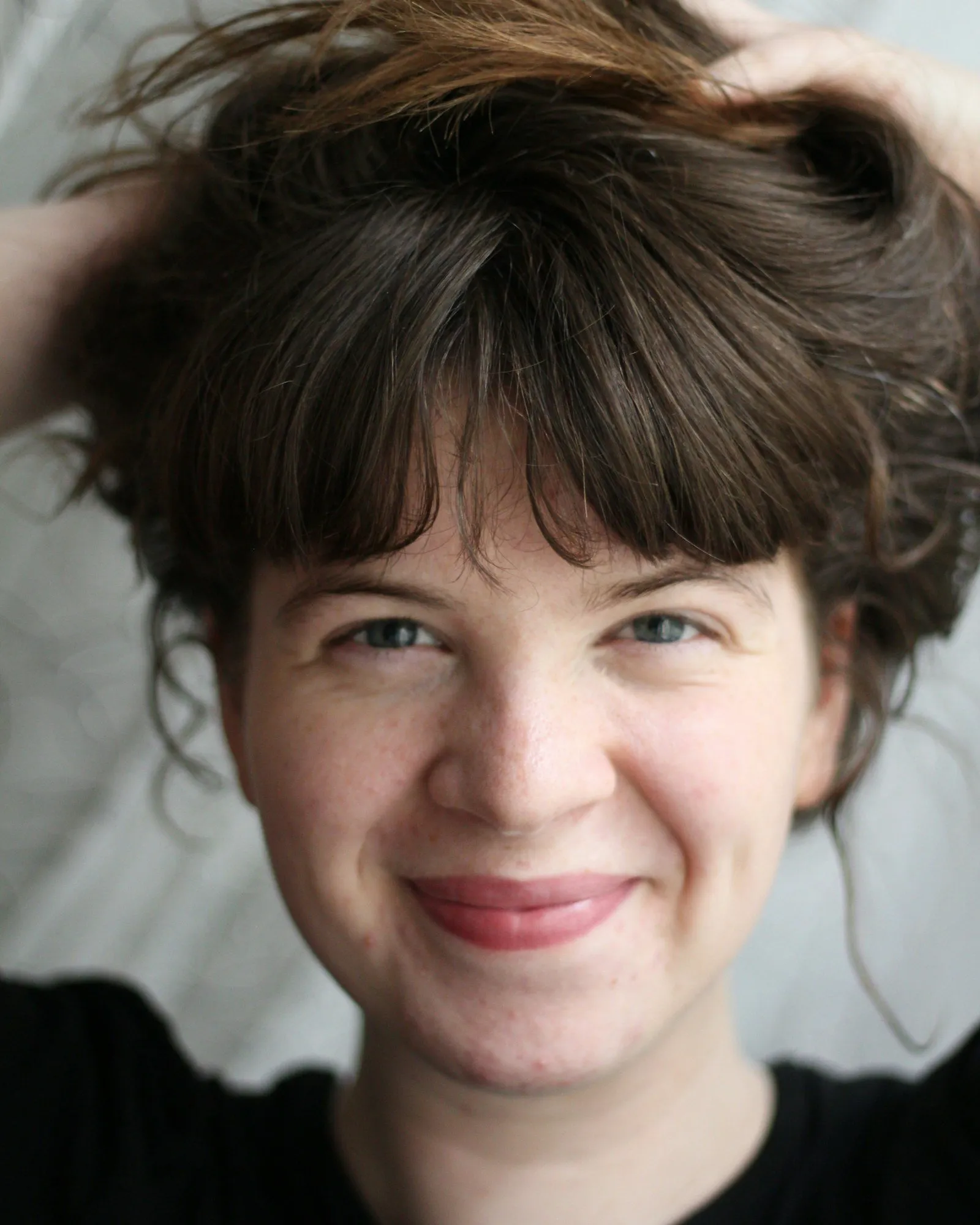
“Big forehead” means high, wide or both, and the fixes differ. High: measure from your hairline to between your brows, then from there to the base of your nose. If the first is clearly longer, the forehead is high. (An old drawing canon makes the two equal, but real faces rarely match it.) Wide: A/B at 1.00 or above, so the forehead is at least as wide as the cheekbones, as on heart faces and some square ones.
| High forehead | Wide forehead | |
|---|---|---|
| Bangs | Dense, or curtain bangs that start high | Side-swept, or curtain over the corners |
| Part | Deep side part | Deep side part |
| Volume | At the sides, not on the crown | At the jaw, not at the temples |
| Shows it most | Slicked back, a high top knot | A blunt straight fringe, puffed temples |
If yours is both at once, go for curtain bangs that start high and fall over the corners. Face-framing pieces at the temples help either kind. A short forehead is the opposite case, and it wants light bangs and some height at the crown.
If you don’t wear bangs, the part does the work. A middle part is a vertical line with two even curtains. With flat sides it adds two more verticals, so the face reads longer and the whole forehead shows. With curtain bangs or side volume it frames the forehead instead. A side part sends a diagonal across the crown and puts more hair on one side. The deeper it is, roughly above the arch of one brow, the more forehead it covers, in height and width at once.
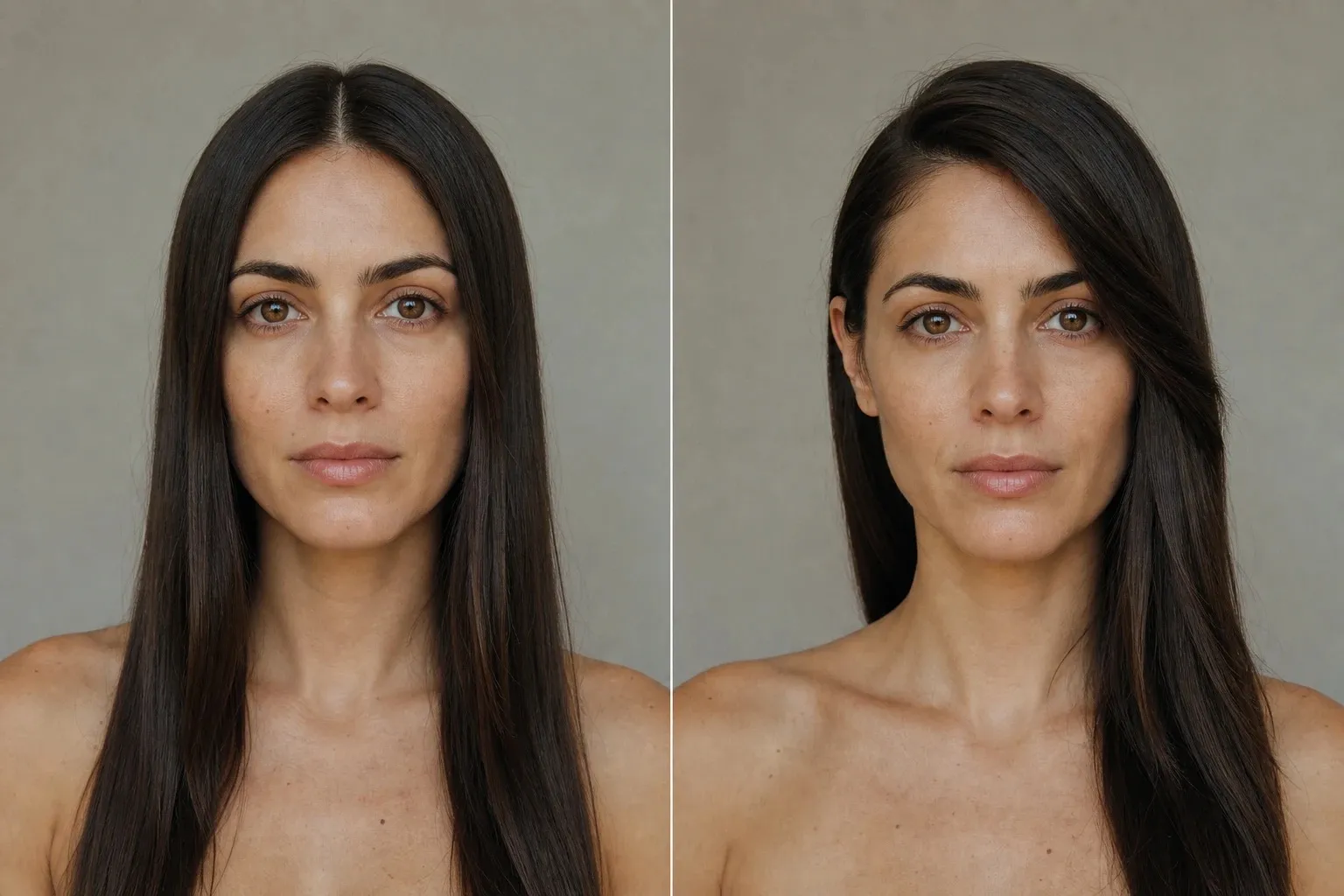
| Face shape | Middle part | Side part |
|---|---|---|
| Oval | Works | Works |
| Round | With crown height and length below the chin | Very good: the diagonal adds length |
| Square | With flat sides, repeats the straight lines | Very good: breaks the edges |
| Oblong | With flat sides it lengthens; fine with curtain bangs | Good: sweeps across the forehead |
| Heart | With fullness at the jaw | Very good: covers one corner |
| Diamond | With sleek sides and crown height | Very good, deep: widens the forehead |
| Triangle | With lift at the roots | Good: adds volume on top |
Decide with photos, because a mirror flips your face and front cameras often do too. Use the rear camera on a timer, at eye level, and shoot middle, left and right. No face is perfectly symmetric, and one side usually looks more settled. Choose that one, or the side your hair falls to on its own.
Short hair and the 2.25-inch rule
The 2.25-inch rule is a quick test credited to the hairstylist John Frieda, which Birchbox Magazine described in 2015. Hold a pencil level under your chin and a ruler upright under your earlobe, and measure from the bottom of the lobe to the pencil. Under 2.25 inches (5.7 cm), short cuts are likely to frame your face well. Over it, the rule suggests keeping some length.

It’s easy to get wrong. Pull your hair back and level your head, so the line from the outer corner of your eye to the top of the ear opening is roughly horizontal. Tipping the chin up shortens the reading, and tipping it down lengthens it. Hold the pencil flat at the lowest point of the chin, set the ruler’s zero at the bottom of the earlobe, and measure twice.
The test measures a vertical drop. That depends on the slope of the jaw, the thing it’s after, and on the length of the lower face, where your ears sit and how long your lobes are as well. It’s one threshold for every face, and it ignores width and texture, which even the 2015 article says play a part.
| Face shape | What a short cut should do |
|---|---|
| Oval | Most work; choose by texture |
| Round | Height at the crown, close sides, a side-swept fringe |
| Square | Soft pieces in front of the ears, no hard line at the jaw |
| Oblong | Fullness at the sides, a fringe, no height on top |
| Heart | A side-swept fringe, a flat crown, softness at the nape |
| Diamond | A fringe to widen the forehead, sides close at the cheekbones |
| Triangle | Height and width on top, close at the jaw |
If you measure over 2.25 inches, I’d go short in steps, with a lob below the jaw first.
Hair and glasses
Hair with glasses comes down to two lines and a gap. The lines are the frame’s top rim and the edge of your bangs. When they’re a finger’s width apart or less, they read as one heavy band, and bangs that rest on the rim get pushed up and brush the lenses. End the bangs clearly above the rim, cross it with a diagonal, or skip bangs and let the frame carry the horizontal.

Blunt bangs need the most care, so end them a little above the brows or choose a lower, thinner top rim. Curtain bangs work easily if they part above the bridge and sweep out past the frame. Side-swept bangs should end at the arm or tuck behind it, so they don’t fall into the lens.
The gap is at the sides, where the arms run back to the ears. Hair tucked thickly under an arm lifts it and tilts the frame, and the arms press hair flat at ear level, so put volume below them or at the crown. Short hair and updos show the arms, so choose ones you like.
| Face shape | Cut and bangs with glasses |
|---|---|
| Oval | Anything; keep the gap |
| Round | Crown height, length below the chin, long side-swept bangs |
| Square | Soft layers from the cheekbones, an off-center part |
| Oblong | Full bangs ending just above the rim: the one face where they may sit close |
| Heart | Side-swept or curtain bangs, fullness at the jaw |
| Diamond | Bangs and a defined rim both widen the forehead |
| Triangle | Volume at the crown and temples, a hem below the jaw |
Frame size: reading 52-18-140
The three numbers inside a temple arm are millimeters. A small square sometimes replaces the first dash, and you read it the same way.
| Number | What it measures | Usual range |
|---|---|---|
| 52 | Lens width, each opening | 40 to 60 mm |
| 18 | Bridge width, the gap between lenses | 14 to 24 mm |
| 140 | Temple length, hinge to tip | 120 to 150 mm |
Sellers call lenses of 50 mm or less small, 51 to 54 mm medium and 55 mm and up large. The number that decides the look isn’t printed. It’s the total width of the front. For 52-18-140, lenses and bridge come to 52 + 52 + 18 = 122 mm, and the end pieces add the rest, more on thick acetate than on thin metal. Many shops list the total, so use it when they do.
A frame should be about as wide as your face where it sits, and cheekbone width B, taken just below the outer corners of the eyes, is a practical stand-in. Aim for a total within a few millimeters of B. Heart faces can go up to the forehead width A, while diamond faces should stay at or a little under B. In the worked example, that’s a target of about 135 mm.
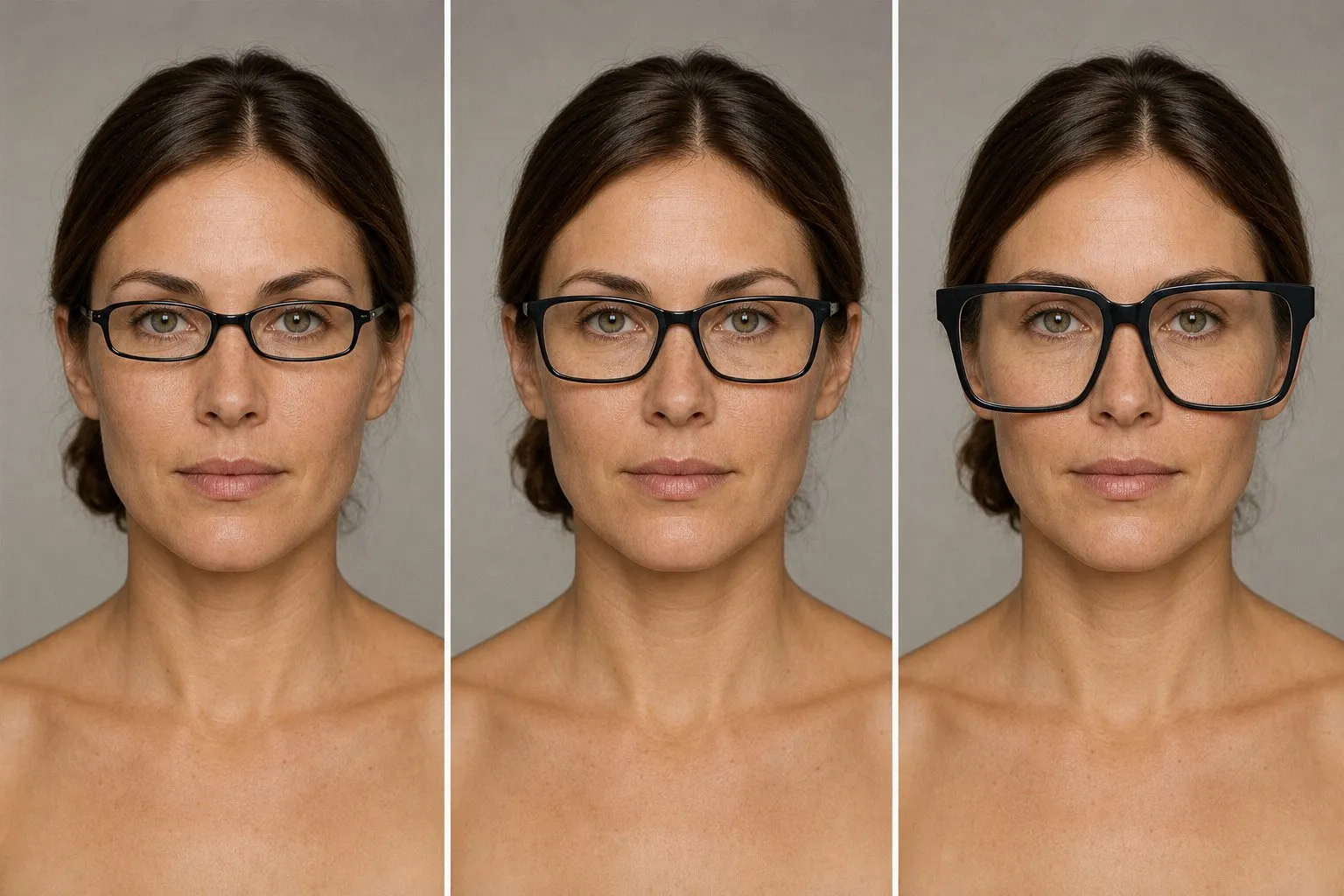
Within that total, your eyes should sit roughly centered in each lens. A frame that’s too wide pushes them toward the inner edges and makes them look close-set, and one that’s too narrow pushes them toward the outer edges. A bridge too wide for your nose slides, and one too narrow sits high and leaves red marks. Temples should run straight back and curve down behind the ear. Too short and they press on the ear, too long and the frame slides forward. The surest guide is a pair you already own, because a frame within a couple of millimeters on lens and bridge fits about the same.
What glasses suit your face
Once the width is right, three checks decide the shape. Width: never clearly narrower than the face. Weight: the heavier part of the frame belongs where your face is narrower. Line: angles contrast with curves and curves with angles, and repeating the outline emphasizes it.
| Face shape | Choose | Handle with care | Width and weight |
|---|---|---|---|
| Oval | Almost any shape | Much wider or narrower than the face | About B |
| Round | Rectangles wider than deep, cat-eye, browline | Small round, any narrow frame | At least B; a top line that rises |
| Square | Round, oval, aviator, soft cat-eye | Heavy flat bottom rims, sharp rectangles | About B; weight on top |
| Oblong | Deep rectangles, aviators, deep round, browline | Shallow, small or rimless frames | Close to B; depth, detail at the temples |
| Heart | Aviator, thin round metal, oval, rimless | Browline, heavy top rims, oversized square | At or under A; light on top |
| Diamond | Cat-eye, browline, trapezoid, oval with a stronger top | Wider than the cheekbones; deep lenses on them | At or under B; light lower rim |
| Triangle | Cat-eye, trapezoid, browline | Bottom-heavy frames | About B; weight on top |
On an oblong face, “low bridge” also names a style. A bridge set low on the frame front crosses the nose lower and shortens the middle of the face, while a high or keyhole bridge adds length, which helps a round one. Frame color follows your coloring and has nothing to do with your shape, and seasonal color analysis covers it.
Low bridge fit
“Low bridge fit” is a fit category for a nose bridge that sits low or projects little between the eyes. On such a nose a standard frame sinks until something else holds it, usually the cheeks. How do you know it’s happening? The frame slides although the width is right, the rims rest on your cheeks and lift when you smile, your lashes brush the lenses and your pupils sit near the top rim.
Two mirror tests confirm it. In exact side view, a high bridge projects clearly at the point between the eyes where glasses rest, and a low one sits only slightly forward. Then put on a pair you own and look straight ahead. Your pupils should sit near the middle of each lens or slightly above it, and pupils close to the top rim are the warning sign.
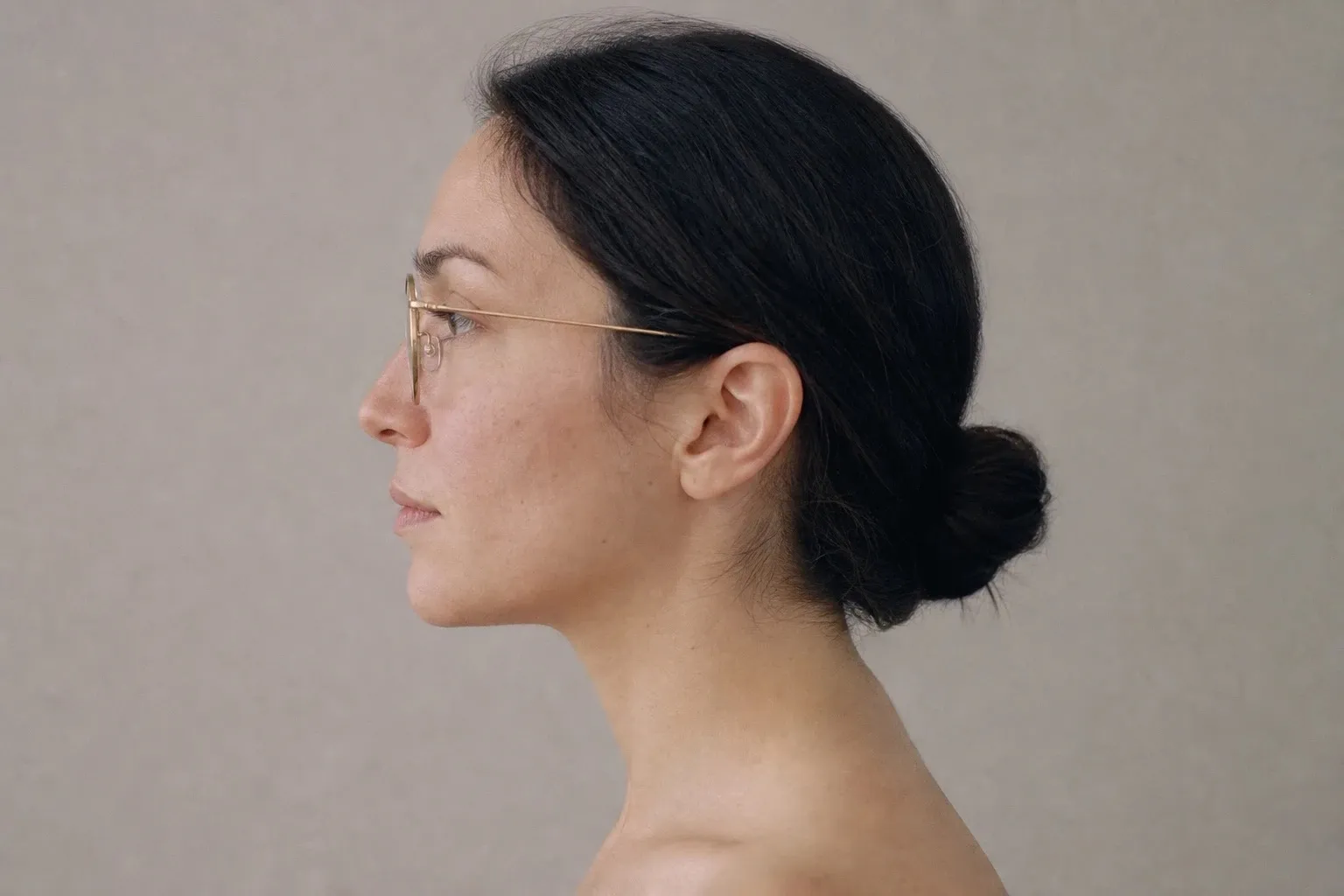
Sellers use “low bridge fit” and “Asian fit” for the same adjustments. Those depend on bridge height and cheekbones and have nothing to do with ethnicity. You’ll get taller or larger nose pads, a lens angle that keeps the rims off the cheeks and a little more width at the temples. The 18 in 52-18-140 measures the gap between the lenses and can’t tell you how high the frame sits, so only pads lift a sinking frame. Fix the width first, then the height.
| Bridge type | Adjustable? | For a low bridge |
|---|---|---|
| Pads on metal arms | Yes, by an optician | The most forgiving option |
| Molded acetate | Very little | Only in a low bridge fit version |
| Acetate with raised pads | Limited | If labeled low bridge fit and it passes the pupil test |
In the shop, blink (no lashes on the lenses), smile broadly (the frame stays put), look down (no slipping) and look ahead (pupils near the middle). If one fails, ask for the pads to be adjusted before trying another frame.
Sunglasses by face shape
Sunglasses pass the same three checks. Aviators are deeper at the bottom, trapezoids and cat-eyes are wider on top, and a shield reads as one band across the face.
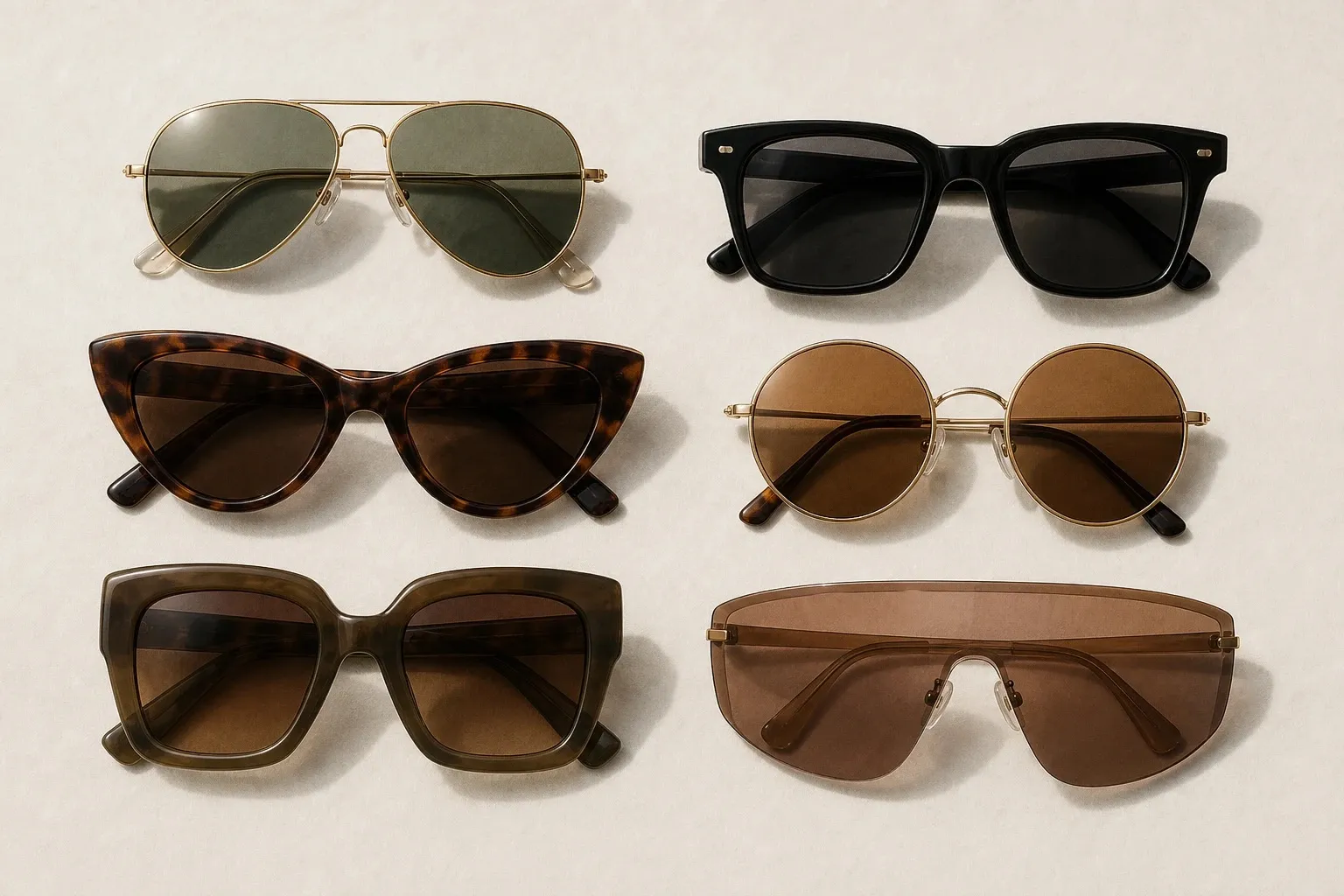
| Face shape | Aviator | Trapezoid | Cat-eye | Round | Oversized | Shield |
|---|---|---|---|---|---|---|
| Oval | Good | Good | Good | Good | Good | Good |
| Round | Possible | Very good | Very good | Avoid if small | Possible | Possible |
| Square | Very good | Possible | Good | Very good | Good | Possible |
| Oblong | Very good | Good | Possible | Good | Very good | Good |
| Heart | Very good | Avoid | Possible | Very good | Avoid | Avoid |
| Diamond | Good | Good | Very good | Good | Possible | Possible |
| Triangle | Possible | Very good | Very good | Possible | Possible | Good |
“Possible” means some versions work, such as the right width, a lighter rim or a softer angle. Aviators suit heart faces because their weight sits low, and they’ll add to a triangle’s jaw unless the top bar is strong.
Face shape decides how sunglasses look. It doesn’t decide how well they protect. The American Academy of Ophthalmology advises lenses labeled to block 100 percent of UV light (“UV absorption up to 400nm” also qualifies). It also notes that darker or colored lenses don’t necessarily block more, and that polarization cuts glare without blocking UV. Oversized and wraparound frames shield the most.
Contour and blush by face shape
Contour borrows what daylight does to bone. A darker matte area reads as shadow and recedes, and a lighter one reads as a plane catching light and comes forward. So shade where your face is widest and add light where it’s narrow. Blush adds direction, because the eye follows the long axis of a mark. Swept horizontally it shortens and widens, and angled toward the temple it lengthens.
Your ratios give the zones. An A/B above 1.00 puts shade at the temples and a C/B near 1.00 puts it at the jaw corners, and the closer your D/B sits to the oblong window, the more horizontal the blush.
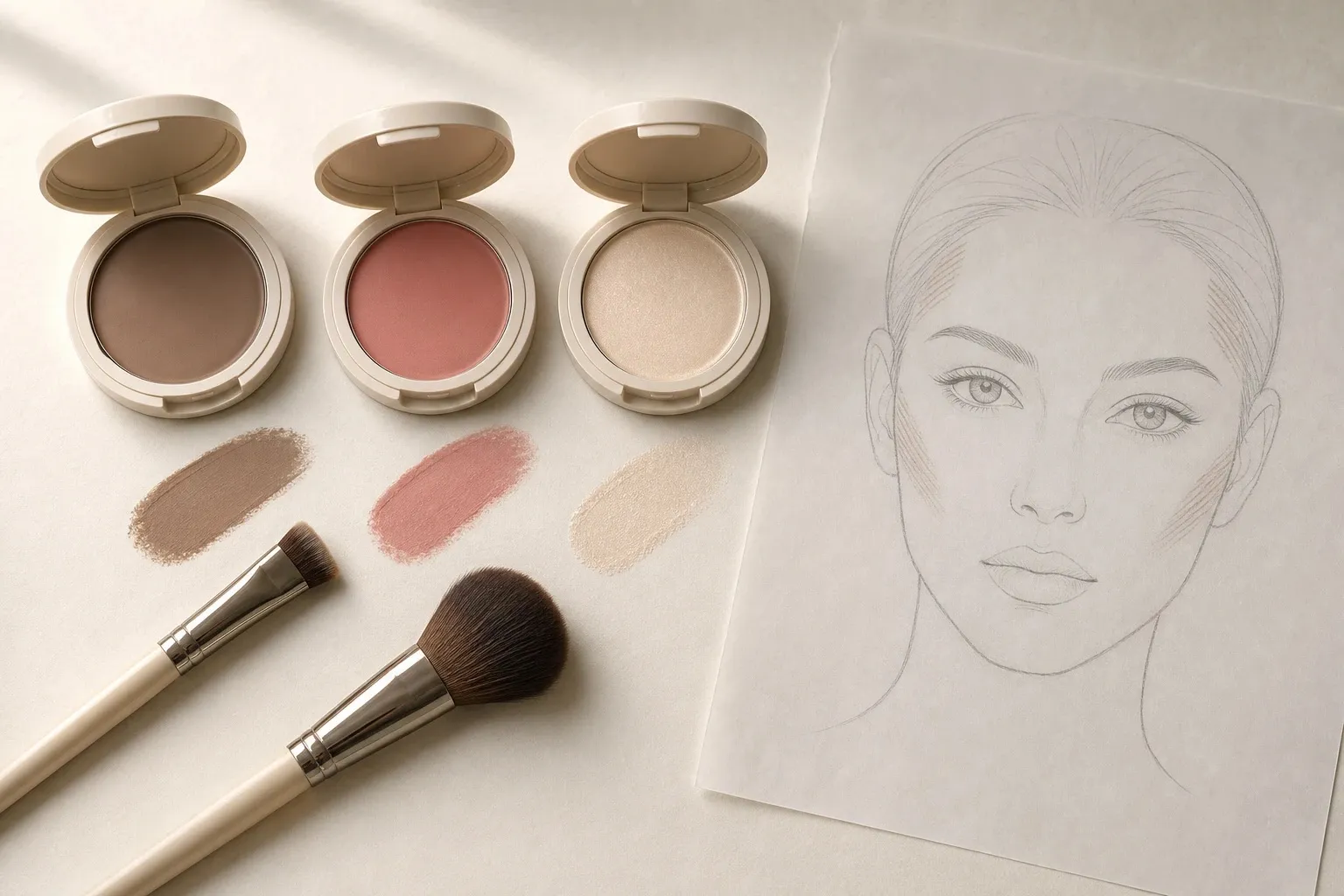
| Face shape | Shade | Light | Blush |
|---|---|---|---|
| Oval | A soft line under the cheekbone, or nothing | Center of the forehead | On the cheekbone, blended up and back |
| Round | Temples down past the cheekbones | Center of forehead and chin | Angled up toward the temple |
| Square | Jaw corners, outer forehead corners | Center of forehead and chin | On the cheekbone, rounded, angled slightly up |
| Oblong | Along the hairline, under the chin tip | Center of the cheek | Horizontal, straight back to the ear |
| Heart | Temples and outer forehead | Jaw and chin | A little lower, toward the ear |
| Diamond | The outer cheekbone, lightly | Center of forehead and chin | Just below the cheekbone, toward the center |
| Triangle | Jaw corners and jawline | Temples and forehead | High, angled toward the temple |
To place blush, press below the outer corner of your eye until you feel bone, then follow it toward the ear. Start no closer to the nose than a line down from the outer edge of your iris and no lower than the tip of your nose, sweep in your direction and fade the edge. Contour should be matte, a step or two deeper than your skin, and neutral or slightly cool. Bronzer is warmer and reads as a tan. Sharp contour is built for studio light and shows as stripes by day, so check yours by a window at arm’s length.
Earrings by face shape
An earring adds width at the height where it’s widest, so it should be widest where your face is narrow. Where it ends matters too. Above the jaw it keeps attention on the eyes, and below it draws a line down the neck.
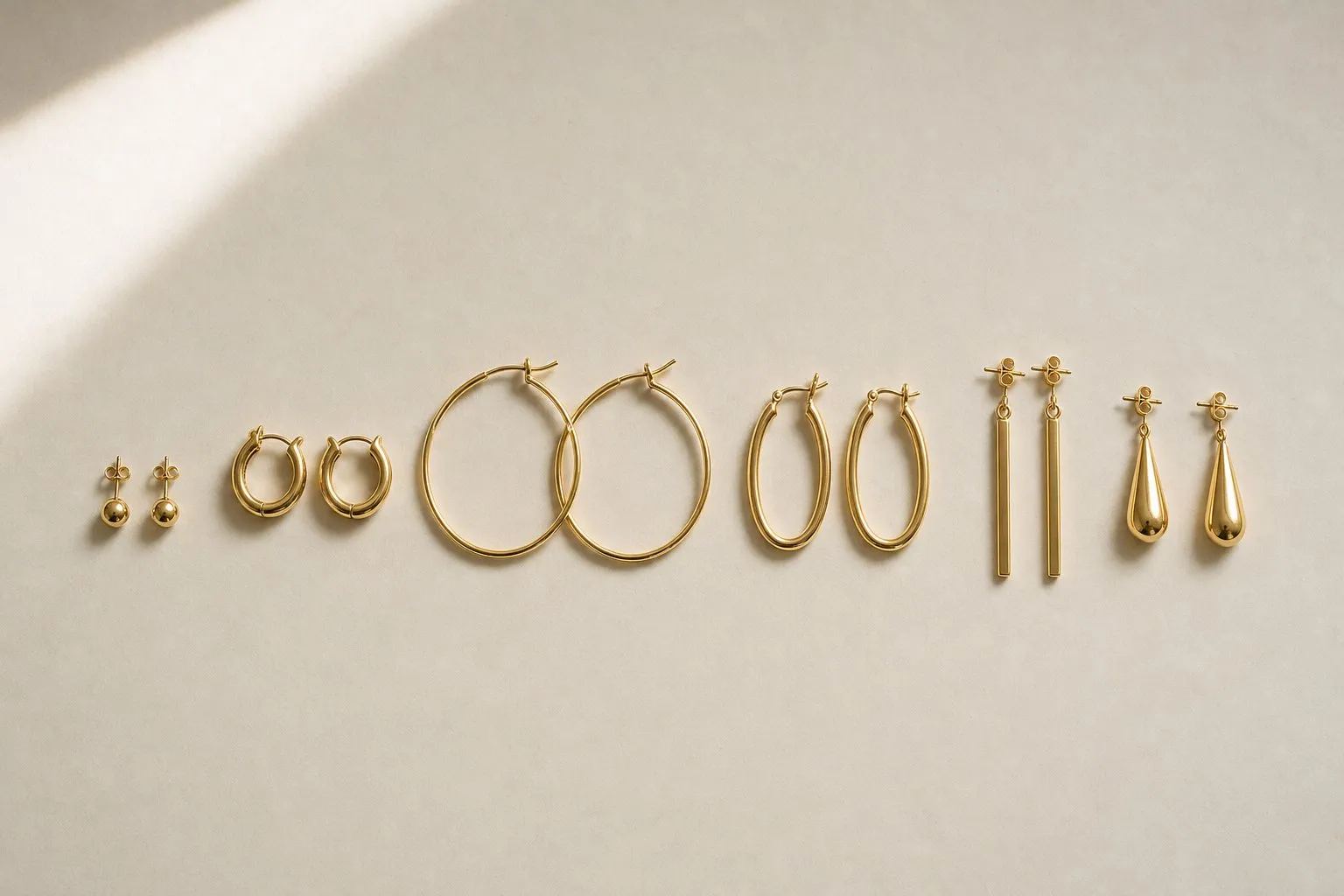
| Face shape | Choose | Go easy on |
|---|---|---|
| Oval | Almost anything; scale and neckline decide | Very long drops near the oblong end |
| Round | Long narrow drops, linear and angular shapes below the jaw | Large round hoops, wide clusters at cheek level |
| Square | Oval hoops, curved drops, teardrops below the jaw | Wide geometric shapes ending at the jaw angle |
| Oblong | Studs, clusters, round hoops, short wide shapes | Long thin drops |
| Heart | Teardrops and chandeliers wider at the bottom, ending near the jaw | Wide, heavy studs high on the ear |
| Diamond | Studs, teardrops, drops that widen at jaw level | Wide pieces at cheekbone height |
| Triangle | Slim drops, inverted triangles, studs | Chandeliers that flare at the jaw |
Studs suit every shape, and oval hoops add less width than round ones. A high neckline leaves room for bigger earrings, and a statement necklace calls for smaller ones. How big you can go depends on your features and frame more than your outline, which the Body Shape Calculator guide covers as jewelry scale. Metal sits next to your skin like a small drape, and that’s something the skin tone chart tests.
Necklines, neck and bust
A neckline frames the face, shows or hides the neck and shapes how bust and shoulders read, all at once, through depth, width and shape. So a neckline you’ve chosen for the face alone can fail on the other two.
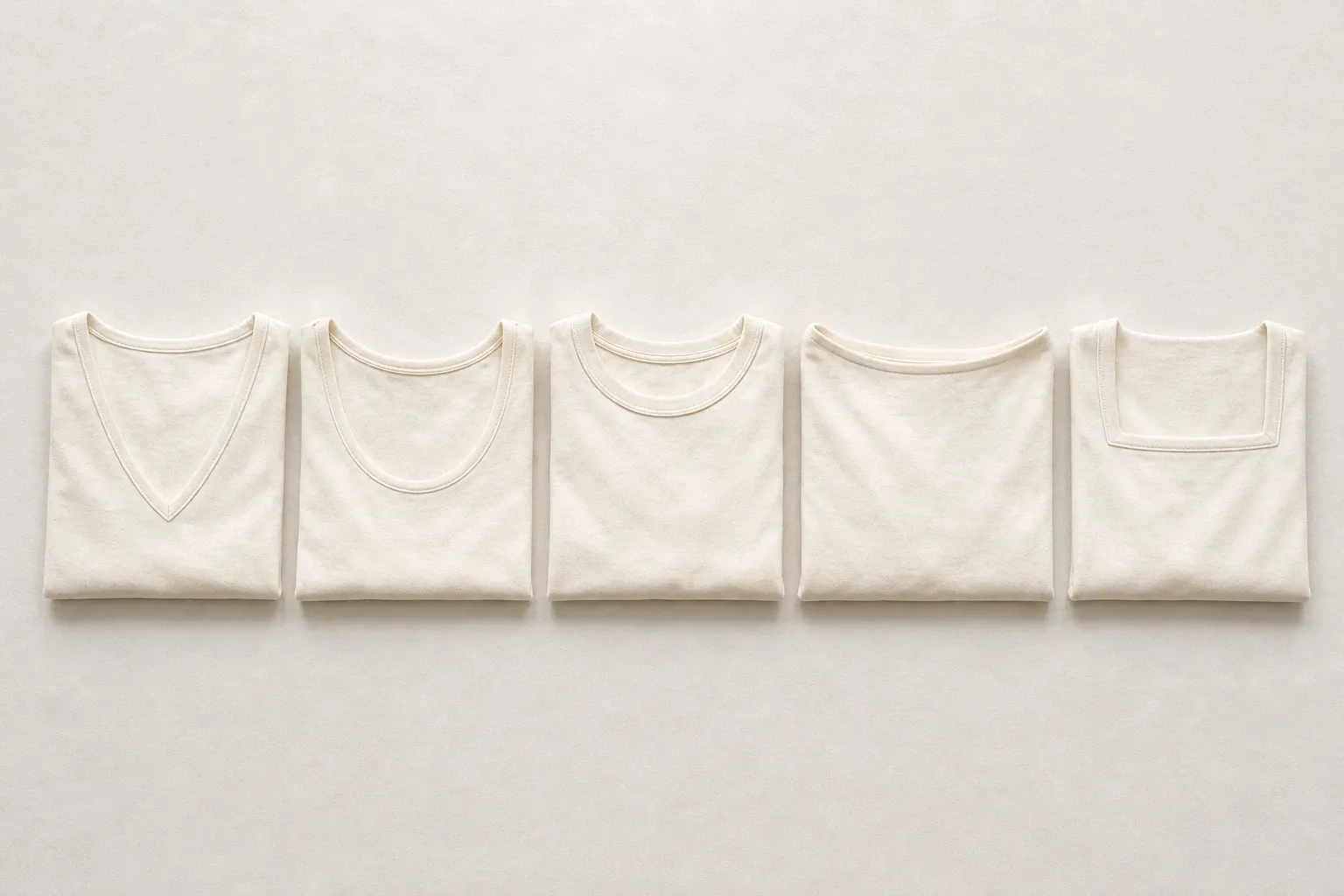
| Face shape | Necklines that work | Handle with care |
|---|---|---|
| Oval | Almost any; neck and bust decide | Nothing in particular |
| Round | V-neck, deep scoop, halter | A high crew right under the chin |
| Square | Scoop, sweetheart, cowl, V-neck | Stiff square necklines that repeat the jaw |
| Oblong | Boat, square, crew, cowl, turtleneck | A deep V |
| Heart | Boat, sweetheart, scoop, off-the-shoulder | Narrow, deep necklines |
| Diamond | Scoop, crew, cowl, turtleneck | Sharp, deep V shapes |
| Triangle | Boat, off-the-shoulder | High, narrow necklines under the jaw |
Neck length. Put on a crew-neck top. If it sits close under your jaw with little neck above it, treat your neck as short. Open necklines lengthen it, and turtlenecks, high crews and chokers shorten it further. If a turtleneck still leaves clear space under your chin, your neck is long. High necklines and cowls fill the space, and a very deep V can look stretched.
Bust and shoulders. A full bust looks most balanced in V, scoop and wrap necklines. A high, closed neckline in one solid color reads as a block, which an open jacket breaks up. A small bust carries high necks, boat necks and cowls. Broad shoulders, the mark of an inverted triangle, look narrower in V-necks and halters, and narrow shoulders, common on a pear, widen in boat and off-the-shoulder lines.
On a round face, depth matters more than the curve, so a deep scoop is round and still lengthens. What if face, neck and body disagree? Fit the body first, then the neck, then the face, because bust and shoulders change how the whole garment hangs.
Necklace length chart
Necklace lengths run from a 14-inch collar around the middle of the neck to a 36-inch rope that reaches toward the waist. Lengths are measured end to end, clasp included. The names vary between sellers (collar and choker are often swapped), so shop by the inch number, and read the landing points as typical for an average neck and torso.
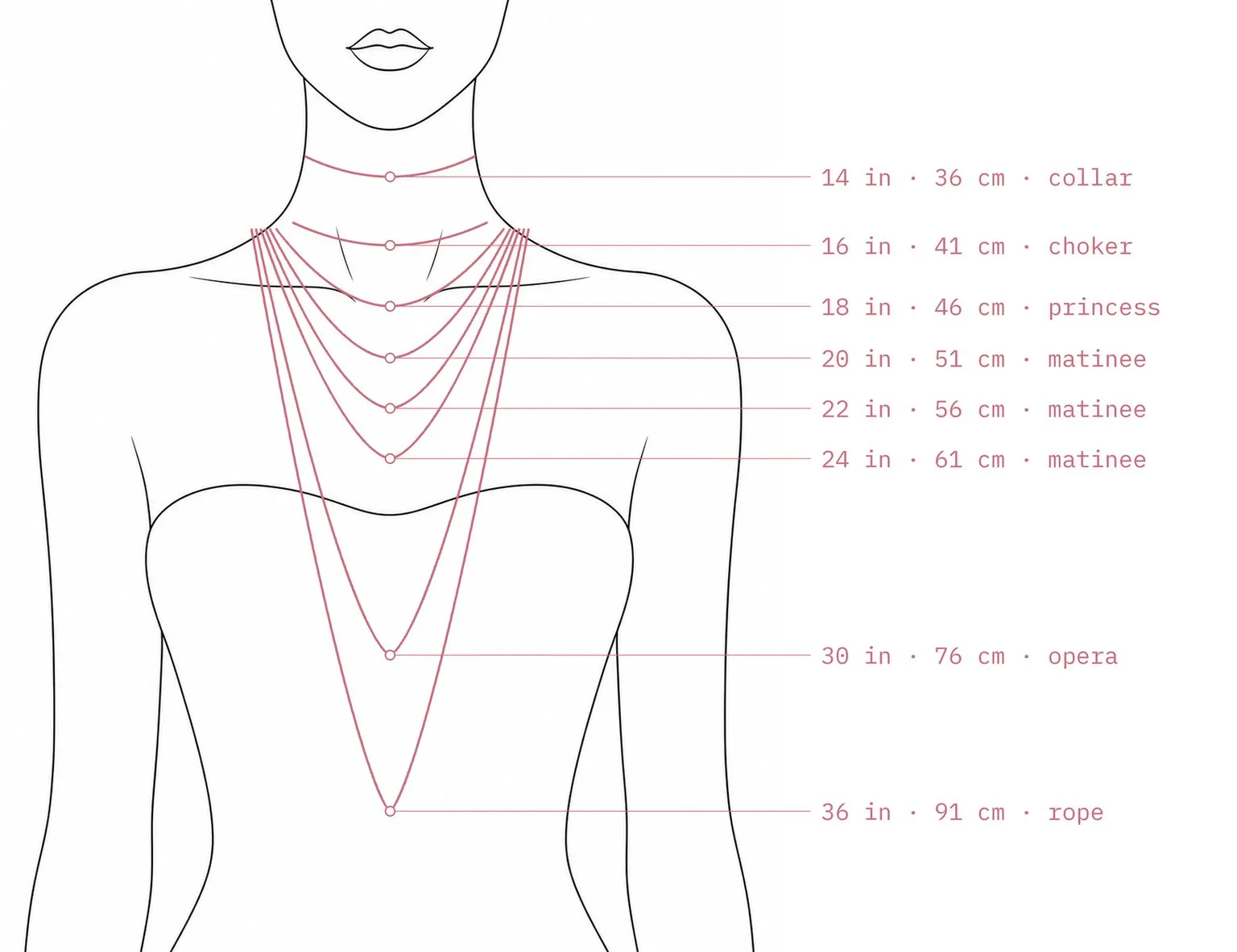
| Length | Usual name | Where it usually falls |
|---|---|---|
| 14 in (36 cm) | Collar | Snug around the middle of the neck |
| 16 in (41 cm) | Choker | At the base of the throat |
| 18 in (46 cm) | Princess | On or just below the collarbone |
| 20 in (51 cm) | Matinee | A few inches below the collarbone |
| 22 in (56 cm) | Matinee | On the upper chest |
| 24 in (61 cm) | Matinee | At or just above the bust |
| 30 in (76 cm) | Opera | Below the bust |
| 36 in (91 cm) | Rope | Toward the waist; often worn doubled |
Where a length lands on you. A larger neck uses up more chain, so a 16-inch piece that sits at the base of one throat sits snug like a collar on another. A fuller bust stops a matinee higher, and a pendant hangs below its chain by its own height. To check, wear the top you’re thinking of, hang a string around your neck and let it fall to where the necklace should sit. Pinch where the ends meet at the back, measure, and round to the nearest standard length.
By neckline. A necklace fills the space a neckline leaves or repeats its shape. A chain that ends a finger’s width above the fabric doesn’t do either.
| Neckline | Lengths that work | Why |
|---|---|---|
| Crew | Long over it, or a short collar above it | Clears the edge instead of tangling with it |
| V-neck | A pendant on 18 to 20 in, ending above the point | Repeats the V without crowding it |
| Scoop | Princess, or a curved bib | Echoes the curve |
| Boat or off-the-shoulder | Choker, collar, or nothing | The neckline is already horizontal |
| Square | Choker or a short, angular piece | Repeats the straight lines |
| Sweetheart | Choker or princess | Leaves the shaped edge to work |
| Turtleneck | A long pendant, matinee or opera | A vertical over solid fabric |
| Collared shirt | Short under the collar, or long over the buttons | Avoids the collar points |
By face shape. A chain that hangs into a V lengthens, and a short one adds width at the base of the neck.
| Face shape | Lengths that work |
|---|---|
| Oval | Any; follow the neckline |
| Round | 20 in and longer, or a pendant that pulls the chain into a V |
| Square | Princess to matinee, with curved or round pendants |
| Oblong | Collar, choker, princess |
| Heart | Choker, collar or a short chain |
| Diamond | Choker or princess |
| Triangle | Princess, or a piece with width at the collarbone |
Neck and bust. A short neck wants the line below the collarbone, 18 inches and longer, ideally with a pendant pulling a slight V. Chokers and collars draw a horizontal across the neck itself. A long neck can take chokers, collars and layered short chains. With a full bust, end above it with a princess length or clear it with a long chain straight down the center. Avoid the length that ends on the slope of the bust, where a pendant tilts and swings. For layers, leave about 2 inches between chains, as in 16, 18 and 20, so each one shows.
Hats and scarves
A hat’s brim should be at least as wide as your cheekbones, because a narrower brim makes the face below read wider. Its crown should be lower the longer your face is, because a tall crown adds height to the whole outline. Tilted, a brim draws a diagonal that breaks up a round or square outline. Pushed back, it shows forehead and adds length, and pulled low, it shortens the face, which helps long faces and high foreheads.
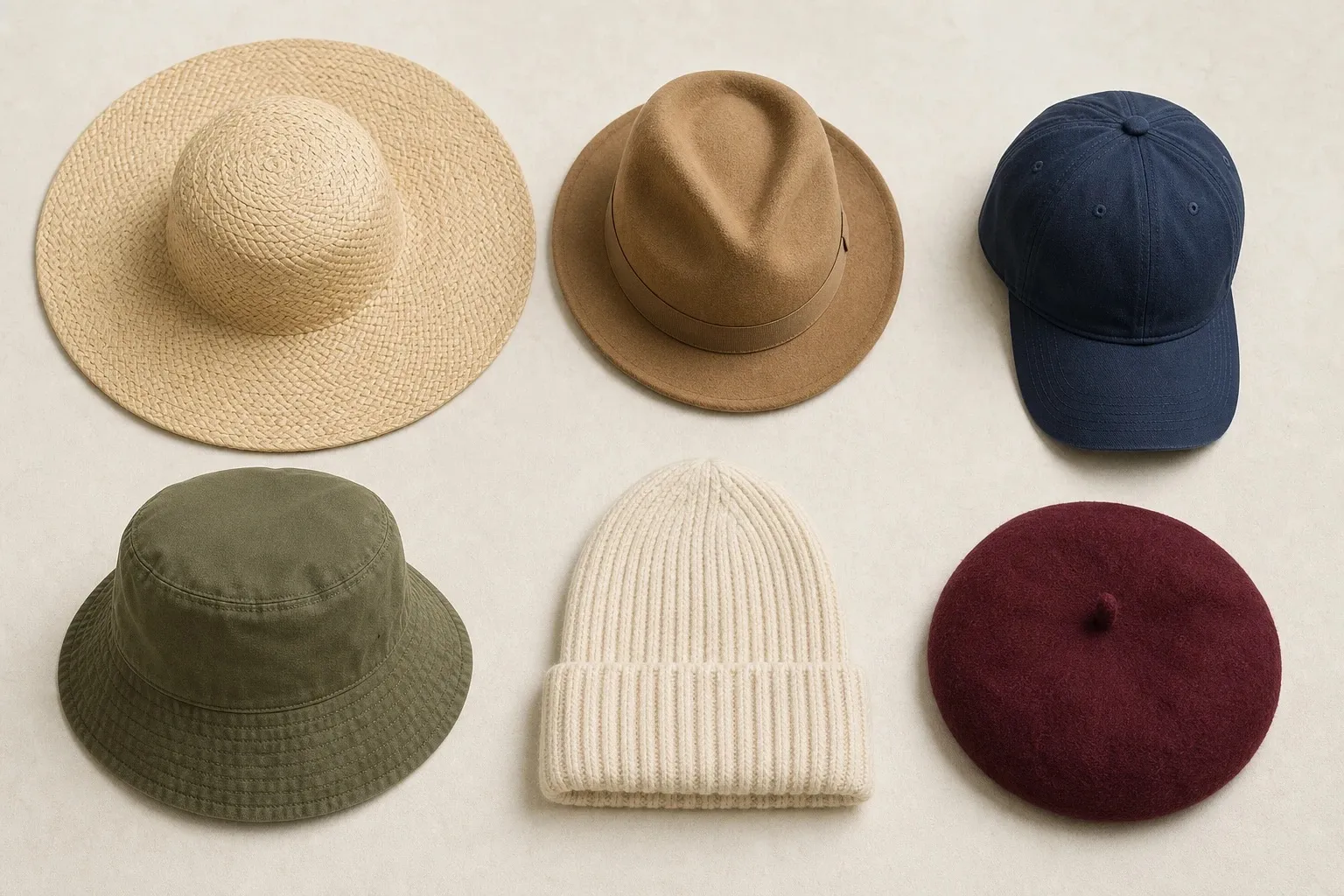
| Face shape | Wide brim | Fedora | Cap | Bucket hat | Beanie | Beret |
|---|---|---|---|---|---|---|
| Oval | Good | Good | Good | Good | Good | Good |
| Round | Good, tilted | Very good | Worn higher | Possible | Possible | Good, tilted |
| Square | Very good, soft | Soft crown | Possible | Good | Good | Good |
| Oblong | Very good | Low crown | Worn low | Very good | Worn low | Very good |
| Heart | Medium brim | Good | Good | Good | Possible | Good, tilted |
| Diamond | Very good | Good | Possible | Good | Slouchy | Very good |
| Triangle | Very good | Good | Possible | Possible | Possible | Very good |
Fit matters more than shape. A hat that’s too small perches high and adds height, and one that’s too large sinks to the brows. Measure around your head with a soft tape, level across the middle of the forehead about an inch above the brows and just above the ears, and buy by that circumference.
A scarf starts with color. Fabric under the chin works like a drape in color analysis, so choose a color from your own palette, which the Color Season Quiz gives you. Over a top in a color outside it, the scarf becomes the color closest to your face. The tie then works like a neckline. Long ends hanging down draw verticals like a V-neck, a close wrap at the throat acts like a cowl and a wide scarf over the shoulders acts like a boat neck.
| Face shape | Tie that works | Handle with care |
|---|---|---|
| Oval | Any | Nothing in particular |
| Round | A long, loose drape; a low knot on the chest | Bulky wraps under the chin |
| Square | Soft, loose loops and curving ends | Tight, stiff knots at the jaw |
| Oblong | A close wrap, a loose cowl, a chunky knit | Long, thin ends hanging straight |
| Heart | A loose cowl or loop | Long, skinny ends |
| Diamond | A soft cowl or loop, full at the jaw | A high, stiff wrap at cheekbone level |
| Triangle | A wide scarf over the shoulders, light fabric | Heavy bulk at the jaw |
If the table and your neck disagree, follow the neck. A short neck wants light fabric draped open, and a long one takes wraps and chunky knits. Of the three basic ties, the long drape, ends loose down the front, lengthens most. The loop, folded in half with the ends pulled through the fold, sits half close and half vertical, and it’s a good default for square and heart faces. The loose cowl, wrapped twice without pulling tight, adds soft width under the jaw for oblong and diamond faces.