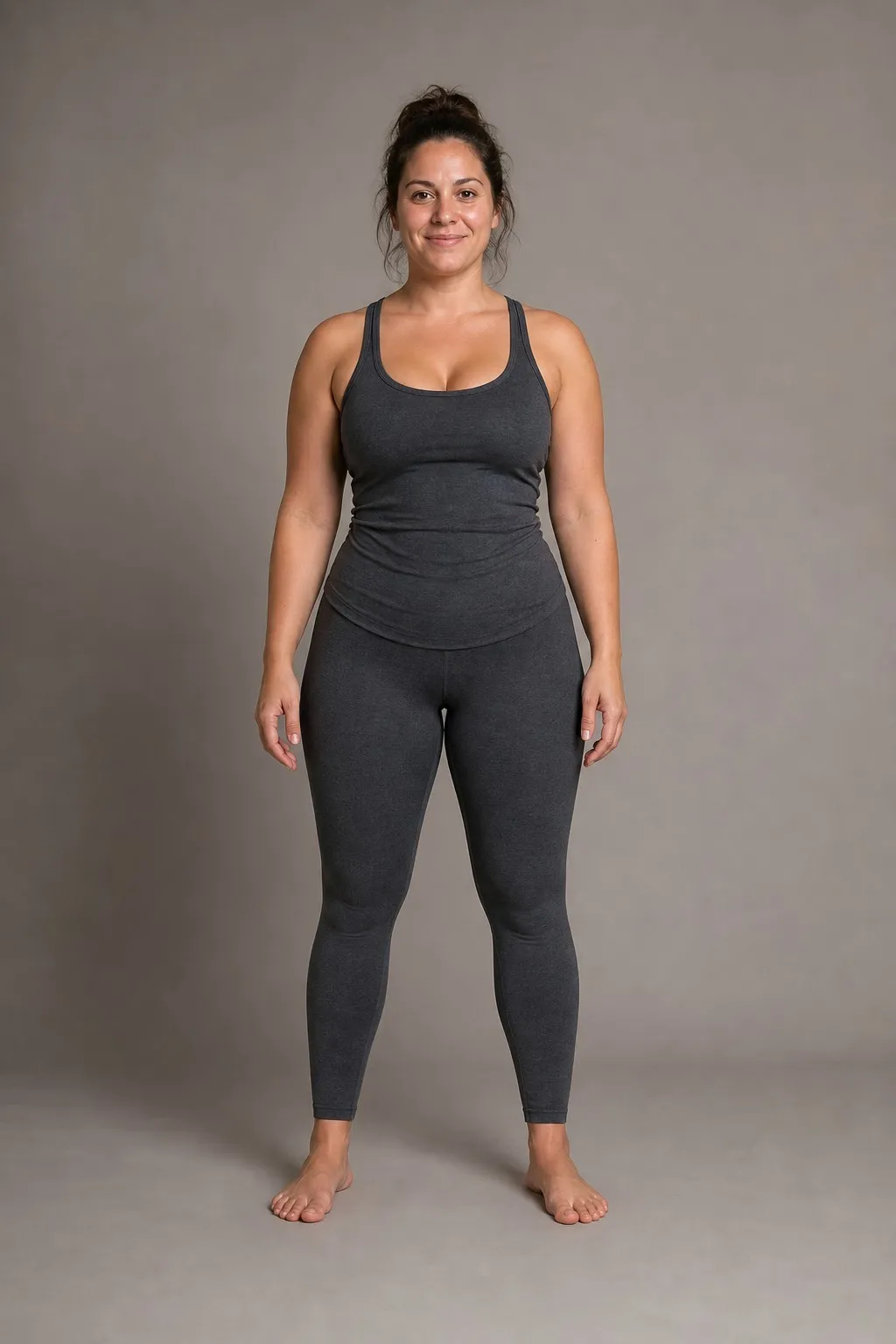
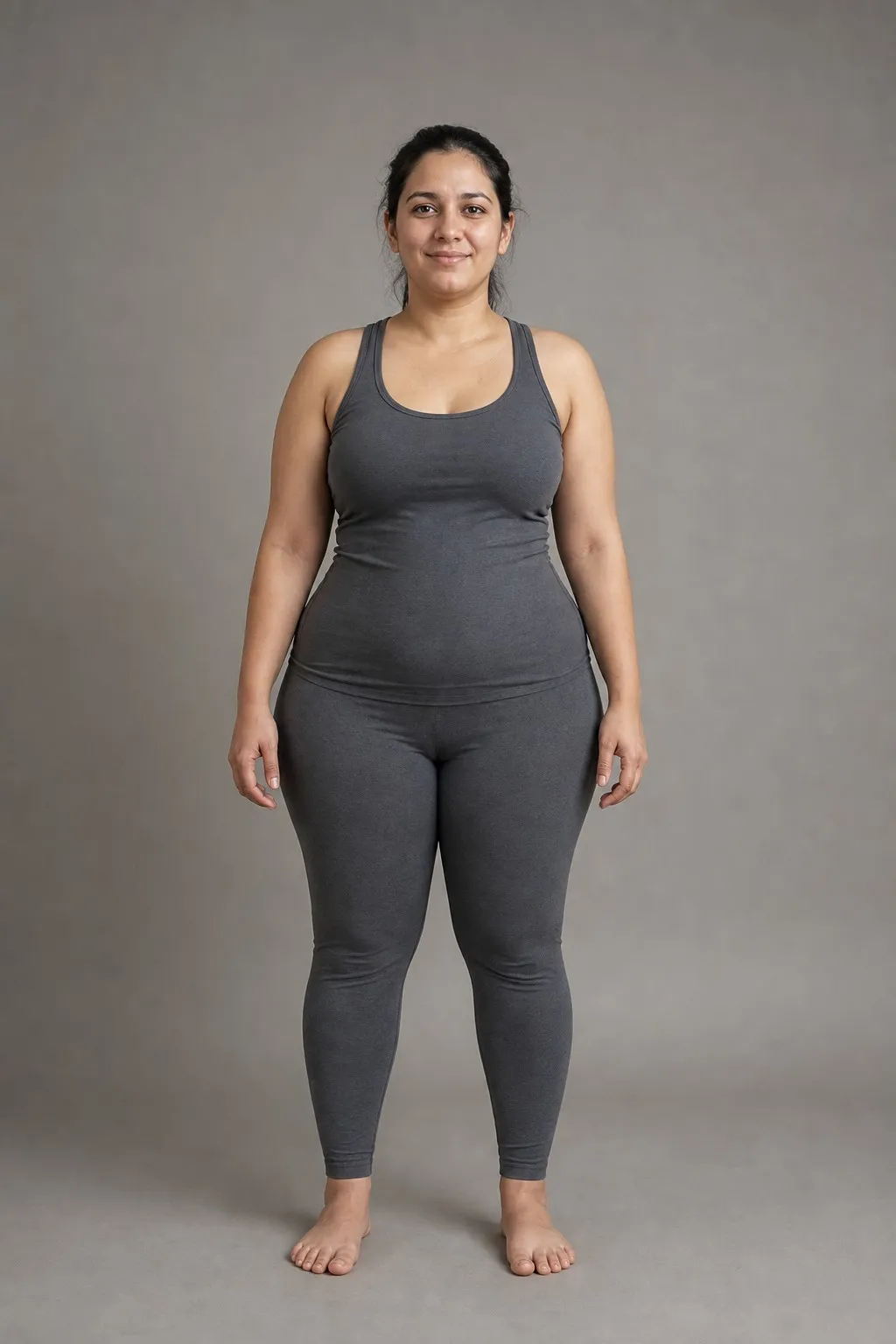
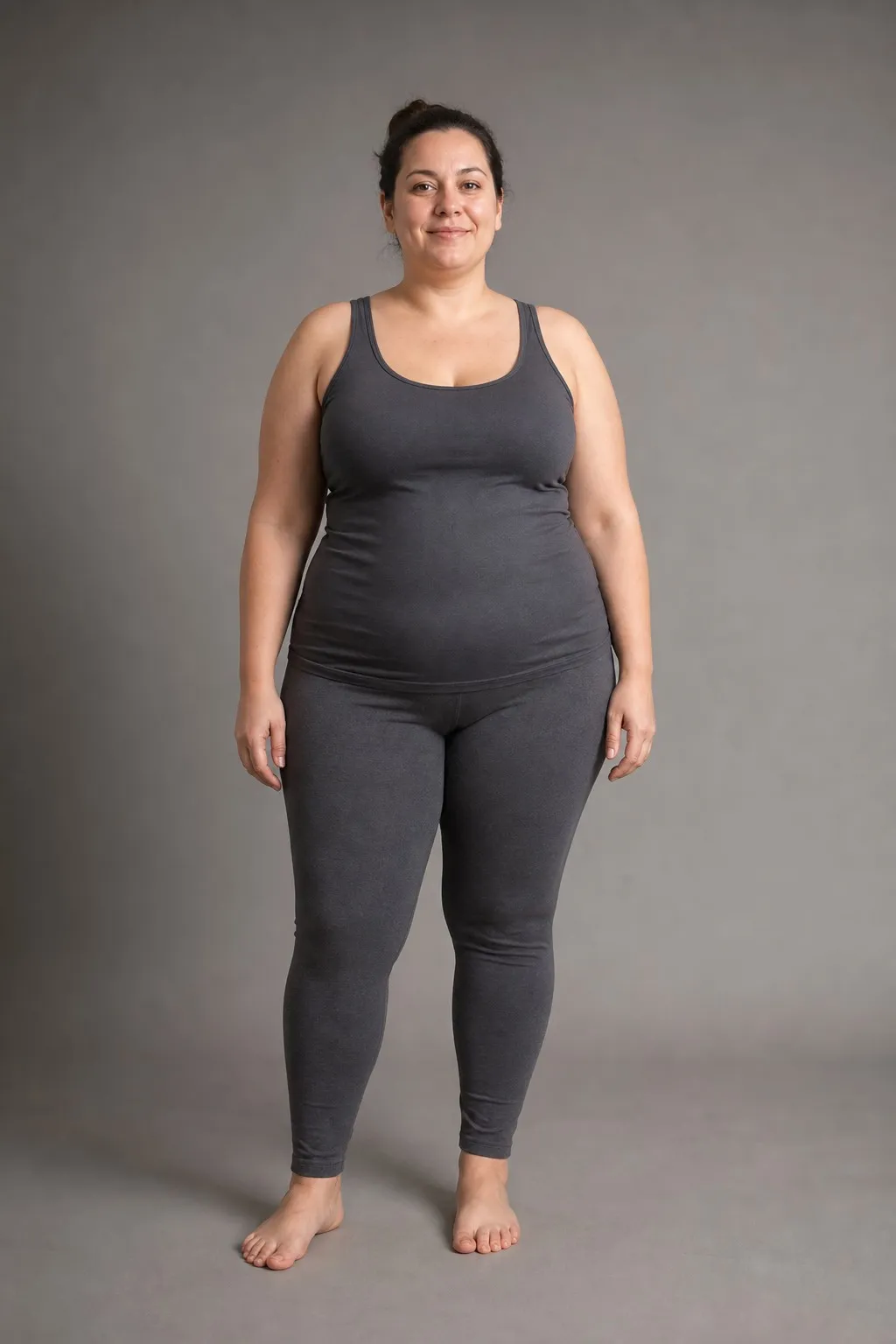
The five body shapes
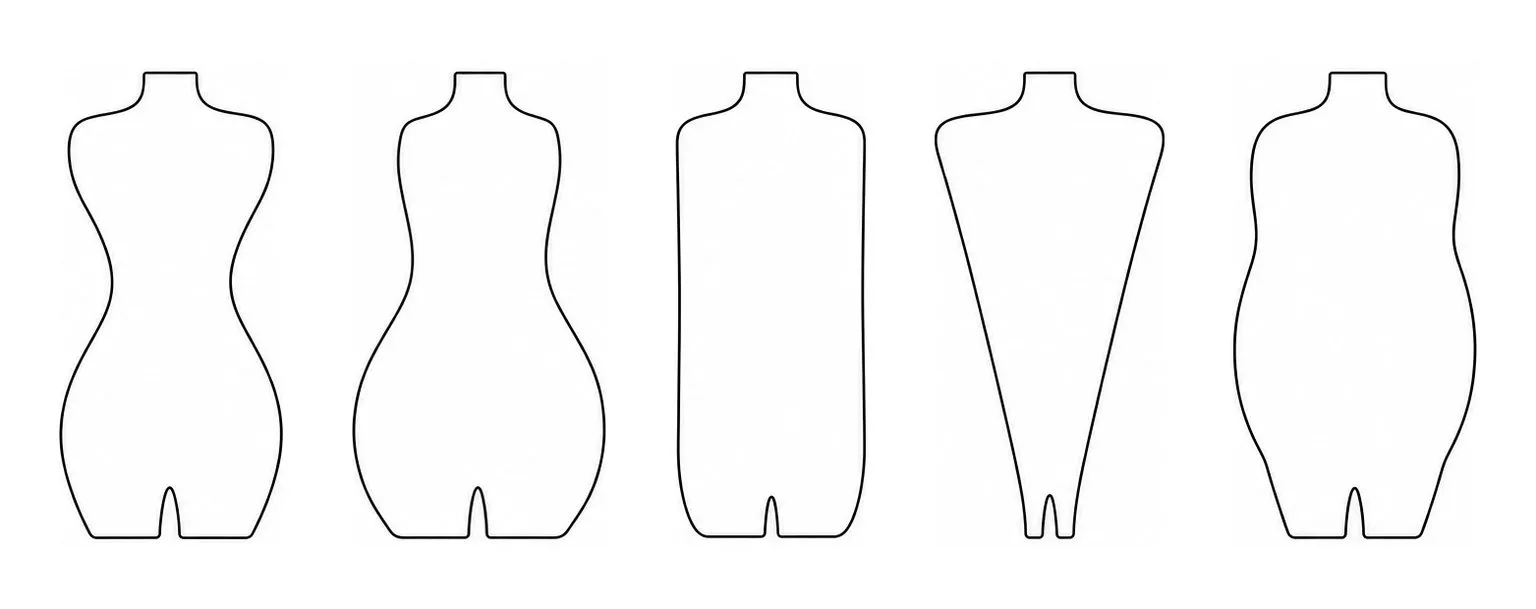
Your body shape comes from two ratios, bust to hips and waist to hips, plus a mirror check of your shoulders. Five shapes cover the combinations: hourglass, pear or triangle, rectangle, inverted triangle and apple or round. The calculator above ranks all five, and the result tells you how clothes will hang: where a waistband gapes, where a dress should be fitted, where a hem meets your widest point.
Body shapes are a fitting framework, not a measure of health or size. The calculator compares three measurements with five reference points, and most bodies sit between two. None of the five is better than another; Framework, not science separates the advice that holds from the advice that is taste.
| Body shape | Bust : hips | Waist : hips |
|---|---|---|
| Hourglass | 1.00 | 0.70 |
| Pear | 0.88 | 0.74 |
| Rectangle | 1.00 | 0.82 |
| Inverted triangle | 1.12 | 0.80 |
| Apple | 1.02 | 0.95 |
Each row is the point where a shape is most typical, not a cut-off. Your ratios are scored by their distance from every row, so a bust-to-hip ratio of 0.94 counts partly as hourglass and partly as pear. Three patterns stand out:
- Rectangle and hourglass share a bust-to-hip ratio. Only the waist separates them.
- Pear and inverted triangle mirror each other. Bust to hips decides between them, and the shoulder check pushes the result either way.
- Apple is the only shape defined by a waist near the hips. Its bust can be smaller or larger than its hips.
Charts with more shapes split the same space more finely. FFIT, a system built for apparel sizing from 3D body scans, uses nine: hourglass, top hourglass, bottom hourglass, rectangle, triangle, inverted triangle, oval, diamond and spoon. Several are in-between cases of these five; a bottom hourglass, for example, sits between hourglass and pear.
How to measure bust, waist and hips
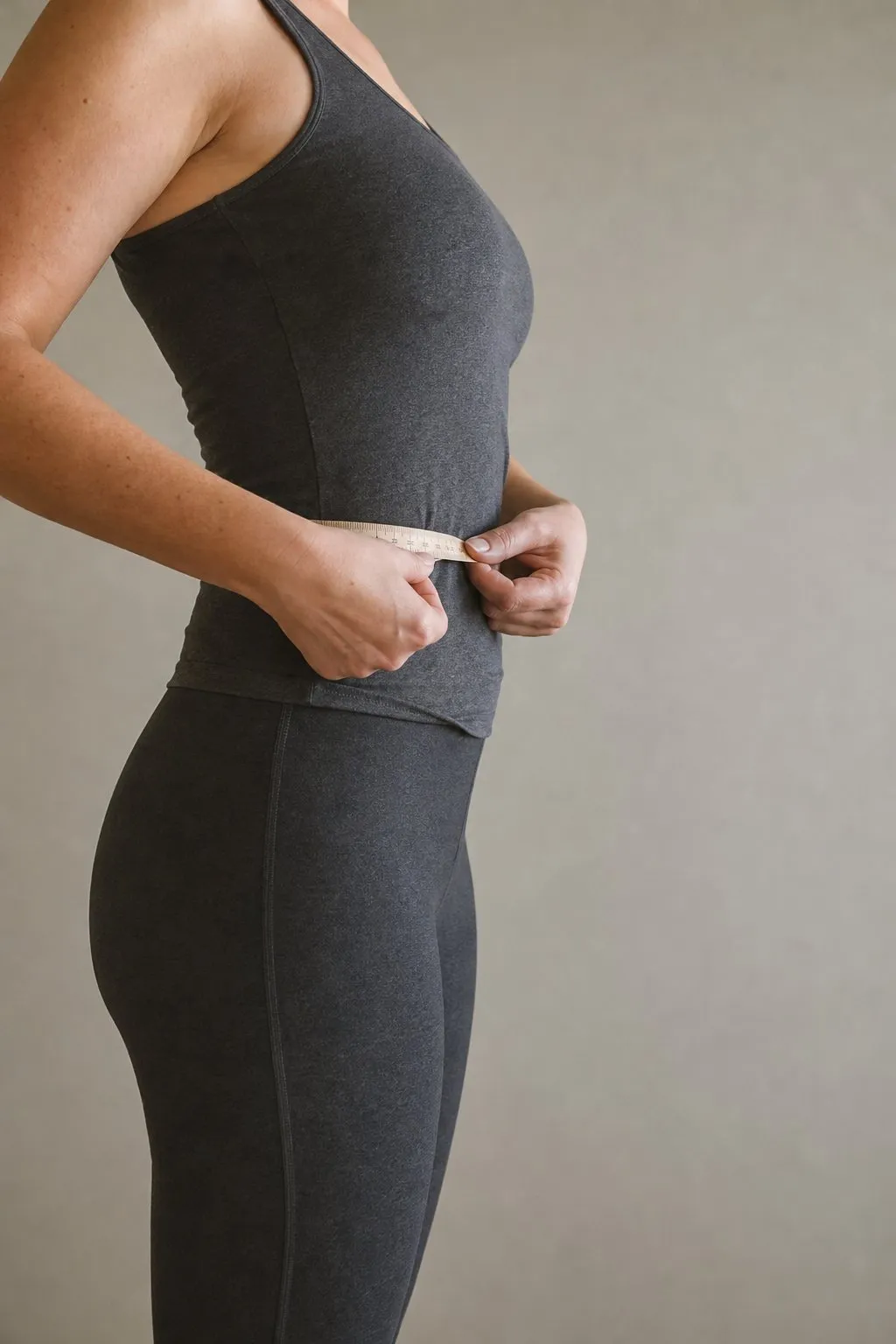
You need a soft tape, a mirror and two minutes. Measure over underwear or one thin layer, since jeans and belts add several centimeters. Stand straight, feet together, arms relaxed, and keep the tape level all the way round; the mirror shows whether it dips at the back.
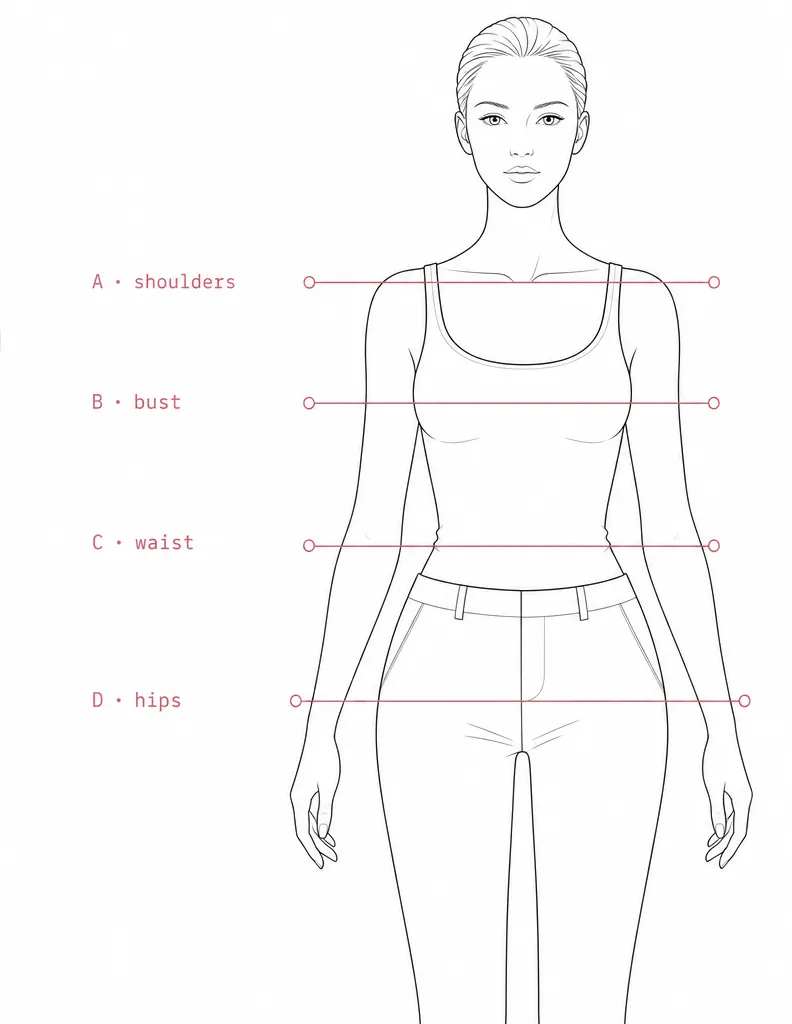
A · Shoulders: look, don’t measure. In the mirror, compare the outer edge of your shoulders with the outer edge of your hips: wider, about the same, or narrower. A tape around the bust measures the chest, not the bones above it, so it misses this. If the mirror is hard to judge, have someone photograph you straight on from a few meters away, camera at waist height; up close, a phone lens enlarges whatever is nearest to it.
B · Bust. Around the fullest part of your bust, tape level across your back, in a bra that neither flattens nor lifts.
C · Waist. Around your natural waist, the narrowest part of your torso, usually a few centimeters above the navel; bend to one side and the crease marks it. Read the tape at the end of a normal breath out, as health protocols do, without pulling in. If no point is narrower than the rest, use the point midway between your lowest rib and the top of your hip bone.
D · Hips. Around the fullest part of your hips and seat, feet together. Check from the side that the tape crosses the fullest point of the buttocks, which can sit lower than you expect.
Pull the tape snug, with room for one finger under it, and use one unit for all three: only the ratios count, so the cm and in switch changes the label, not the math. The usual slips are a tape sloping at the back, a held breath and hips measured at the hip bones instead of the seat.
How the calculator decides
The calculator turns your numbers into two ratios, bust ÷ hips and waist ÷ hips, shown under the result. There are no hard cut-offs: for each shape it checks how far each ratio sits from that shape’s reference value, measured in spreads, the distance a ratio can wander before the match weakens.
Closeness falls off like a bell curve. A ratio on the reference earns full marks, one spread away about 60 percent of them, two spreads away under 15 percent. The two ratio scores are averaged, so each counts half, and the result is a score out of 100.
Then the shoulder answer reweights two shapes. Shoulders wider than your hips multiply the inverted triangle score by 1.2 and the pear score by 0.8; narrower shoulders do the reverse; about the same changes nothing. Scores are rounded and capped at 100, all five appear as ranked bars, and when the top two are fewer than 10 points apart the result says you are close to the second shape too.
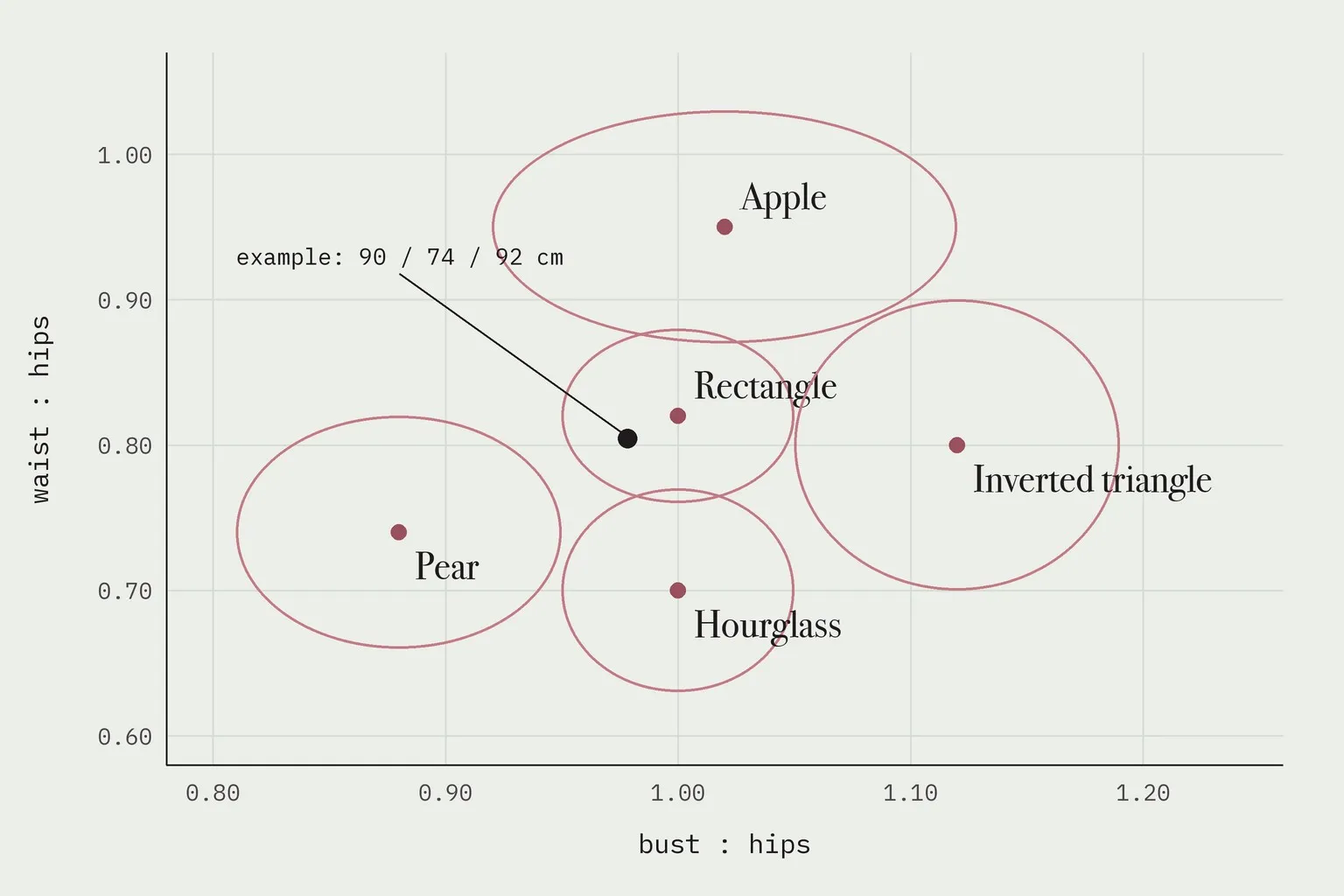
The rings differ on purpose. Hourglass and rectangle have the narrowest bust-to-hip window, a spread of 0.05, because both need a balanced top and bottom. The apple’s bust window and the inverted triangle’s waist window are the widest, 0.10 each: an apple can carry more or less bust than hip, and an inverted triangle’s waist can be straight or defined.
The example in the form shows the arithmetic. Bust 90, waist 74 and hips 92 cm give 0.98 and 0.80, well inside one spread of the rectangle reference on both ratios, so rectangle scores 94. Hourglass follows at 62, held back by a waist too wide for its reference, and the other three score 55 or 56. In inches, the same body gets the same scores.
The shoulder answer matters most in a close call. Bust 34, waist 26 and hips 36 inches give 0.94 and 0.72: with shoulders about the same as the hips, pear scores 82 and hourglass 75, with the close-call line. Answer “wider” and pear drops to 65, so hourglass leads; answer “narrower” and pear rises to 98.
All of this runs in your browser. Your measurements are never sent to us, and pressing Calculate saves only the name of your shape in this browser, so other pages can show it.
What 0.7, 0.8 and 0.9 mean
Waist-to-hip ratio is your waist divided by your hips: a 30-inch waist over 40-inch hips gives 0.75, and 76 cm over 98 cm gives 0.78. For shape, it says how defined your waist is:
- About 0.70: clearly defined, where the hourglass and pear references sit.
- About 0.80: gently defined, near the inverted triangle and rectangle references.
- 0.90 and above: close to the hips, as in the apple reference.
The waist ratio alone cannot name a shape, since hourglass and pear share almost the same waist, and so do rectangle and inverted triangle. Run typical values of both ratios through the calculator and the top results form this grid:
| Waist ÷ hips | Bust ÷ hips about 0.88 | About 1.00 | About 1.12 |
|---|---|---|---|
| About 0.70 | Pear | Hourglass | Inverted triangle |
| About 0.82 | Pear | Rectangle | Inverted triangle |
| About 0.95 | Apple | Apple | Apple |
In the top row, 0.7 reads pear with a smaller bust and inverted triangle with a larger one. The bottom row shows why apple is the one shape a high waist ratio decides alone.
Waist-to-hip ratio says how defined your waist is. Bust-to-hip ratio says what it is defined between.
Waist-to-hip ratio and health
Health screening uses the same ratio, measured differently and for a different purpose. A WHO expert consultation in 2008 reported cut-offs of 0.85 for women and 0.90 for men for a substantially increased risk of metabolic complications. Its protocol takes the waist midway between the lowest rib and the top of the hip bone, not always the narrowest point that styling uses, and the hips around the widest part of the buttocks.
The calculator measures for fit only and makes no health judgment; for what your ratio means for your health, ask a doctor and let them measure their way. And when you see 0.7 called an ideal online, here it is only the center of the hourglass reference, one proportion among five.
Between two shapes
A result between two shapes is normal: ratios that fall between two reference points score well for both, and the ranking shows how close the call is. Each neighboring pair has one deciding ratio:
- Hourglass or pear: bust to hips. Both have a defined waist; the pear’s hips are wider than its bust.
- Hourglass or rectangle: the waist. Around a waist ratio of 0.76 you sit halfway.
- Rectangle or apple: the waist again, as it moves toward the hip measurement.
- Rectangle or inverted triangle: bust to hips, plus your shoulder answer.
- Pear or inverted triangle: mirror images, rarely close on the tape; the shoulder answer moves one up and the other down.
Worked examples, including measurements people search for:
| Bust / waist / hips | Ratios | Top results |
|---|---|---|
| 100 / 76 / 100, any unit | 1.00, 0.76 | Hourglass 85, rectangle 80, close-call line |
| 37 / 30 / 35 in | 1.06, 0.86 | Inverted triangle 76, apple 72, rectangle 67; inverted triangle 91 with shoulders “wider” |
| 36 / 32 / 36 in | 1.00, 0.89 | Apple 86, rectangle 76; exactly 10 apart, so no close-call line |
| 32 / 27 / 33 in | 0.97, 0.82 | Rectangle 92 |
| 36 / 24 / 36 in | 1.00, 0.67 | Hourglass 95 |
| 94 / 76 / 92 cm | 1.02, 0.83 | Rectangle 95 |
Within 10 points, read the advice for both shapes: the fit rules of the first, and whatever you like from the second. If the call flips between attempts, measure the waist again at the end of a breath and redo the shoulder check in a photo, the two inputs most likely to tip it. Each shape article shows how to tell that shape from its neighbors.
Vertical proportions: long torso or long legs
Body shape measures width. Vertical proportions measure where your length goes, legs or torso, a high or low waist, hips that widen early or late, and they decide where a rise, a waistband and a hem should land. The calculator does not measure them. You need a wall, a pencil, a soft tape, a mirror and ideally a second person; stand barefoot in close-fitting clothes.
Legs or torso?
- Stand with your back to the wall, mark your height and measure it.
- Lift one knee slightly and feel the crease where the leg meets the body at the front: your leg line. Stand straight and measure from the floor to it.
- Compare the leg line with half your height.
This borrows the figure-drawing convention of a midpoint at the hips, a reference rather than a norm. Clearly above the halfway mark means long legs and a shorter torso; close to it, balanced; clearly below, a long torso and shorter legs. Measure twice and allow a centimeter or two of wobble, since the crease is not a sharp point. At 165 cm (5’5”), half is 82.5 cm: a crease at 86 cm is clearly above it, one at 83 cm balanced.
High or low waist
In the mirror, put one hand flat under your bust and stack the other below it, hand over hand, down to your natural waist. Fewer than two hand widths means short-waisted, about two balanced, more than two long-waisted. Wear a well-fitted bra, since a low bust shortens the distance. It is a stylist’s rule of thumb, not a standard, but repeatable.
Short-waisted is not the same as a short torso: a short torso is short against the legs, while short-waisted means the waist sits close under the bust at any torso length. The two tests combine like this:
| Legs or torso | Waist | Where the length sits |
|---|---|---|
| Long legs | Short-waisted | Short torso, little of it above the waist |
| Long legs | Long-waisted | Short torso, with the waist low in it |
| Balanced | Balanced | Standard patterns fit as designed |
| Long torso | Short-waisted | Long torso, most of the length below the waist |
| Long torso | Long-waisted | Long torso, most of the length above the waist |
Hip height: high or low hips
Hip height is where your hips widen, not how wide they are: a waist ratio of 0.74 is typical of a pear whether the hips flare an inch under the waist or eight inches down. Sewing patterns usually place the hip line about 7 to 9 inches (18 to 23 cm) below the natural waist, so if your widest point sits much higher or lower, clothes in your size fit in the wrong places.
Tie a string around your natural waist, find the largest hip reading, and measure down your side from the string to that point. Clearly under 7 inches (18 cm) means high hips, a short, steep curve stylists call a hip shelf; clearly over 9 inches (23 cm), low hips, fullest near the thighs. These are pattern conventions, not body norms.
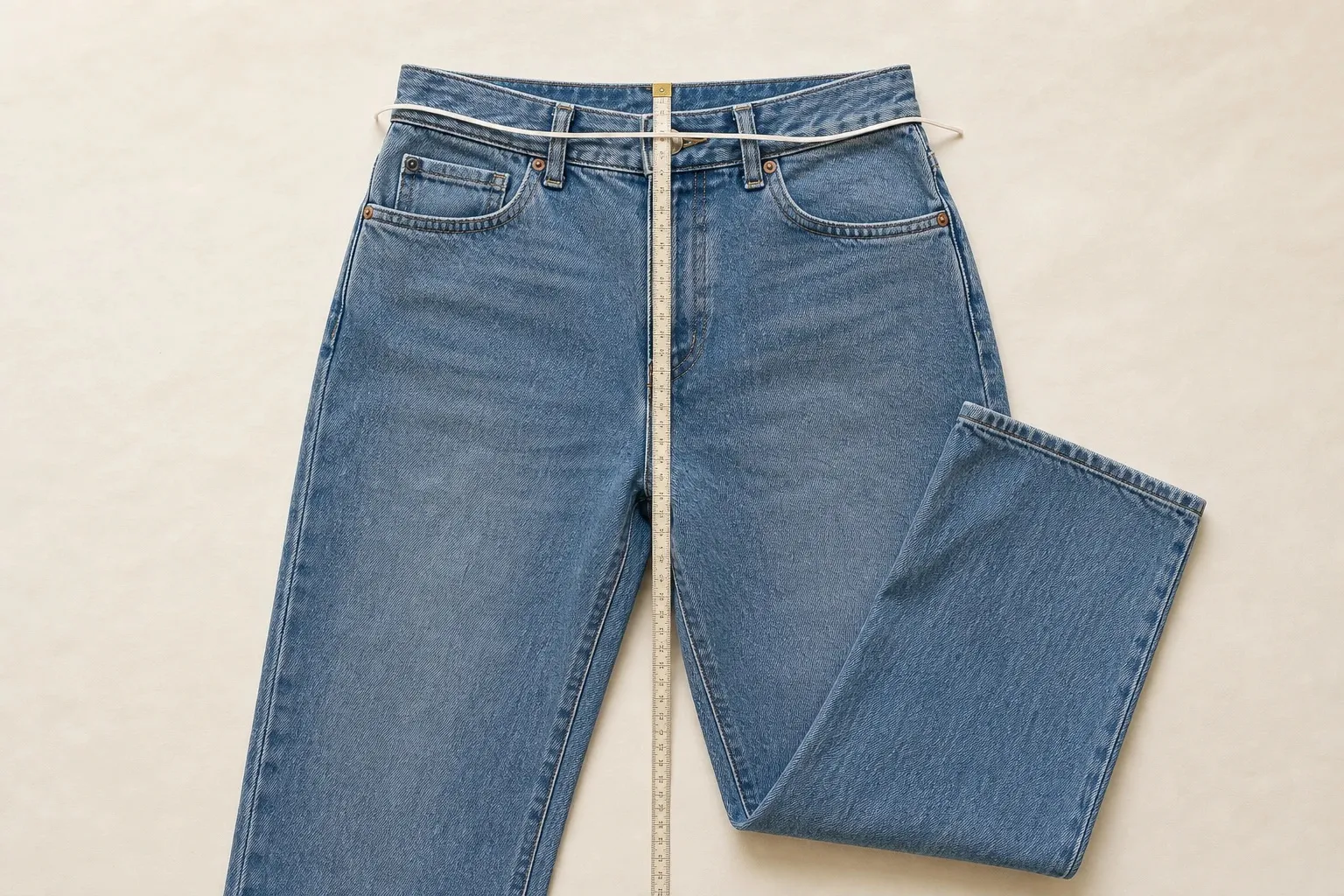
Hip dips are something else: an inward curve between the hip bone and the thigh. The Cleveland Clinic explains that they come from the shape and spacing of the pelvis and thigh bone, and that exercise and weight loss do not remove them. Hip height shows first in jeans:
| Hip height | What goes wrong | Look for |
|---|---|---|
| High | Jeans that clear the hips gape at the back waist; a lower rise digs into the shelf | High rise, curvy cut, some stretch |
| Average | Problems come from the waist ratio, not the height | Choose by ratio and torso length |
| Low | The waist fits, then the seat and thighs pull | Mid or high rise, room at the seat, straight or bootcut leg |
Dressing each result
- Long torso, shorter legs. Raise the leg line with high rises, tucked or cropped tops and jackets ending at the waist or high hip. Shoes matching your trousers or tights, heels and pointed toes extend the leg. One-piece swimsuits and fixed-bodice dresses can pull; look for long-torso sizes or separates.
- Long legs, shorter torso. Give the torso room with mid rises, untucked or half-tucked tops, longer jackets and a belt in the color of your top.
- Short-waisted. Empire lines and high waistbands merge with the bust; a slightly lower waistline, a V-neck and narrow belts work better.
- Long-waisted. Wide belts, high rises, cropped jackets and tucked tops shorten the stretch from bust to waist.
- High hips. A-line, flared and wrap skirts fit at the waist and release before the shelf. Try pencil skirts on: they need room right under the waistband.
- Low hips. Size for the seat and have the waist taken in. A hip-length top ends partway down the curve, so tuck it in or end it below the fullest part.
Height is a separate thing: a tall woman can have a long torso and a petite one long legs. Height sets the scale of your garments, proportion decides where their lines fall. Kibbe’s “vertical line” is a visual impression rather than a measurement, as Kibbe body types explains.
Frame size and scale
Frame size is the scale of your bones, not your shape or your weight, and in styling it sets the scale of what you wear: jewelry, prints, buttons, bags. Ratios ignore it, so a waist ratio of 0.70 is a defined waist at any frame size.
The wrist test
Wrap a soft tape snugly around the narrowest part of your wrist, on the hand side of the wrist bone, and read where it overlaps. Then find your height, without shoes, in the MedlinePlus chart for women; centimeters are converted and rounded.
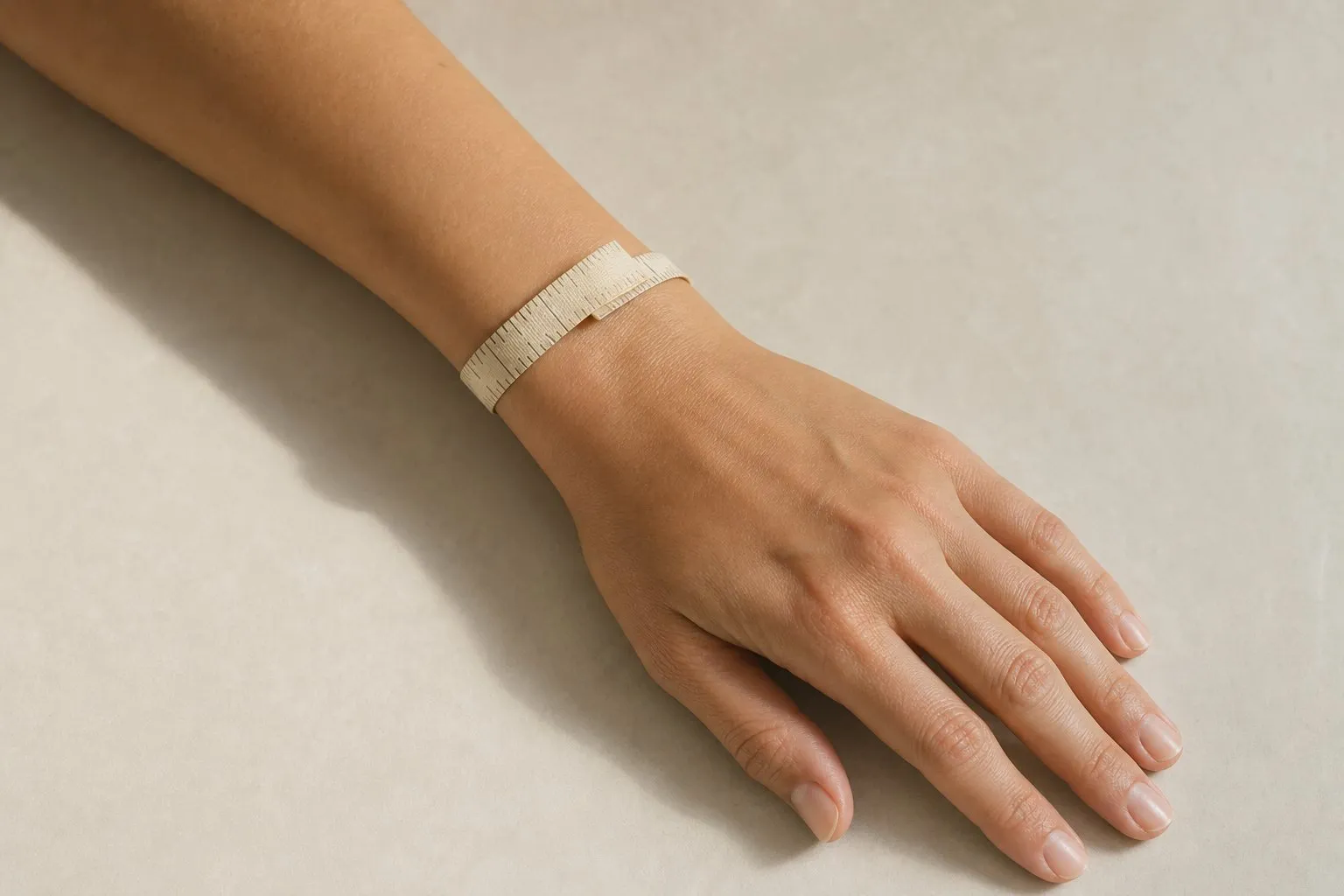
| Height | Small frame | Medium frame | Large frame |
|---|---|---|---|
| Under 5’2” (157 cm) | Wrist under 5.5” (14.0 cm) | 5.5” to 5.75” (14.0 to 14.6 cm) | Over 5.75” (14.6 cm) |
| 5’2” to 5’5” (157 to 165 cm) | Under 6” (15.2 cm) | 6” to 6.25” (15.2 to 15.9 cm) | Over 6.25” (15.9 cm) |
| Over 5’5” (165 cm) | Under 6.25” (15.9 cm) | 6.25” to 6.5” (15.9 to 16.5 cm) | Over 6.5” (16.5 cm) |
Treat the result as a rough sort: one bone, three height bands and a medium band a quarter of an inch wide, so tape tension alone can move you across a line. Within an eighth of an inch of a boundary, call yourself medium. Height matters because a 6-inch wrist is a larger bone at 5’0” than at 5’8”.
Bust size is soft tissue, not bone, so a small frame with a large bust is common. It is a fitting problem: a top bought for the bust is cut for a larger body everywhere else, with seams past the shoulders and fabric hanging straight from the fullest point. Buy for the shoulders and have the bust let out or the waist taken in, and choose V-necks, wrap fronts and knits that follow the body below the bust.
Kibbe’s 1987 test in Metamorphosis opens with bone structure: shoulders, the length of arms and legs, the size of hands and feet. Wrist size is not among its questions, but it measures the same idea.
Jewelry scale
Two checks set your jewelry scale: your frame and your features. For the second, photograph your face straight on from across the room and look at the picture small, as others see you: do your eyes, brows, nose and lips read delicate, moderate or strong? When the checks disagree, jewelry near the face follows the features and jewelry on the hands follows the frame.
| Frame and features | Natural scale | For example |
|---|---|---|
| Small frame, fine features | Dainty to medium | Fine chains, studs, slim drops, thin bands |
| Small frame, strong features | Medium near the face, finer below | Medium hoops and pendants, thin to medium rings |
| Medium frame, moderate features | Medium, either direction | Mid-size pendants and hoops, a watch with presence |
| Large frame, fine features | Medium near the face, bolder below | Medium chains and earrings, wider bands, cuffs |
| Large frame, strong features | Medium to statement | Chunky chains, large hoops, sculptural drops, stacked bangles |
A piece much larger than your features is seen before your face; a much smaller one disappears, like a thread-thin chain on broad collarbones. Contrast changes the weight a face carries: high contrast between hair, skin and eyes holds polished metal and bolder pieces, while low contrast suits brushed, matte or antique finishes at the same size.
On a small frame, wear one statement piece at a time, a step down in size, in open shapes such as a large thin hoop; on a large frame, layer dainty pieces. Under about 5’4”, keep drops a little shorter. What suits your face shape covers earring shapes and necklace lengths, and the skin tone chart settles gold or silver.
Print scale
Prints follow three checks: height, frame and contrast. A motif is read against its wearer, so the same print takes up more of a shorter figure; frame, the scale of the bones underneath, counts for more when the two disagree; contrast sets how strong the gap between motif and background can be.
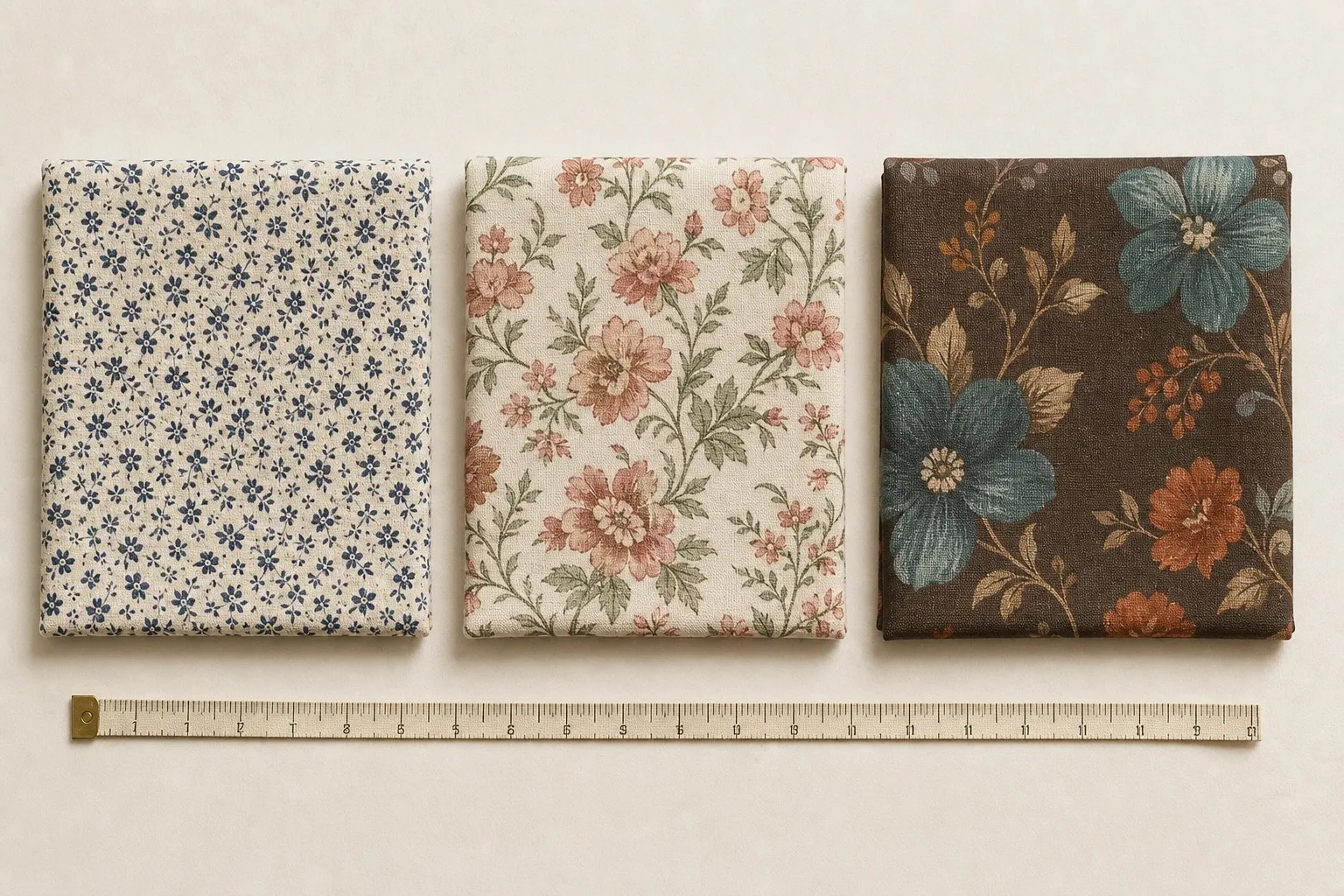
| Frame and height | Natural print scale | Examples |
|---|---|---|
| Small frame, petite | Small to medium | Ditsy florals, fine stripes, small dots |
| Small frame, average or tall | Small to medium, spaced out | Scattered small motifs, narrow stripes |
| Medium frame | Medium, either direction | Mid-size florals, medium checks, paisley |
| Large frame, petite | Medium | Medium florals and geometrics |
| Large frame, average or tall | Medium to large | Large florals, wide stripes, bold geometrics |
Match print contrast to your face: strong, like black and white stripes, for high-contrast coloring; moderate, like navy on light blue, for medium; tonal, like taupe on oatmeal, for low. Plus size is not a frame size, so the wrist test still sets the scale, and a petite figure can carry a larger motif spaced out on a plain ground or on one piece.
Your season picks the colors and the character: airy prints for the light seasons, dark grounds for the deep, crisp graphics for the bright, blended motifs for the soft, as seasonal color analysis explains. And a print you love and wear beats one that fits the chart and stays in the closet.
Shape at every size and age
Shape is a ratio, so height, size and age do not enter it. What changes is practical: lengths, fabric and fit, and how proportions drift in midlife.
Petite
Petite is a height, not a shape or a size. US petite ranges are usually cut for women about 5’4” and under, with brands drawing the line between 5’3” and 5’5”, and are shorter in the body, rise and sleeves, in the full run of sizes. What petite changes is where hems land, so three length rules apply to every shape:
- End hems at a narrow point, just below the knee or just above the ankle bone. A midi cut for average height can stop at the widest part of the calf.
- Keep breaks few and quiet. A contrast belt, cropped trousers and an ankle strap together cut a shorter body in three.
- End jackets at the waist or high hip, and coats at hip length or long enough to cover what is underneath.
| Petite shape | Jackets | Dresses and skirts | Trousers |
|---|---|---|---|
| Hourglass | Fitted, to the waist | Wrap or sheath, knee or just below | High rise at the natural waist |
| Pear | Structured shoulders, ending above or below the widest point of the hips | A-line, just below the knee | Dark, straight or gently flared, full length |
| Rectangle | Cropped or waist length, straight | Shift or slip, near the knee | Straight or tapered, full length |
| Inverted triangle | Soft shoulders, no padding | Fuller skirt from the waist, knee length | Wide or straight leg |
| Apple | Open, single-breasted, to the upper thigh | Empire or shift, V-neck | Straight leg, mid to high rise |
Plus size
Plus-size bodies come in all five shapes, and the calculator scores them exactly as it scores any other body. Each row pairs two bodies, the second 9 to 14 inches larger at each point:
| Shape | Smaller: bust, waist, hips | Score | Plus size: bust, waist, hips | Score |
|---|---|---|---|---|
| Hourglass | 36, 25, 37 in | 90 | 48, 34, 49 in | 96 |
| Pear | 34, 27, 38 in | 96 | 45, 36, 51 in | 96 |
| Rectangle | 36, 30, 36 in | 99 | 48, 40, 48 in | 99 |
| Inverted triangle | 38, 30, 34 in | 86 | 50, 40, 45 in | 83 |
| Apple | 36, 34, 37 in | 91 | 50, 47, 50 in | 99 |
The rectangle pair is an exact scale-up, so its scores match to the digit; the others differ slightly because their ratios do, and the larger inverted triangle reaches 100 once the shoulder answer is “wider”. The table also undoes the idea that a larger body must be an apple: 48, 34 and 49 inches make an hourglass. Nobody has a reliable count of which shape is most common at plus size.
On a softer body, let the tape rest flat, because it sinks in quickly if you pull. Then three things decide how well the advice works. Fabric weight: ponte, heavier crepe and denim with body skim, thin jersey follows every contour. Structure: a seamed waist or a tailored shoulder draws a line, a belt on a soft knit mostly bunches. Fit: buy for your largest measurement, have the rest taken in, and on a full bust check the shoulder seam first. None of it is about hiding.
After 40 and menopause
Body shape changes after 40 for two reasons that are easy to blur. The Menopause Society describes midlife as roughly 40 to 65 and names aging as the main driver of weight gain: women lose muscle with age, so the body burns less at rest. Menopause does something else. As estrogen falls, the body stores more fat in the abdomen, so the waist ratio can rise even when the hips barely change. Two pairs, before and after, show the drift:
| Bust, waist, hips | Bust ÷ hips | Waist ÷ hips | Calculator result |
|---|---|---|---|
| 35, 28, 38 in | 0.92 | 0.74 | Pear 92 |
| 37, 33, 38.5 in | 0.96 | 0.86 | Rectangle 78, apple 68 |
| 36, 30, 36 in | 1.00 | 0.83 | Rectangle 99 |
| 37, 34, 37 in | 1.00 | 0.92 | Apple 95 |
Measure again whenever clothes fit differently at the waist, and about once a year through perimenopause and the years just after, since the shift is gradual. Then dress the body you have now. If your waist has outgrown your trousers but your hips have not, buy for the waist and have the hips taken in; the old size puts pull lines where you notice the change most. A seam just under the bust, a higher wrap or no waist seam often sits better than a defined waist, and an open jacket or one color head to toe draws a long vertical line.
Your bone frame does not change, so the wrist test and your jewelry scale stay as they were. Questions about weight or waist size as health measures belong with your doctor.
Garments by shape at a glance
The table gathers each shape’s starting points, and each shape’s own article gives the reasons. If you sit between two shapes, read both rows.
| Shape | Tops | Dresses | Trousers and skirts | Jackets and coats | Swimwear |
|---|---|---|---|---|---|
| Hourglass | Fitted or wrap, following the waist; V or scoop necks | Wrap, fit-and-flare, sheath, belted midi | High or mid rise cut for a curvy waist; pencil, A-line, wrap | Shaped or belted at the waist: wrap coat, trench | Underwire or molded cups, a waist seam or ruching |
| Pear | Detail, color and wider necklines; structured shoulders | Fit-and-flare, A-line, detail on the bodice | Dark, straight or gently flared legs; A-line skirts | Structured shoulders; hem at the waist or below the widest point | Detail on top, a plain darker bottom, leg line at the hip bone |
| Rectangle | Straight shapes, or tucked tops and seamed waists | Column, slip, shift, or a structured waist with a fuller skirt | Any rise; straight, wide or pleated legs | A straight tailored coat, or a belted one with structure | Ruffles, ties and cut-outs, or a clean sporty one-piece |
| Inverted triangle | V-necks, halters, soft or raglan shoulders | Plain bodice with an A-line or full skirt, or a column | Wide, flared or pleated legs; full skirts | Soft shoulders, flared from the waist, hip length or longer | A plain halter or racerback top, pattern below |
| Apple | V and scoop necks in fabric with some weight | Empire, A-line, wrap tied at the side | Mid rise below the fullest part of the stomach or a flat-front high rise; straight legs | Single-breasted, straight or gently A-line, worn open | V or scoop with support, ruching, high leg, or a tankini |
Two ideas run through the table. A horizontal edge, whether a hem, a waistband or a neckline, reads as width where it falls, while vertical and diagonal lines read as length. And the rectangle and inverted triangle rows offer two routes, to balance the line or to dress it as it is; both are correct.
Swimsuits
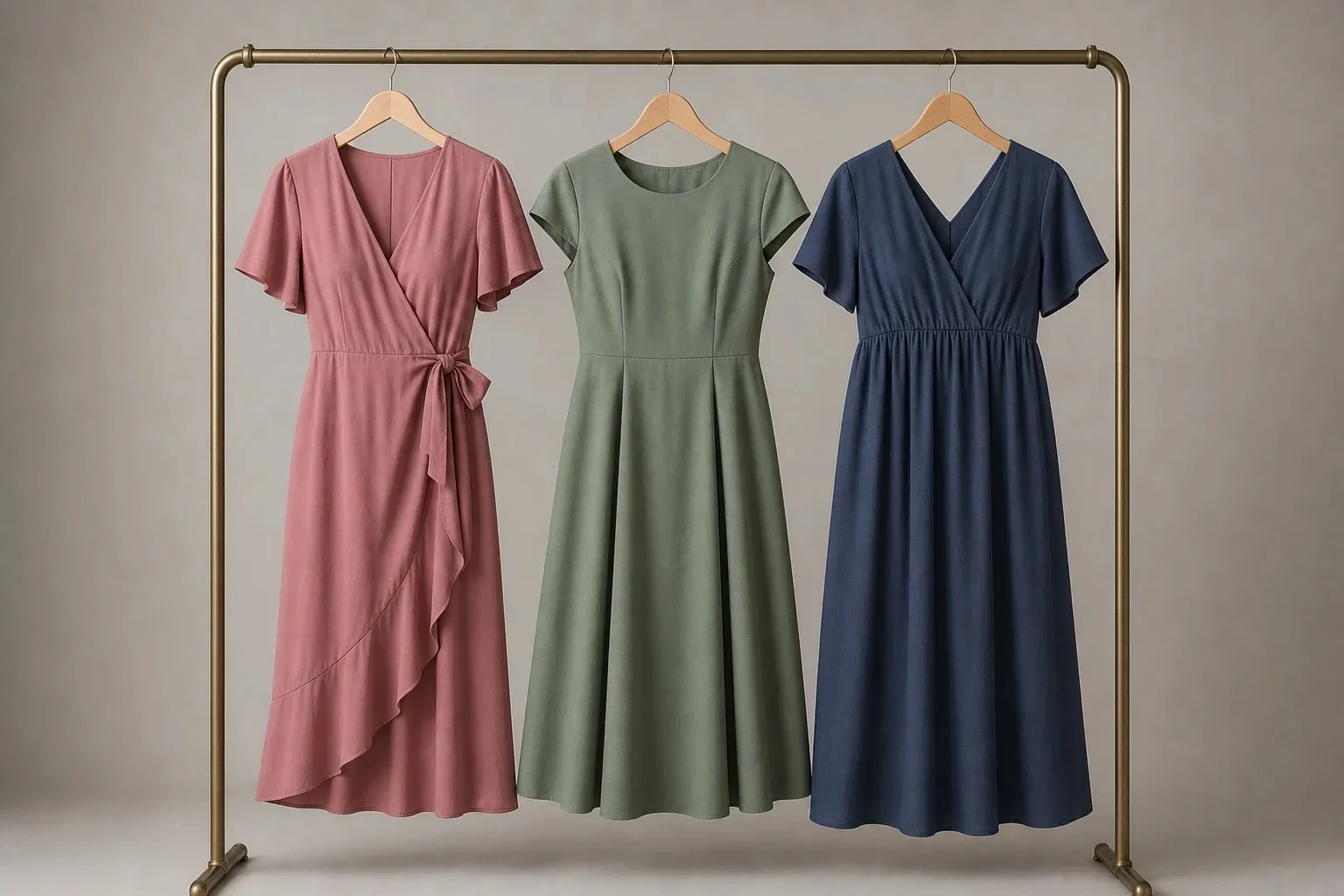
Three lines decide a swimsuit. A high leg opening continues the leg, while a low, straight one such as a boy short draws a line across the thigh. A V or plunge neckline draws a vertical, a bandeau a horizontal across the bust. Halter straps angle in and narrow the shoulders; straps set wide at the shoulder edge widen them.
Torso length decides whether a one-piece fits at all, because its shoulder-to-crotch length is fixed and not part of a dress size: a long torso makes it pull, a short one makes it bunch. Adjustable straps, long-torso sizes or separates solve it. For a full bust, look for suits sold by bra size, and on any shape a firm, lined fabric holds better than a thin one.
Coats and jackets
A coat hangs from the shoulders, so fit them first, over the thickest sweater you will wear: a tailor can take in a waist or shorten a hem, but rarely fix a shoulder. The hem is a long, heavy horizontal line, so end it at a narrow point: the waist if yours is defined or your torso is long, the high hip above your widest point, mid-thigh below it, the knee, or below the fullest part of the calf. A maxi works as one long line, on long legs or in one color with what is underneath.
A belt only shapes a coat that holds its own shape, such as firm wool, a gabardine trench or a seamed waist; on a soft or quilted coat it bunches. At the natural waist it marks the narrowest point of an hourglass or pear and the widest of an apple. Wide peaked lapels and double-breasted fronts broaden the chest, single-breasted fronts keep it narrow, and any coat worn open becomes two long vertical lines. On a puffer, a waist has to be sewn in, not tied on.
Work outfits
Start with the blazer hem: end it at a narrow point, the waist or clearly below the fullest part of the hips, never exactly on it. Vertical proportion picks between the two: a long torso suits a cropped or waist-length blazer, long legs one to the upper thigh.
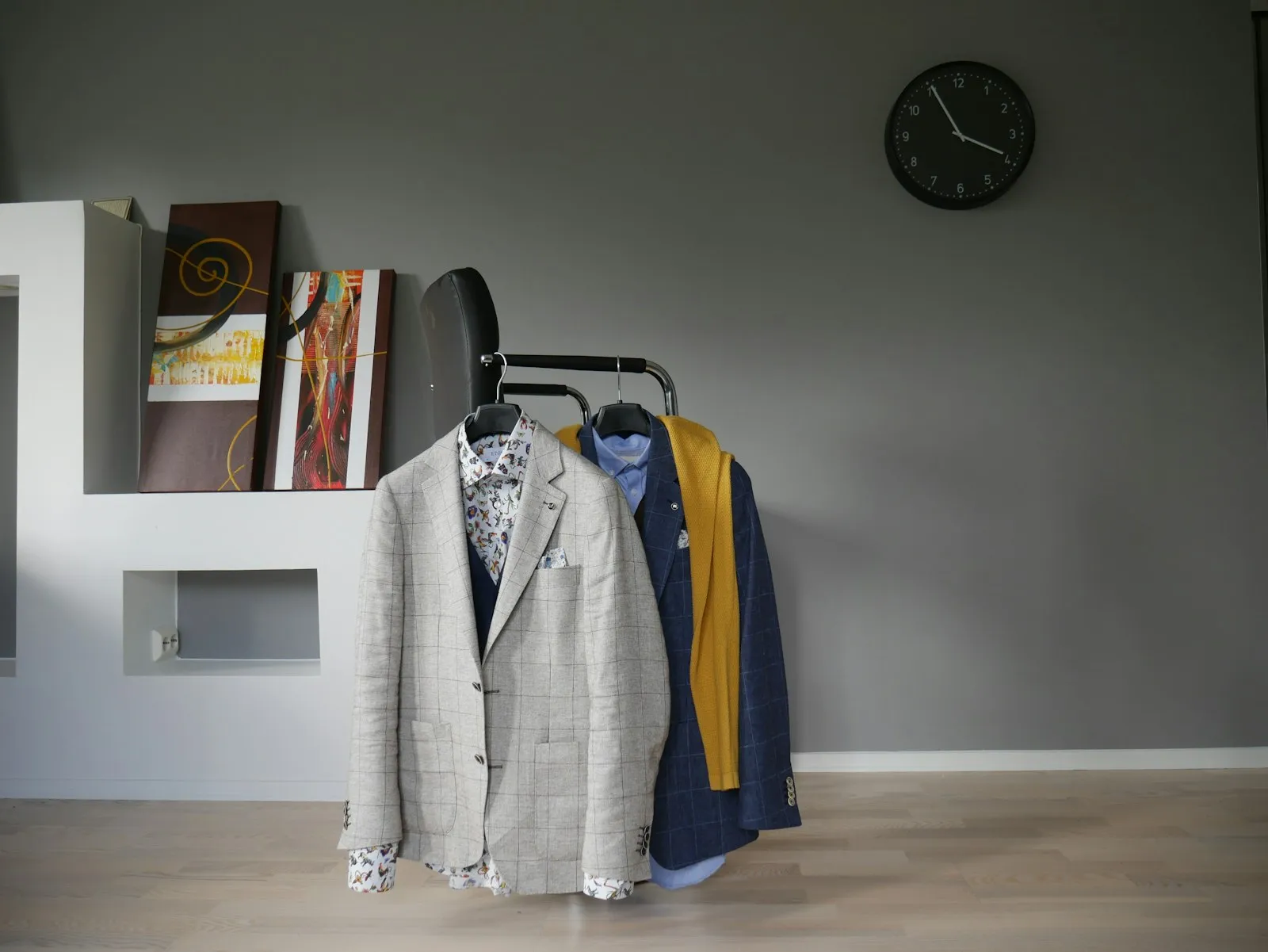
The button stance, the height of the fastening, decides where a closed blazer pulls in. At the natural waist it shows a defined waist on an hourglass or pear; a slightly lower stance opens a longer V for a short-waisted body; a lower single button, or the blazer worn open, keeps a vertical line on a straight or full middle. Underneath, a shirt should lie flat, which princess seams or a little stretch help with, and skirts end just below the knee or below the fullest part of the calf.
Wedding guest dresses
Choose in this order: the silhouette from your shape, in the dresses column above; the length from the dress code; the color from your season. Black tie usually means floor length; formal or black tie optional, floor length or an elegant midi; cocktail, knee length to midi; daytime and garden weddings, a midi in a lighter fabric. In most Western weddings, white and ivory are left to the bride.
Pick sleeves that end short or long rather than at the elbow, which sits at waist level with your arms down. The color sits next to your face in nearly every close-up, so take it from your palette; the Color Season Quiz finds your season. Then sit down in the dress for a minute before you buy: the waist should not dig in, the skirt should not ride up, and the neckline should stay put when you lean forward.
Body shape, body type or Kibbe
“Body type” can mean three different systems, which is why an answer from one does not convert into another.
| System | What it measures | Typical names | What it is for |
|---|---|---|---|
| Body shape | Bust, waist and hip circumferences, plus shoulders | Hourglass, pear, rectangle, inverted triangle, apple | Fit: where seams, waistlines and hems sit |
| Somatotype | Build: fat, muscle and linearity on three scales | Endomorph, mesomorph, ectomorph | Fitness talk; historically, physique research |
| Kibbe | An overall impression of bones, flesh and face | Dramatic, Natural, Classic, Gamine, Romantic and their subtypes | Style identity: lines, fabrics, overall look |
Somatotypes come from W. H. Sheldon’s The Varieties of Human Physique (1940, with S. S. Stevens and W. B. Tucker), which scored three components from one to seven. Sheldon tied the scores to temperament, an idea now considered discredited; the labels survive in fitness talk and have no direct link to the five shapes.
David Kibbe’s Metamorphosis (1987) described image identities judged by eye from the whole person, with no tape and no formula. Kibbe does not use bust, waist and hip ratios, so nothing stops an hourglass from being a Soft Natural. Use body shape for fit you can test in a fitting room, vertical proportions for lengths, and Kibbe, if it appeals, for the direction of your wardrobe.
Framework, not science
The criticism of dressing for your body type is fair in parts. Much classic advice is damage control: minimize the hips, hide the arms, never wear a horizontal stripe. Fruit names reduce a person to produce, rules contradict each other, and the system seems to assume everyone wants to be an hourglass. Advice that only moves you toward a slimmer or curvier outline is not telling you how to dress your body; it is telling you which body to pretend to have.
The shapes come from apparel fitting, where pattern makers grade one block across many bodies. Read that way, some rules hold because of how fabric behaves on anyone:
- A garment has to fit the widest part it passes over, then be taken in elsewhere.
- Strain shows. Pull lines across the bust, gaping buttons and a rolling waistband are fit problems on every shape.
- The eye stops where a hem or seam lands, which may or may not be where you want it.
Other rules quietly aim at one outline, a defined waist with matching bust and hips. That is a valid aesthetic choice, not a law of fit:
| Rule | What it really does | Keep it? |
|---|---|---|
| Tailor to your largest measurement | Removes strain and gaping | Yes |
| End jackets above or below your widest point | Moves a horizontal line | If you want to move it |
| Belt everything to find a waist | Pulls toward an hourglass outline | Only if you like the look |
| Never show your arms | Hides a part of you | Your call, not a fit rule |
| Dark on the bottom, light on top | Shifts attention upward | Optional emphasis |
Even the optical rules deserve scrutiny. The most repeated one, that horizontal stripes make you look wider, runs against the Helmholtz illusion: Thompson and Mikellidou (2011) found that a square of horizontal stripes looks taller and narrower than one of vertical stripes, and the effect held on a drawn figure and on mannequins.
So read every shape guide, this one included, in two layers. The fit layer, what to tailor and where seams and hems land, applies whatever you want to look like. The emphasis layer, what to show and what to play down, is a menu you order from by what you like about your body.