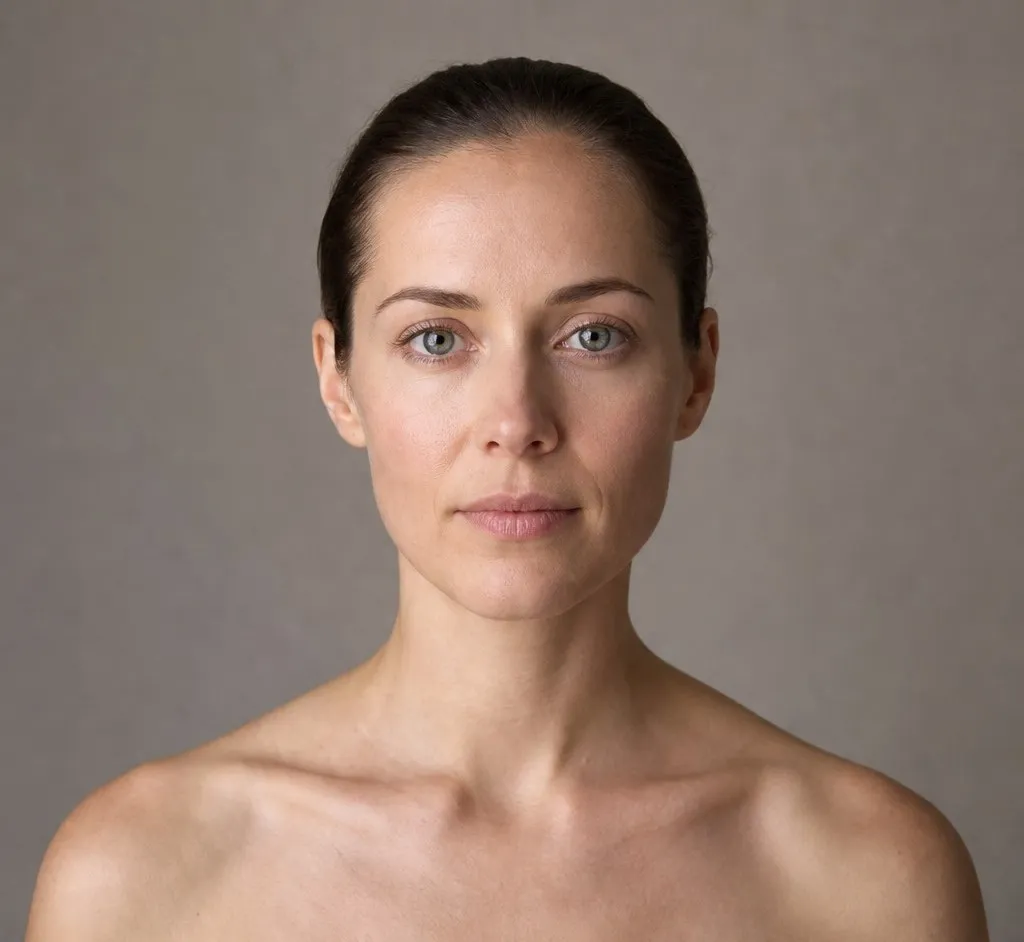
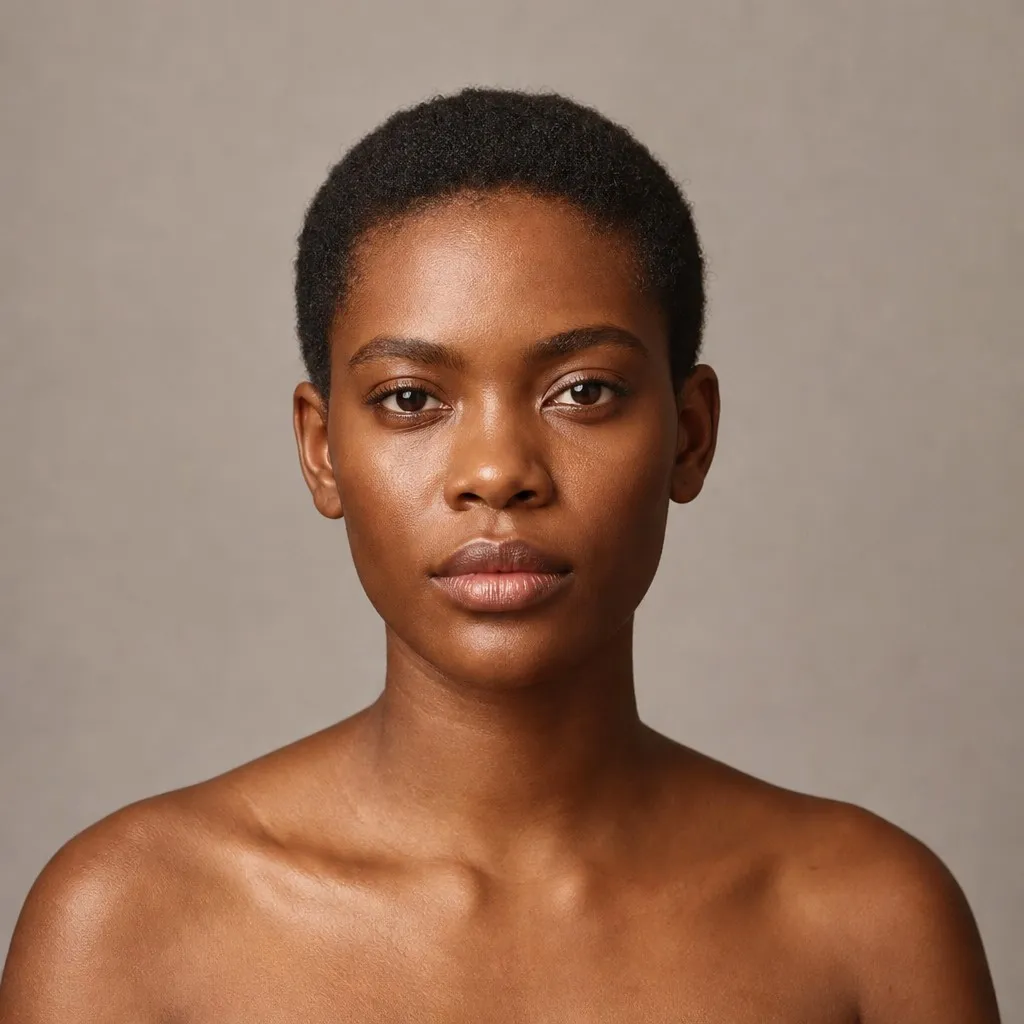
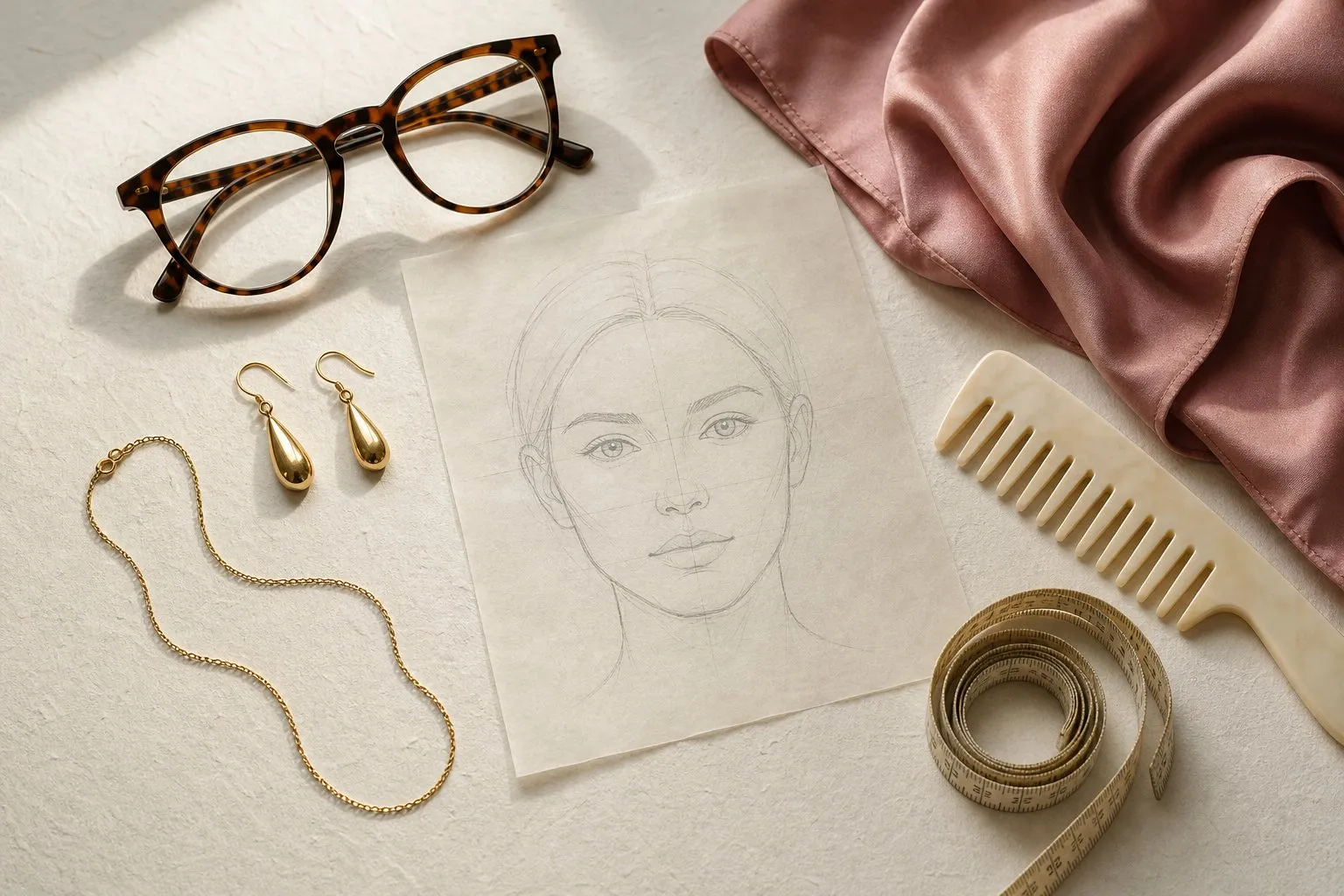
A round face is barely longer than it is wide. Its widest point is at the cheekbones, and the jaw curves from ear to chin without turning a corner. Measured, the length comes to 1.10 to 1.30 times the cheekbone width. Hair and glasses that suit it add a little height and a little angle and keep their strongest horizontal line away from the cheeks. In practice that means lift at the crown, a main length below the chin, and frames at least as wide as the cheekbones with a top line that rises toward the outer corners.
Face shapes are a styling framework, not an anatomical classification. The calculator compares three ratios with seven reference windows, and many faces sit between two shapes.
How to tell if you have a round face
Four straight measurements settle it: forehead (A), cheekbones (B), jaw (C) and face length (D). Pull your hair back, look straight ahead and keep the ruler level and off the skin. A tape pressed around the cheeks measures skin, and on a full-cheeked face that error alone can add a centimeter to B.
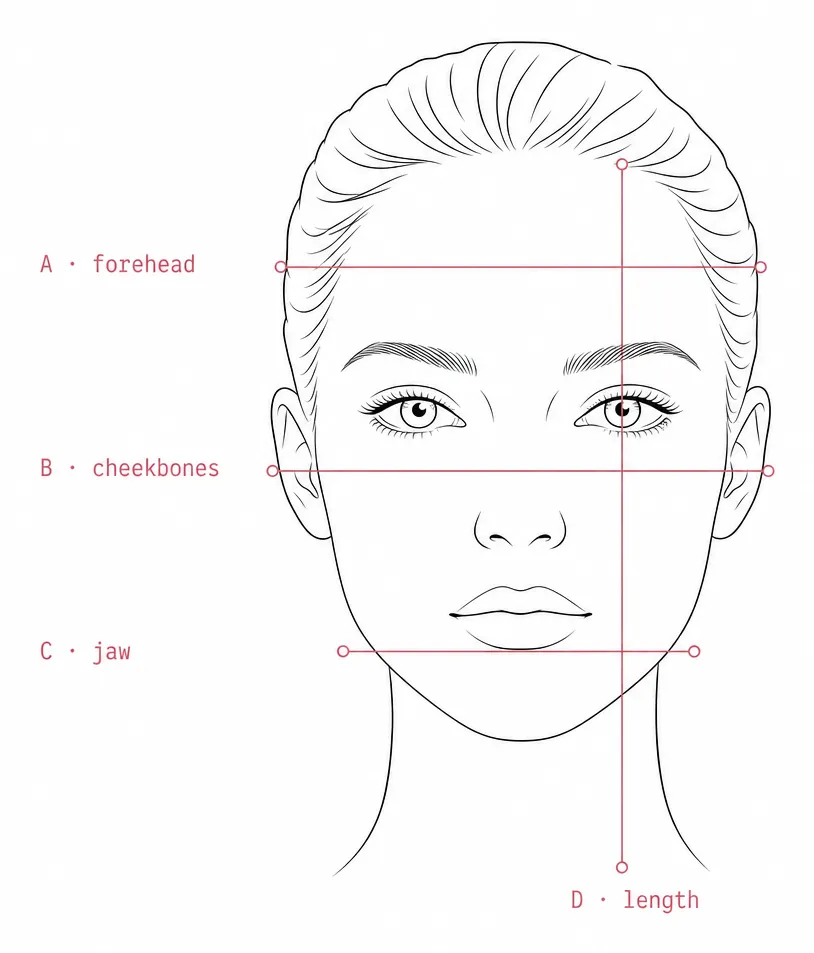
Then divide forehead, jaw and length by the cheekbone width. The round windows are 1.10 to 1.30 for length (D/B), 0.86 to 0.98 for the forehead (A/B) and 0.80 to 0.92 for the jaw (C/B). In plain terms, the face is only a little longer than it is wide, the forehead and the jaw both sit inside the cheekbone line, and the jaw sits a little further in than the forehead. Seen straight on, the outline curves out at the cheeks and back in.
| Face shape | Forehead : B | Jaw : B | Length : B |
|---|---|---|---|
| Oval | 0.88 – 1.00 | 0.75 – 0.88 | 1.30 – 1.50 |
| Round | 0.86 – 0.98 | 0.80 – 0.92 | 1.10 – 1.30 |
| Square | 0.92 – 1.04 | 0.90 – 1.00 | 1.10 – 1.30 |
| Oblong | 0.90 – 1.02 | 0.85 – 1.00 | 1.50 – 1.75 |
| Heart | 1.00 – 1.12 | 0.65 – 0.80 | 1.25 – 1.50 |
| Diamond | 0.75 – 0.88 | 0.70 – 0.85 | 1.30 – 1.55 |
| Triangle | 0.78 – 0.90 | 0.95 – 1.08 | 1.20 – 1.45 |
Take D with particular care. It’s the number that separates round from oval, and our calculator weighs length most. Run the ruler from the center of your natural hairline down to the chin with your eyes level. Tipping the chin up shortens the face on the ruler. Tipping it down lengthens it. Then trace your jaw with a fingertip from just below the earlobe toward the chin. On a round face you feel a gradual curve and no distinct corner.
A worked example: forehead 12 cm, cheekbones 13 cm, jaw 11 cm, length 15.6 cm. The ratios are 0.92, 0.85 and 1.20, and the calculator ranks the face round 99, oval 61, square 60. Two runners-up that close together are typical. A round face has one neighbor on length and another on the jaw.
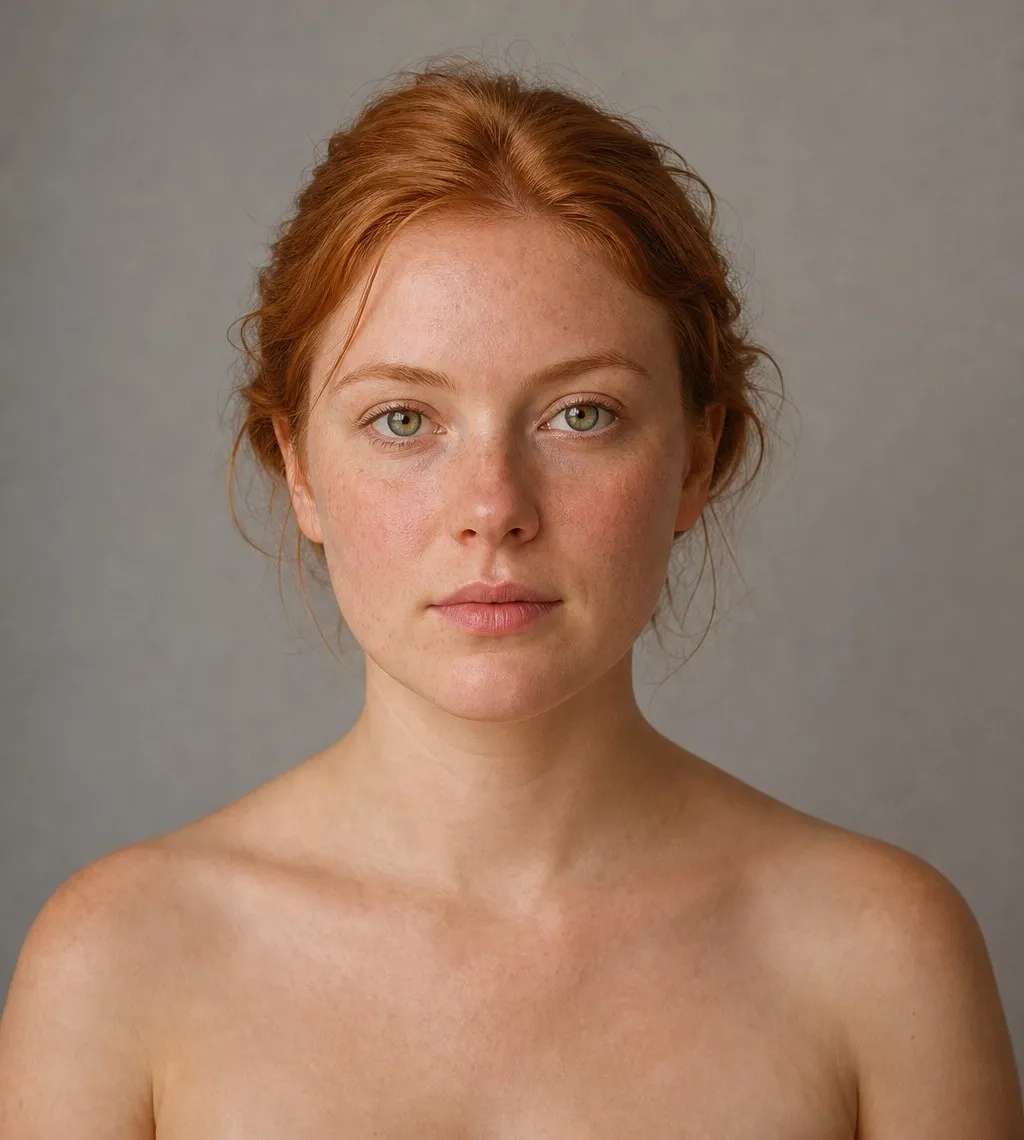
Round, oval or square?
Round shares one measurement with each neighbor. With oval it shares the taper: both are widest at the cheekbones with a narrower jaw, and only the length separates them. With square it shares the length, and the jaw separates them. Here is the worked example with one measurement nudged at a time:
| Change from the example | New ratio | Top result | Runner-up |
|---|---|---|---|
| None | D/B 1.20 | Round 99 | Oval 61 |
| Length 16.5 cm | D/B 1.27 | Round 91 | Oval 72 |
| Length 17.0 cm | D/B 1.31 | Oval 81 | Round 81 |
| Jaw 11.7 cm | C/B 0.90 | Round 93 | Square 77 |
| Jaw 12.0 cm | C/B 0.92 | Square 86 | Round 85 |
| Jaw 12.3 cm | C/B 0.95 | Square 91 | Round 77 |
A face 1.4 cm longer ties with oval. A jaw 1 cm wider ties with square. Neither is much on a ruler, so if your round result sits near either border, measure again on another day with your hair pinned back both times. When a face lands between round and oval, the usual cause is a long chin or a chin tipped up during measuring.
The square border has a second check, one the calculator can’t make because it measures widths and knows nothing about angles. Pull your hair back and run a fingertip along the jawbone from below the ear toward the chin. Then hold the edge of a card against the underside of the jaw. A square jaw turns a clear corner and follows the edge for a few centimeters. A round one curves away from the card almost at once. If the numbers say square and your fingertip finds a curve, you’re on the border and the advice for both shapes applies: no heavy horizontal line at the cheekbones or the jaw.
The calculator labels a gap under 10 points between the first two shapes a close call. Between round and oval, follow the round rule for where a haircut ends and choose freely otherwise.
The round-face rule: length and angle
A round face is short and widest in the middle, and its outline is made of curves. Every suggestion below answers that in one of two ways. Add a little length: height at the crown, lines that run downward, length below the chin. Or add a little angle: a side part, a frame with corners, an earring with a straight edge. What works against the face is a horizontal line or a mass of volume at the cheekbones, because it sits exactly where the face is already widest.

This is balance by contrast. It’s a convention about how lines read, and nobody is telling you what you may wear. The opposite choice, echoing the curves, is legitimate too. Round hoops on a round face look soft and deliberate, and a round frame can look intentional and friendly. Echo makes the roundness the point. Contrast makes the face read a little longer. Just know which one you’re choosing.
For anything not listed below, ask two questions of the piece. Does it add height or a downward line? Does it add an angle? If the answer is no both times and it sits at cheek level, it will make the face read wider.
Hairstyles for a round face
Two things decide a haircut for a round face: where the volume sits and where the ends stop.
Volume belongs on top, length belongs below the chin. Everything else is detail.
Lift at the crown lengthens the silhouette. A little height at the roots, or layers cut at the crown, does more than any amount of styling at the sides. The main length should fall at the collarbone or below. A shorter cut should be angled so it’s longest at the front. Hair that stops at chin or cheekbone level draws a horizontal line exactly where the face is widest.

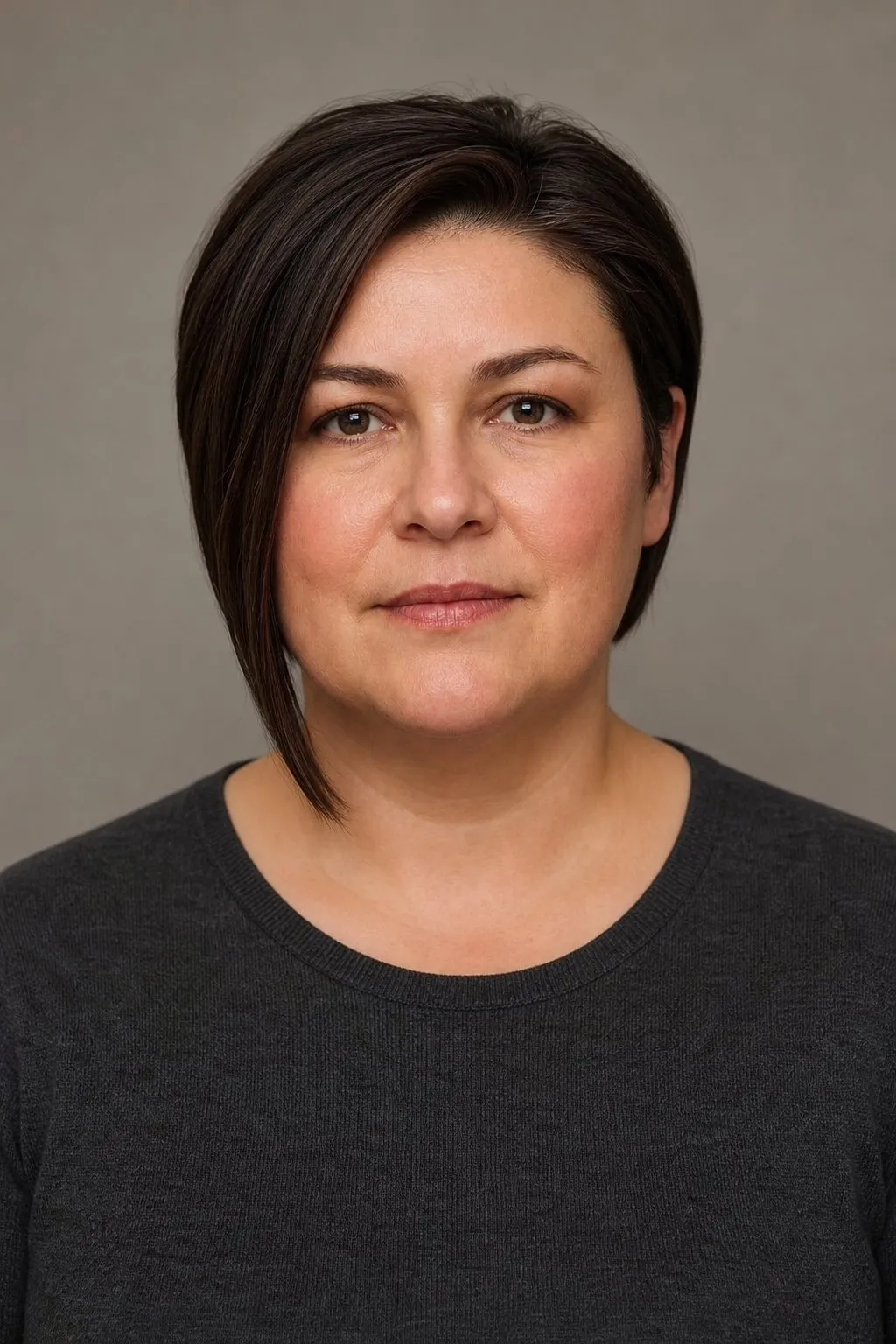
Cuts that work, and what to ask for:
- Long layers starting below the chin. Face-framing pieces that begin at the jaw or lower draw vertical lines along the sides of the face.
- An angled long bob. Shorter at the back, longer at the front, with the front ending past the chin.
- A side part. It breaks the symmetry of the outline and adds a diagonal. Even a slight shift from the center helps.
- A high ponytail or top knot. Pulled-back styles work well when the height is on top of the head and not at the back.
Cuts that work against a round face:
- A blunt bob ending at the chin, full at the sides.
- A heavy, straight fringe that sits just above the brows.
- Tight curls or volume concentrated at cheek level.
- A center part with the hair tucked flat behind the ears, which shows the full width.
Curly and coily hair follows the same map. Shape the cut so the fullness sits at the crown and below the chin and stays off the cheeks. Judge the length dry: curls spring up as they dry, and a cut that looks long when wet can end at cheek level.
Bangs, bobs and short cuts
Bangs. A round face gains little from covering the forehead and a lot from diagonals. Curtain bangs suit it best when they open at the cheekbones, with their shortest point around cheekbone level, so the two diagonals run down past the widest part of the face. Long side-swept bangs draw one longer diagonal. Wispy bangs work if they are long. Full, blunt bangs and micro bangs both draw a horizontal across a short face and shorten it further.

Bobs. A bob ends in a horizontal line, and a horizontal line widens the face at the height where it sits. For a round face, the hem belongs a few centimeters below the chin, angled longer at the front, with flat sides. That makes the lob, which ends between the jaw and the collarbones, the easier choice. Its hem already sits below the widest part, and it leaves the stylist room to angle it.
Short hair. A pixie can look very good on a round face if it has height at the crown, close sides above the ears and a side-swept fringe. A pixie that is rounded and full all over repeats the outline.
The part. A side part is the strongest of the small changes, because its diagonal adds length. A middle part works too if the cut has height at the crown and a length below the chin. With flat sides tucked behind the ears, it shows the face at full width.
Glasses for a round face
Three checks, in this order, choose a frame for a round face better than any list of shape names.
- Width. The frame front is at least as wide as your cheekbones. A round face is widest at the cheekbones, just below the line where glasses sit, so a narrower frame leaves a band of cheek showing on each side and the face looks wider by contrast. Aim for a total frame width about equal to B, or a touch wider.
- Angle. The frame has some corners. Round frames repeat the curves of the face. Angular ones contrast with them and add structure the face doesn’t have.
- Top line. The top of the frame is defined, sits at or just below the brows and rises slightly toward the outer corners. That adds an upward diagonal. A flat top line sitting well below the brows leaves a band of forehead above it and makes the face look shorter.
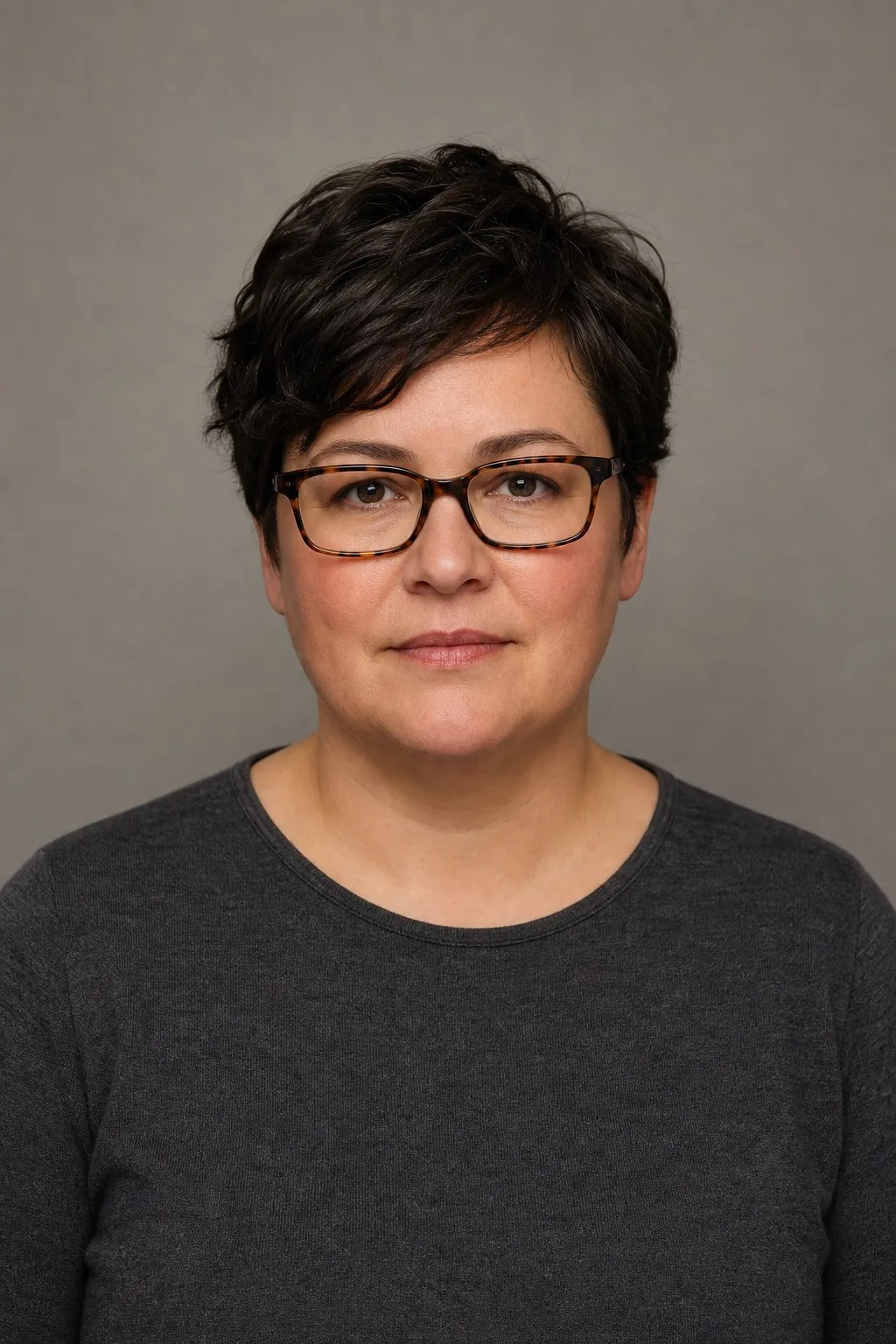
The bridge adds or removes a little vertical space in the middle of the face. A higher bridge, or a clear or keyhole bridge, shows more of the nose and adds a little length. A low, heavy bridge does the opposite. On a short face that small effect points the right way.
A cat-eye does two useful things at once. Its upswept corners add an upward diagonal, and its angled top edge adds structure, which makes it one of the most reliable shapes here. Choose one at least as wide as your cheekbones, with a fairly straight bottom rim. A cat-eye that’s rounded all along the bottom brings the curves back. A soft upsweep looks quiet and a sharp one looks dramatic. Both work.
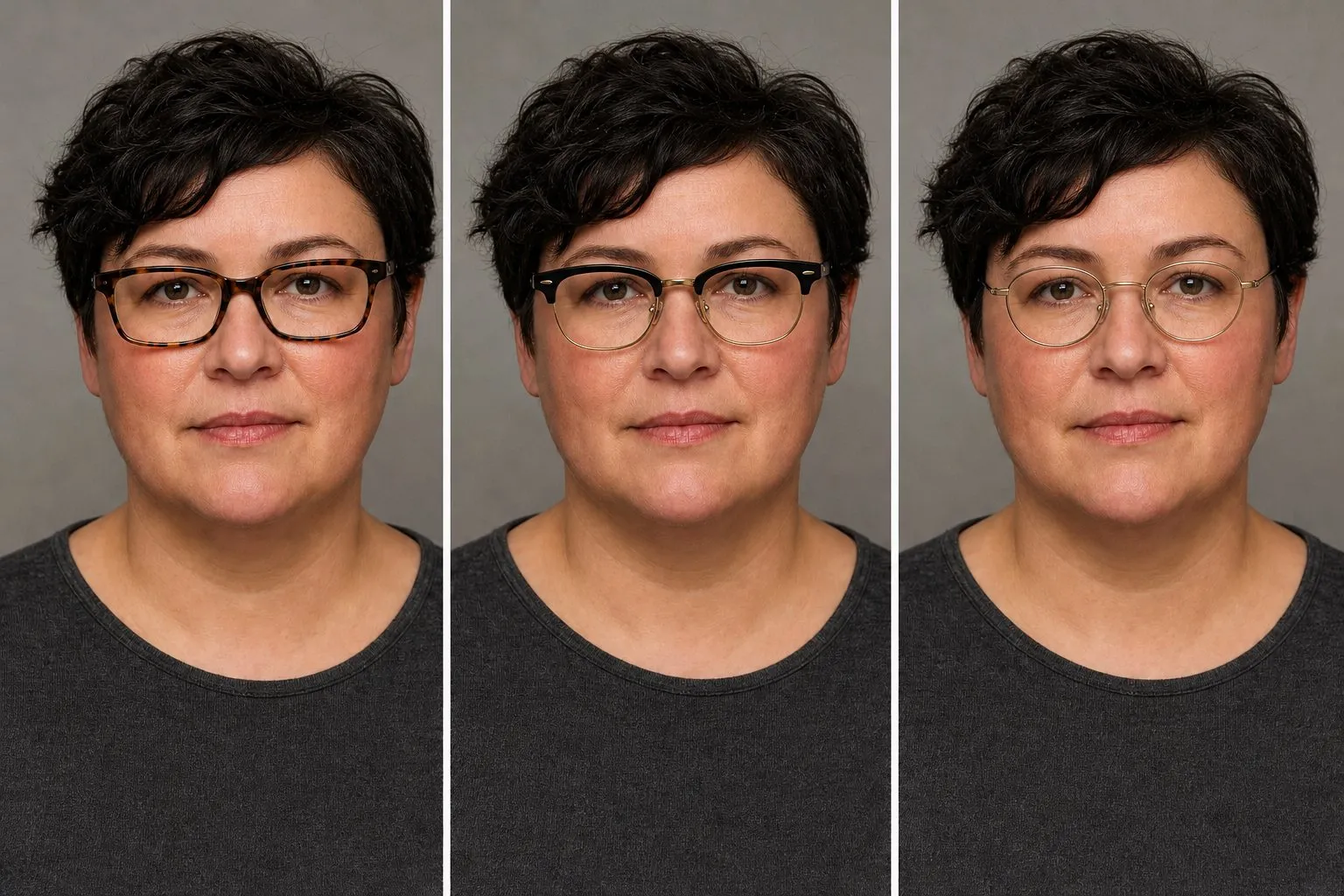
| Frame | Verdict | Why |
|---|---|---|
| Rectangular, wider than deep | Very good | Straight lines against curves, and a horizontal that is not at the widest point |
| Cat-eye | Very good | Upward diagonal and an angled top edge |
| Browline | Good | Strong top line, light lower rim |
| Geometric (soft hexagon, squared oval) | Good | Angles without looking severe |
| Aviator | Possible | Works when wide enough; the rounded bottom repeats the cheeks |
| Large round with a defined top | Possible | Must reach the cheekbones |
| Small round | Avoid | Repeats the curves and is too narrow |
| Narrow frames, any shape | Avoid | Make the face look wider |
Weight and color finish the job. A darker or thicker top rim with a lighter or thinner bottom rim reinforces the lift, and clear or pale lower rims keep weight off the cheeks. Very thick frames all the way around add mass to a face that’s already full in the middle, so a medium weight usually looks best. Frame color is a question for your coloring, and face shape has no say in it. If you wear bangs with glasses, end the fringe a finger’s width above the frame, or let long side-swept bangs cross it on a diagonal, so fringe and rim never merge into one heavy band.
Sunglasses for a round face
Sun frames follow the same three checks, and two shapes pass all of them. Trapezoid frames, the thick acetate shape that is wider at the top than the bottom, and cat-eyes both bring angles and lift. Aviators work when they are wide enough, though their rounded lower edge echoes the cheeks. Oversized frames and shields are possible in versions with some angle. Small round lenses are the one shape to skip, because they repeat the curves and leave the cheeks showing around them.
Moderately oversized sunglasses are often easier on a round face than everyday frames, since their size already covers the width question. Very large round ones are the exception: they cover much of the cheeks with more curves. Whatever the shape, face shape only decides how sunglasses look. UV protection is a separate matter, so check the label.
Brows, contour and blush
A higher, more defined arch suits a round face, because the peak adds a little vertical lift across the top third. Place the peak where a line from the side of your nostril through the outer edge of the iris crosses the brow, and keep the tail no lower than the start.
Contour does with light what the haircut does with lines. A matte shade one or two steps deeper than your skin reads as shadow and recedes. A lighter area reads as a plane catching light and comes forward. On a round face, the shadow goes where the face is widest and the light goes down the middle.
- Shade: the sides of the face, from the temple down past the cheekbone.
- Light: the center of the forehead and the chin, which lengthens the middle line.
- Blush: started high on the cheekbone and angled up toward the temple.
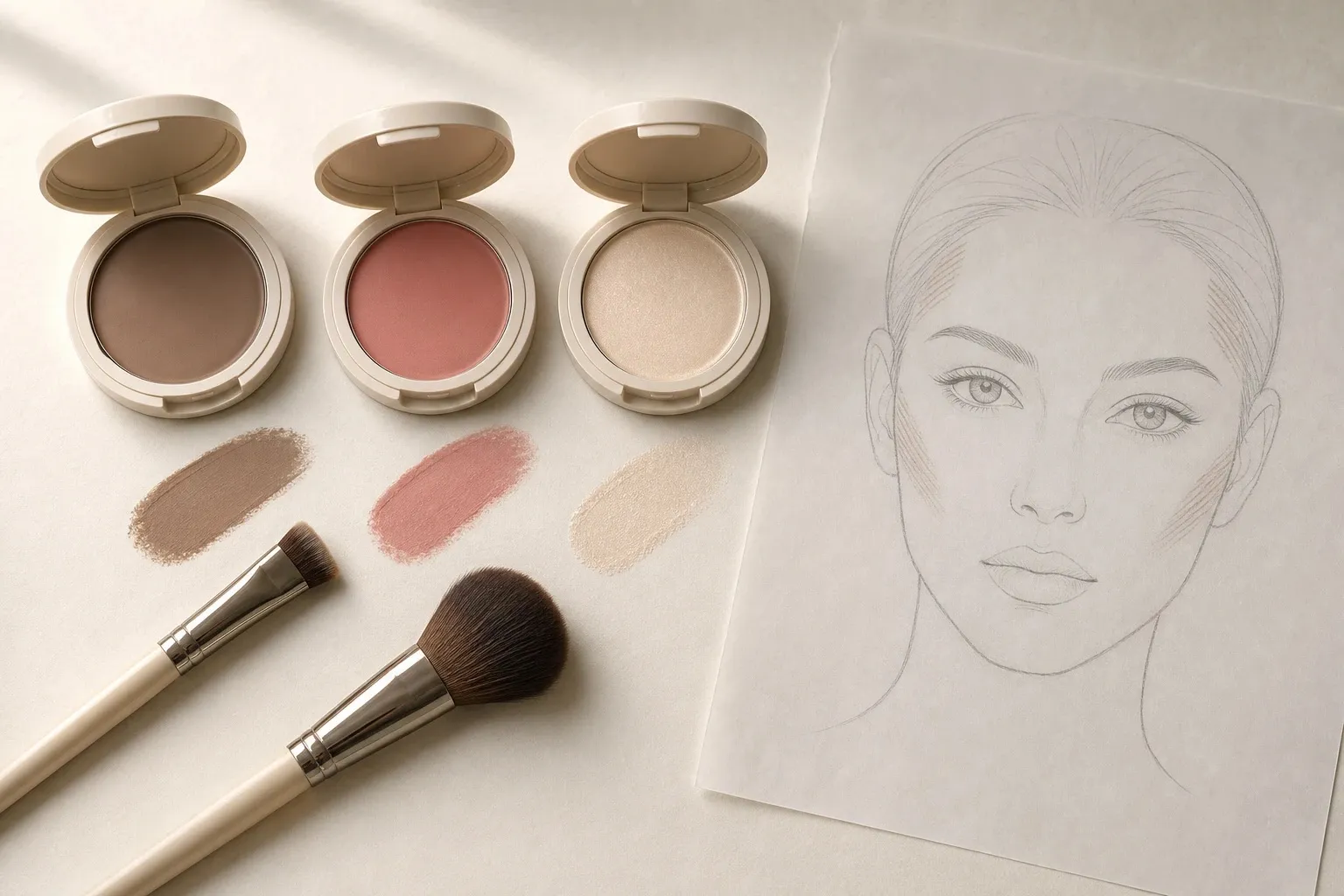
For placement, find the cheekbone by pressing below the outer corner of the eye. Start the blush no closer to the nose than a line down from the outer edge of the iris and no lower than the tip of the nose, then sweep it upward and blend the edges out. Blush placed closer to the center drags the face down, and blush placed on the “apples” while you smile slides lower when the cheeks relax. Keep the contour soft enough that no edge shows by a window at arm’s length. Contour makes the face read a little narrower and leaves the bone as it is.
Earrings, necklines, hats and scarves
Accessories close to the face follow the round-face rule. A downward line or an angle helps, and width at cheek level doesn’t. Two details decide each piece: the height at which it’s widest, and where it ends.
| Accessory | Choose | Go easy on |
|---|---|---|
| Earrings | Long, narrow drops and linear or angular shapes that end below the jaw | Large round hoops and wide clusters at cheek level |
| Necklines | V-necks, deep scoops, square necks and halters | High crew necks and chokers right under the chin |
| Hats | A fedora with some crown height; a wide brim or beret worn tilted | A close, rounded cloche pulled low |
| Scarves | A long, loose drape with the ends hanging; a low knot on the chest | Bulky wraps bunched under the chin |
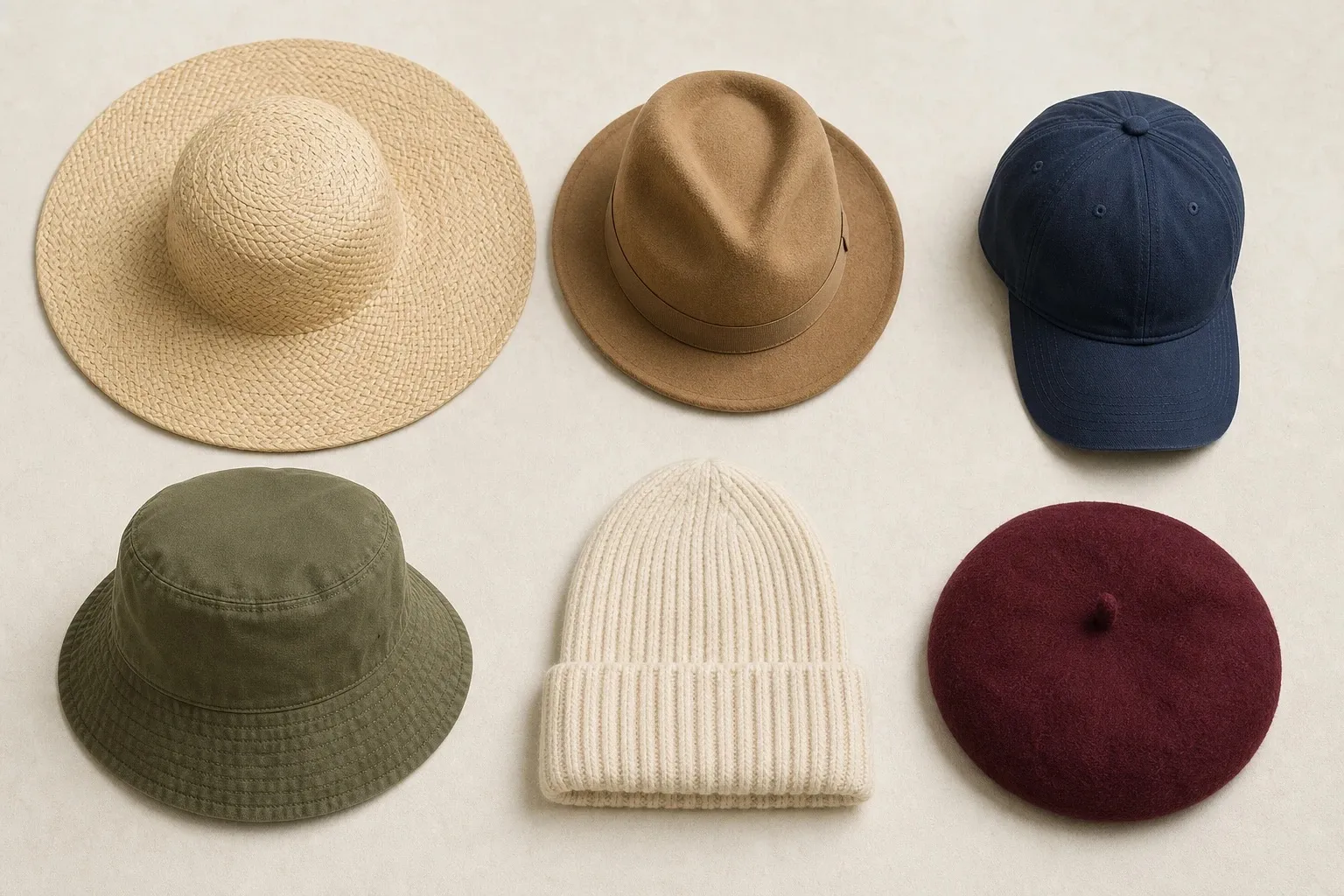
Small hoops close to the lobe suit almost everyone. The large ones, widest beside the cheek, are what add width. With necklines, depth matters more than curve: a deep scoop is round and still lengthens, while a high crew repeats the outline right under the jaw. A hat brim should be at least as wide as your cheekbones, and caps, beanies and bucket hats look better worn a little higher, with some forehead showing, than pulled down to the brows. A long neck may still want a higher neckline than this table suggests. Side-by-side charts for all seven shapes are in what suits your face shape.
Does a round face change with age or weight?
Weight changes can show up on the tape within months. Age takes years. A tape across the cheeks and jaw includes soft tissue, so gaining or losing weight can move B and C while the bone underneath stays the same. After a large weight loss a face can shift from round toward oval without anything structural changing. That’s a reason to measure again, and it doesn’t make the first result wrong.
Aging is slower and pulls in two directions at once. Flatter cheeks narrow B a little, so the face reads a touch longer and a round result can drift toward oval. At the same time, soft tissue settling along the jawline makes the lower face read wider and straighter, which can pull the outline toward square. The bone itself changes less than the outline suggests. Mendelson and Wong’s 2012 review of the aging facial skeleton reports a stable bony distance between the jaw angles, even as the jaw angle widened and the jawbone became slightly shorter and shallower.
Measure again when your weight changes noticeably, and otherwise every few years. Read the ratios and the gap to the runner-up, because the centimeters alone tell you little. If the outline has softened at the jaw, move the hem of your haircut away from it, up to the cheekbones or down to the collarbones, and keep the lift at the crown.