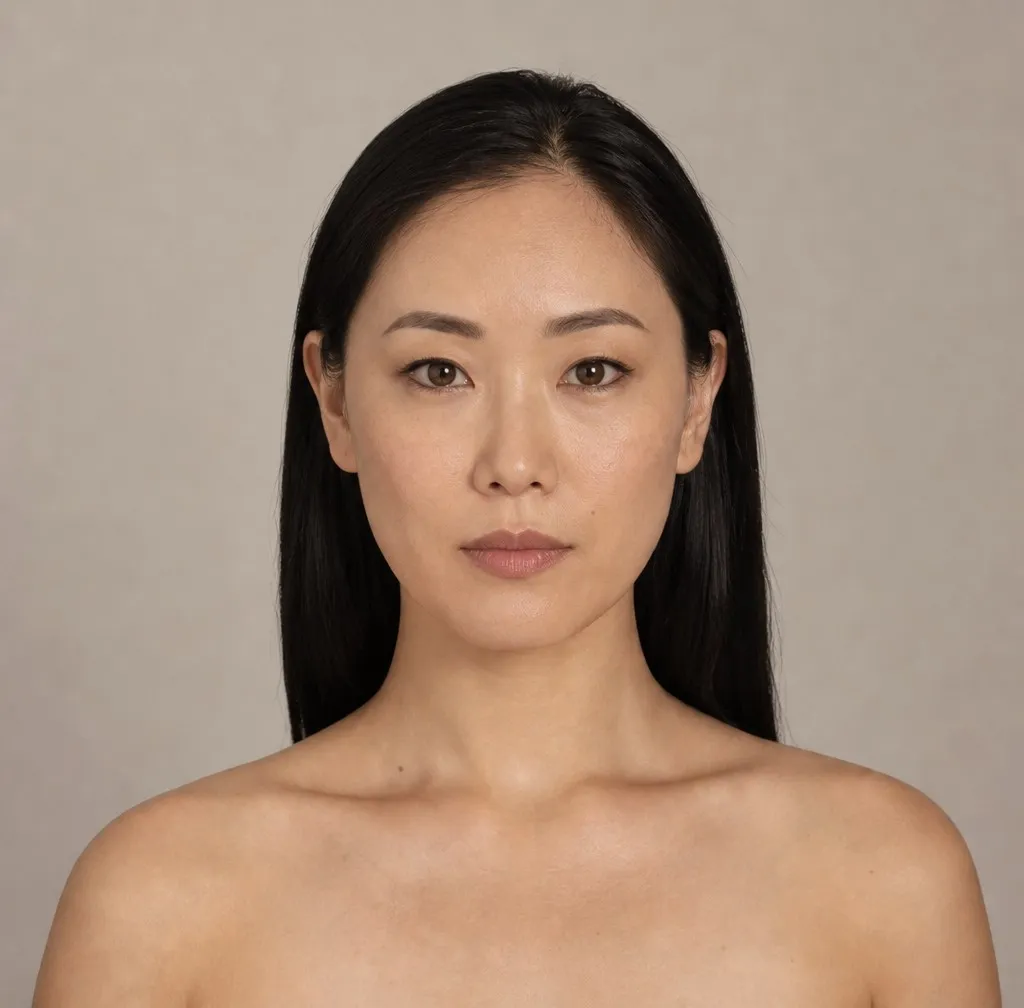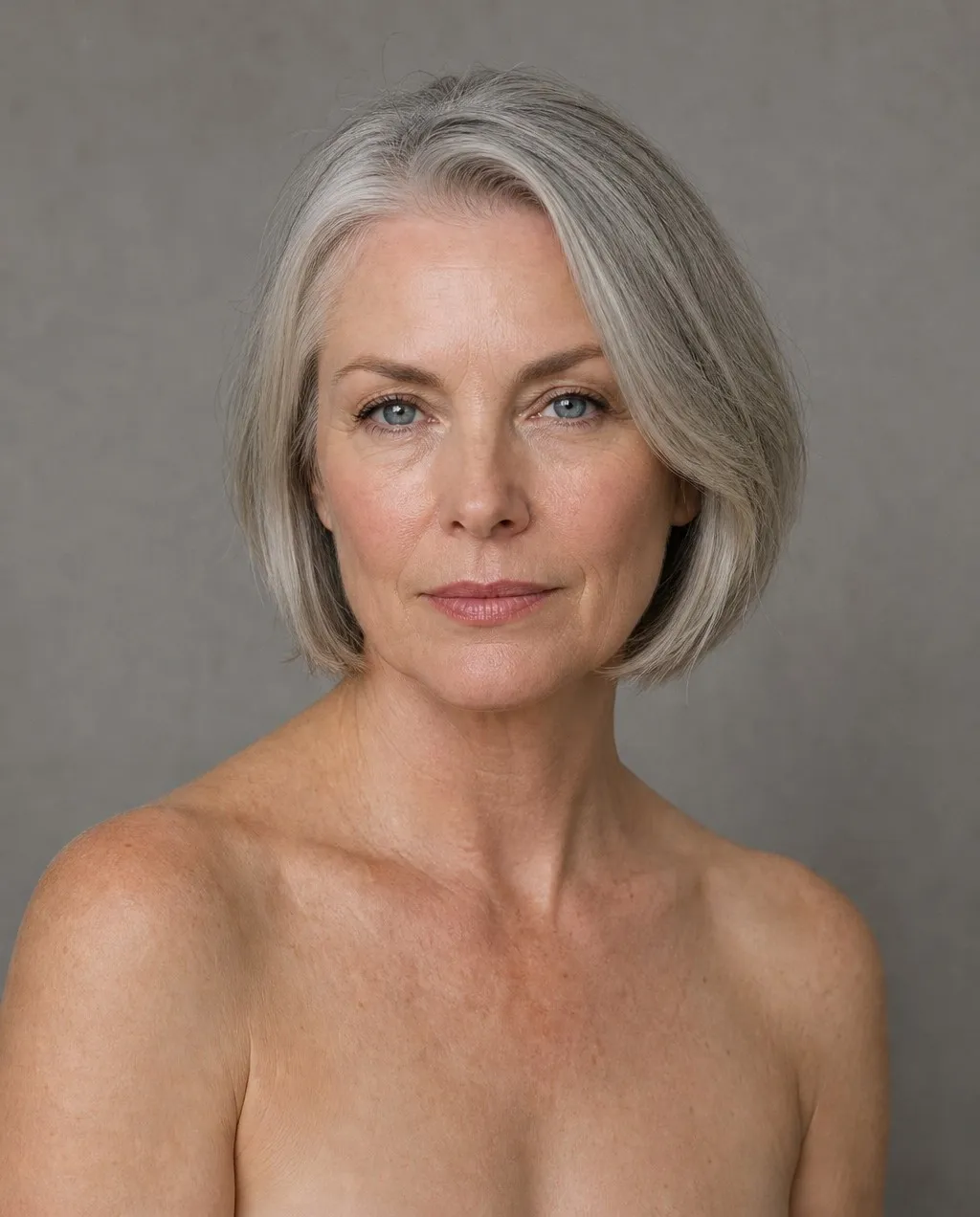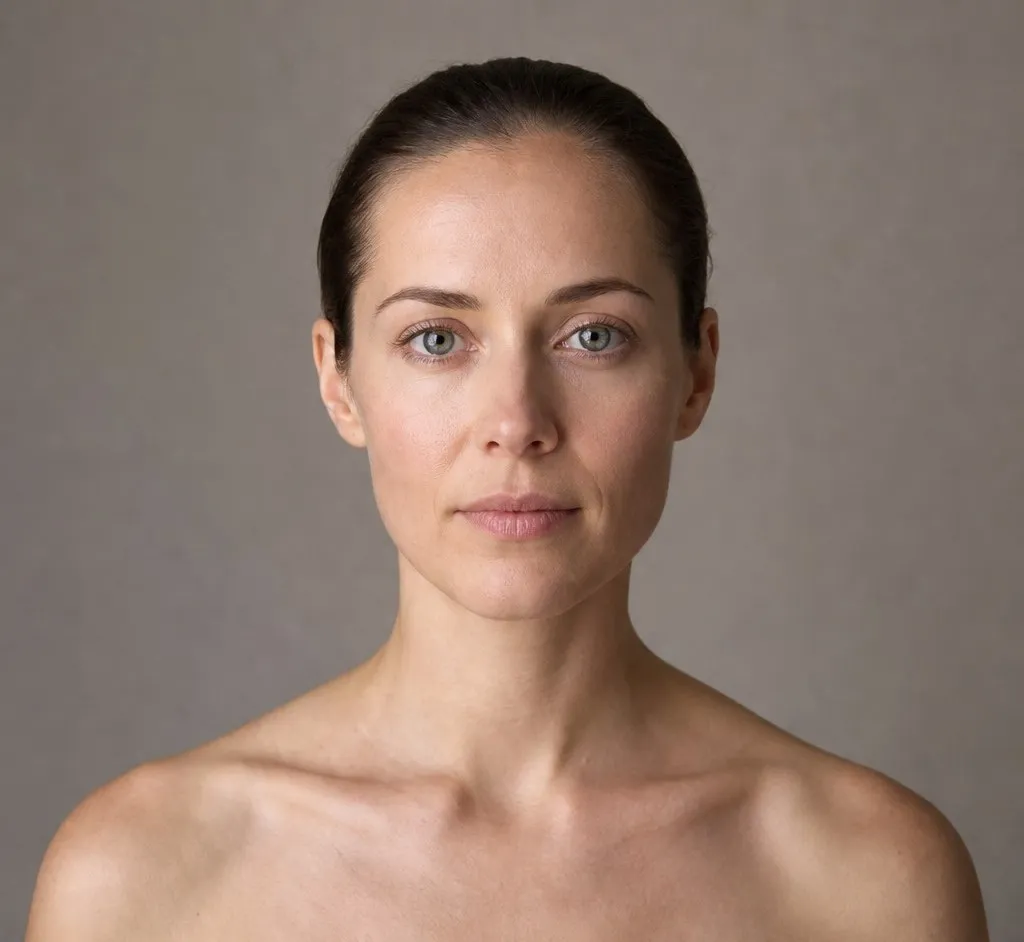
The face shape chart
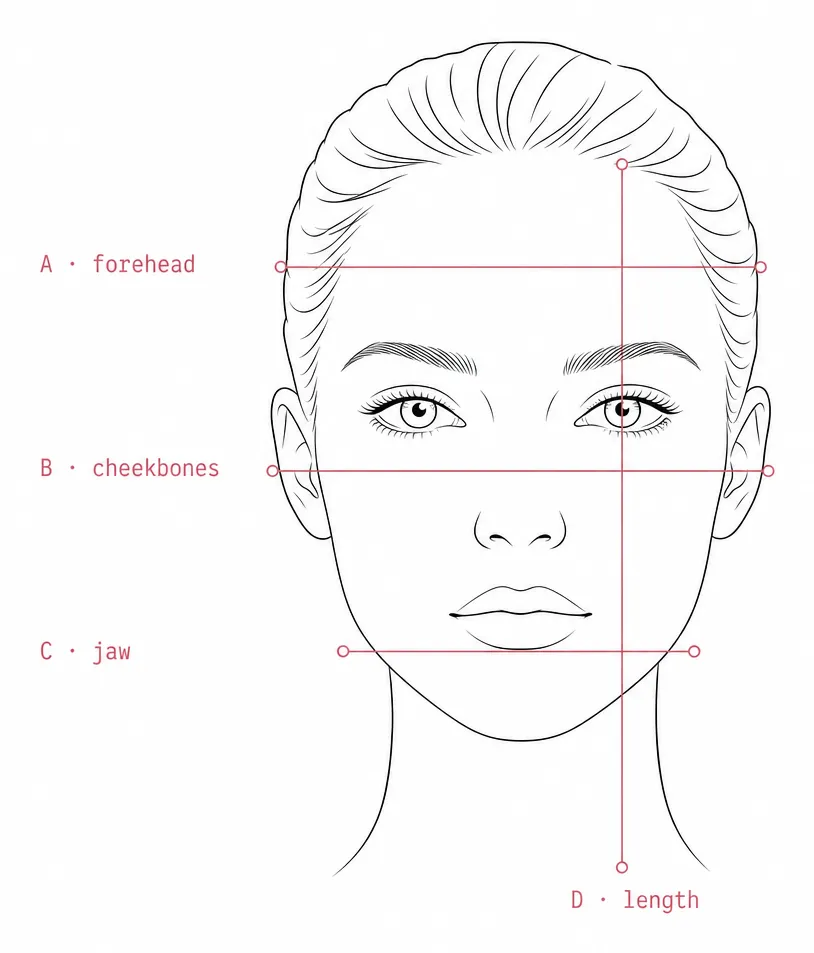
What is my face shape? It comes from four measurements: forehead (A), cheekbones (B), jaw (C) and length (D). Divide the other three by your cheekbone width and you get three ratios. The face shape calculator above scores all seven shapes by how close those ratios sit to each shape’s window and ranks them, and when two shapes score close, one measurement usually settles which.
Face shapes are a styling framework, not an anatomical classification. The calculator compares three ratios with seven reference windows, and many faces sit between two shapes. They describe how a face reads at a glance, which is exactly what a haircut or a pair of frames changes.
A face shape chart answers two questions, in this order: where is the face widest, and how long is it for its width? The seven types of face shapes are the common combinations of those answers, and the three ratios carry them:
- D/B, the length-to-width ratio: how long the face is for its width.
- A/B: the forehead compared with the cheekbones.
- C/B: the jaw compared with the cheekbones.
A ratio of 1.00 means two widths are equal. Below 1.00 that part of the face is narrower than the cheekbones; above it, wider. The calculator’s windows:
| Face shape | Forehead : B | Jaw : B | Length : B |
|---|---|---|---|
| Oval | 0.88 – 1.00 | 0.75 – 0.88 | 1.30 – 1.50 |
| Round | 0.86 – 0.98 | 0.80 – 0.92 | 1.10 – 1.30 |
| Square | 0.92 – 1.04 | 0.90 – 1.00 | 1.10 – 1.30 |
| Oblong | 0.90 – 1.02 | 0.85 – 1.00 | 1.50 – 1.75 |
| Heart | 1.00 – 1.12 | 0.65 – 0.80 | 1.25 – 1.50 |
| Diamond | 0.75 – 0.88 | 0.70 – 0.85 | 1.30 – 1.55 |
| Triangle | 0.78 – 0.90 | 0.95 – 1.08 | 1.20 – 1.45 |
Read each row as the range where a shape is most typical, not as a border you cross. The windows overlap on purpose: round and square share one length window, and oval, heart, diamond and triangle all sit mid-scale. Where length cannot separate two shapes, the widths do.
Step 1: find the widest point. A/B and C/B together sort a face into one of five groups before length comes into it.
| Widest point | What the other widths do | Shape |
|---|---|---|
| Forehead | Forehead as wide as the cheekbones or wider, jaw much narrower | Heart |
| Cheekbones, clearly | Forehead and jaw both well inside the cheekbones | Diamond |
| Cheekbones | Forehead close behind, jaw tapering | Oval or round |
| Nearly level | Forehead, cheekbones and jaw close in width | Square or oblong |
| Jaw | Jaw level with the cheekbones or wider, forehead clearly narrower | Triangle |
Step 2: let length settle the rest. D/B splits the two groups that still hold a pair. Heart, diamond and triangle need it less, because their widths already set them apart.
| D/B | Cheekbones widest, jaw tapering | Three widths close |
|---|---|---|
| 1.10 to 1.30 | Round | Square |
| 1.30 to 1.50 | Oval | A long square or short oblong; oval scores close |
| 1.50 to 1.75 | Oblong, unless the jaw tapers strongly | Oblong |
A worked example: A 12.5 cm, B 13.5 cm, C 11.5 cm, D 18.5 cm. The ratios are A/B 0.93, C/B 0.85 and D/B 1.37. The cheekbones are widest, the jaw tapers and the length lands in the oval band. The calculator scores this face 92 for oval and 69 for round, its nearest neighbor.
The seven shapes in one line each:
- Oval. Longer than wide, tapering gently to the jaw.
- Round. Length close to width, a soft jaw without a defined angle.
- Square. Three widths nearly equal on a short face, a visible jaw angle.
- Oblong. Clearly longer than wide, sides nearly parallel.
- Heart. Widest at the forehead, narrowing to a fine chin.
- Diamond. Cheekbones clearly wider than forehead and jaw.
- Triangle. Widening toward the jaw from a narrow forehead; covered in full below.
Some charts add rectangle, an oblong face with a sharp jaw, which the calculator files under oblong; some call heart an inverted triangle and triangle a pear.
How to measure your face
How do you find your face shape at home? The four face shape measurements take a mirror, a rigid ruler, a pen and two minutes. A soft tape works for the length, not for the widths. Pull your hair back and face the mirror straight on.
A, forehead. Find the widest line across your forehead, usually about halfway between your brows and your hairline. If your hairline dips at the temples, measure the bone where the forehead is widest, not the point where the hair starts.
B, cheekbones. Feel for the most prominent point of each cheekbone, just below the outer corner of the eye, and measure straight across between the two.
C, jaw. Find the corner of the jaw below each ear, where the bone turns forward toward the chin. Measure straight across from one corner to the other, not along the curve.
D, length. Hold the ruler upright and measure from the center of your hairline to the bottom of your chin. Start at the natural hairline, not where a fringe begins; if it has receded, start where it used to be.
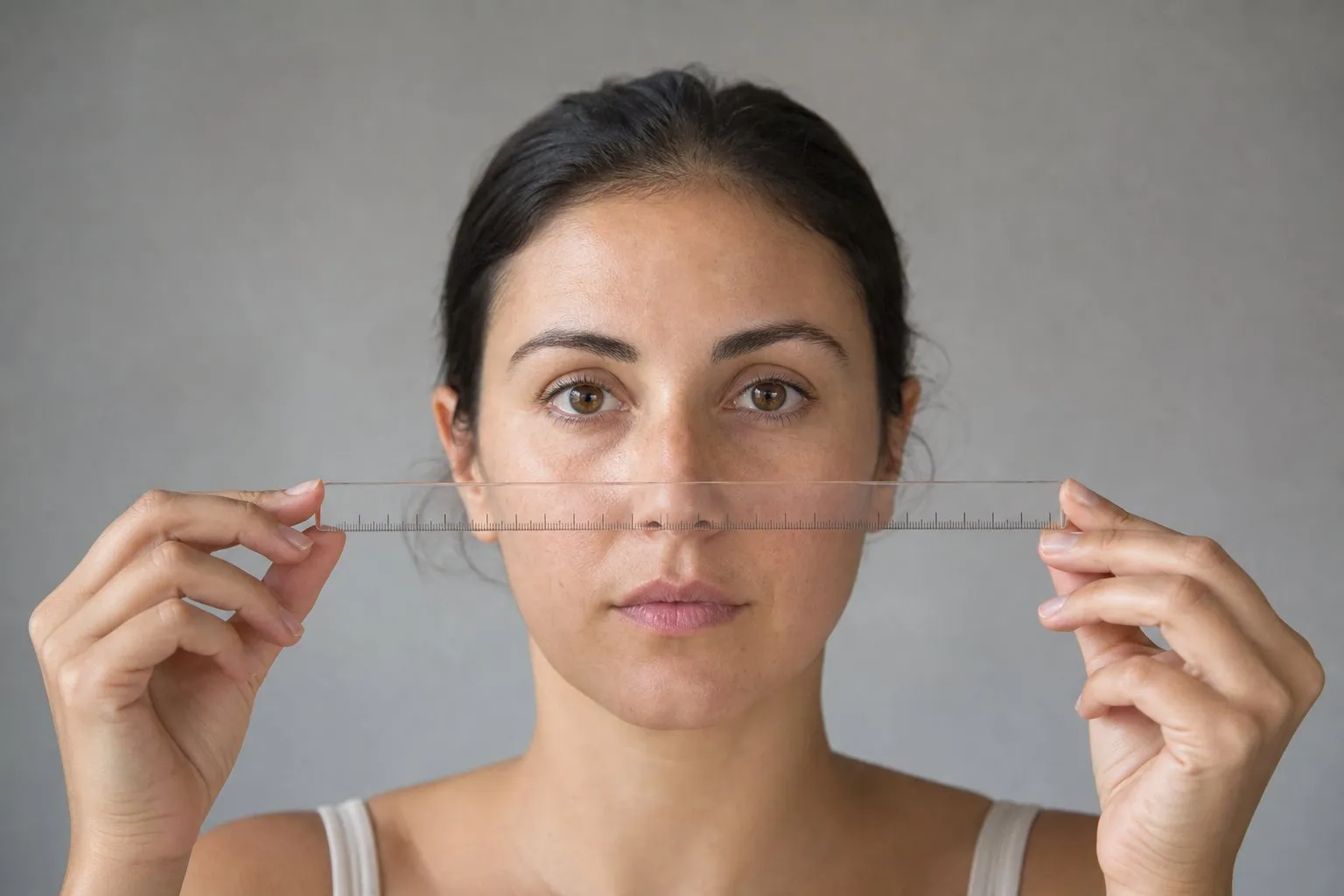
Measure across, not around. A tape that follows the curve of your cheeks measures skin, not the outline.
Units do not matter: the calculator uses only ratios, so centimeters and inches give the same result if all four numbers use one unit. Small errors matter less than people fear. Moving the worked example’s cheekbone measurement 2 mm either way changes its oval score by one or two points.
With your four numbers ready, replace the example values in the calculator, which read oval 99, diamond 69.
Mistakes that skew the numbers
- Wrapping the tape. For the three widths, keep the ruler flat in front of the face. A tape pressed around the cheeks can add a centimeter or more.
- Tilting your head. Tipping the chin up shortens the face; tipping it down lengthens it. Keep your eyes level with their reflection.
- Measuring the hair, not the face. A fringe hides the hairline and volume at the temples hides the forehead edge. Pin everything back.
- Smiling. A smile widens the cheeks and changes the line of the jaw. Keep a relaxed, neutral expression.
How the calculator decides
The calculator turns your four numbers into the three ratios and gives every shape a score out of 100. A ratio at the center of a shape’s window earns all of its points, and the further it sits from the center, the fewer it earns, along a bell curve whose width is set by the window. At the edge of a window a ratio still earns about 61 percent of its points; half a window beyond the edge, about 14 percent. Nothing drops off a cliff at a border.
Length counts most, 40 of the 100 points. The jaw carries 35 and the forehead 25, and the three parts are added and rounded to a whole number. The worked example, broken down:
| Shape | Length (of 40) | Forehead (of 25) | Jaw (of 35) | Score |
|---|---|---|---|---|
| Oval | 38 | 24 | 30 | 92 |
| Round | 9 | 25 | 35 | 69 |
| Diamond | 36 | 6 | 21 | 63 |
| Heart | 40 | 2 | 8 | 50 |
Round fits this face’s widths almost perfectly and still loses by 23 points, because a length of 1.37 lies beyond the round window. Heart takes every length point and little else. That is the chart’s logic in four rows: length places the face in a band, and the widths pick the shape within it.
All seven scores appear under the result, each with a bar. When the top two are less than 10 points apart, the result line calls it a close call and suggests borrowing from both; a gap of exactly 10 does not trigger the note. If two shapes tie, the one named first simply comes earlier in the calculator’s list (oval, round, square, oblong, heart, diamond, triangle).
How accurate is it? As accurate as the four numbers: the arithmetic is exact, so the error comes from the ruler. The calculator measures widths, not angles, which makes the corner of the jaw a check you do yourself (Round or square? shows how). Everything runs in your browser: pressing Calculate saves your shape and length ratio in this browser only, never on a server, so the shape articles can open on your variant.
Between two shapes
A face that scores high for two shapes is what people call a combination face. A few pairs cause most of the confusion, and in each, two of the three ratios point both ways while one decides. Near a border a few millimeters count, so measure twice, on different days, before trusting a close call.
Round or oval?
Round and oval faces are both widest at the cheekbones, with a slightly narrower forehead and a jaw that curves to the chin, and their forehead and jaw windows overlap.
Length decides: round runs up to a D/B of 1.30 and oval starts there. Here is a face with the forehead at 0.92 and the jaw at 0.85 of the cheekbones, as only the length changes:
| D/B | Round | Oval | Reads |
|---|---|---|---|
| 1.20 | 100 | 59 | Clearly round |
| 1.25 | 95 | 67 | Round |
| 1.30 | 84 | 78 | Close call, round ahead |
| 1.35 | 73 | 89 | Oval |
| 1.40 | 65 | 94 | Clearly oval |
Near 1.30, the jaw tips the balance. At exactly 1.30, a narrower jaw (0.80) scores oval 82 and round 70, while a wider one (0.90) scores round 77 and oval 63. A defined taper moves the border down; a fuller jaw moves it up.
If two careful measurements land between about 1.27 and 1.33, you are both: follow the round rule for where a cut ends, below the chin, and choose freely otherwise. See the round face shape and oval face shape.
Oval or oblong?
Oval and oblong faces are both longer than wide. They part ways on how much longer, and on whether the face tapers or runs straight.
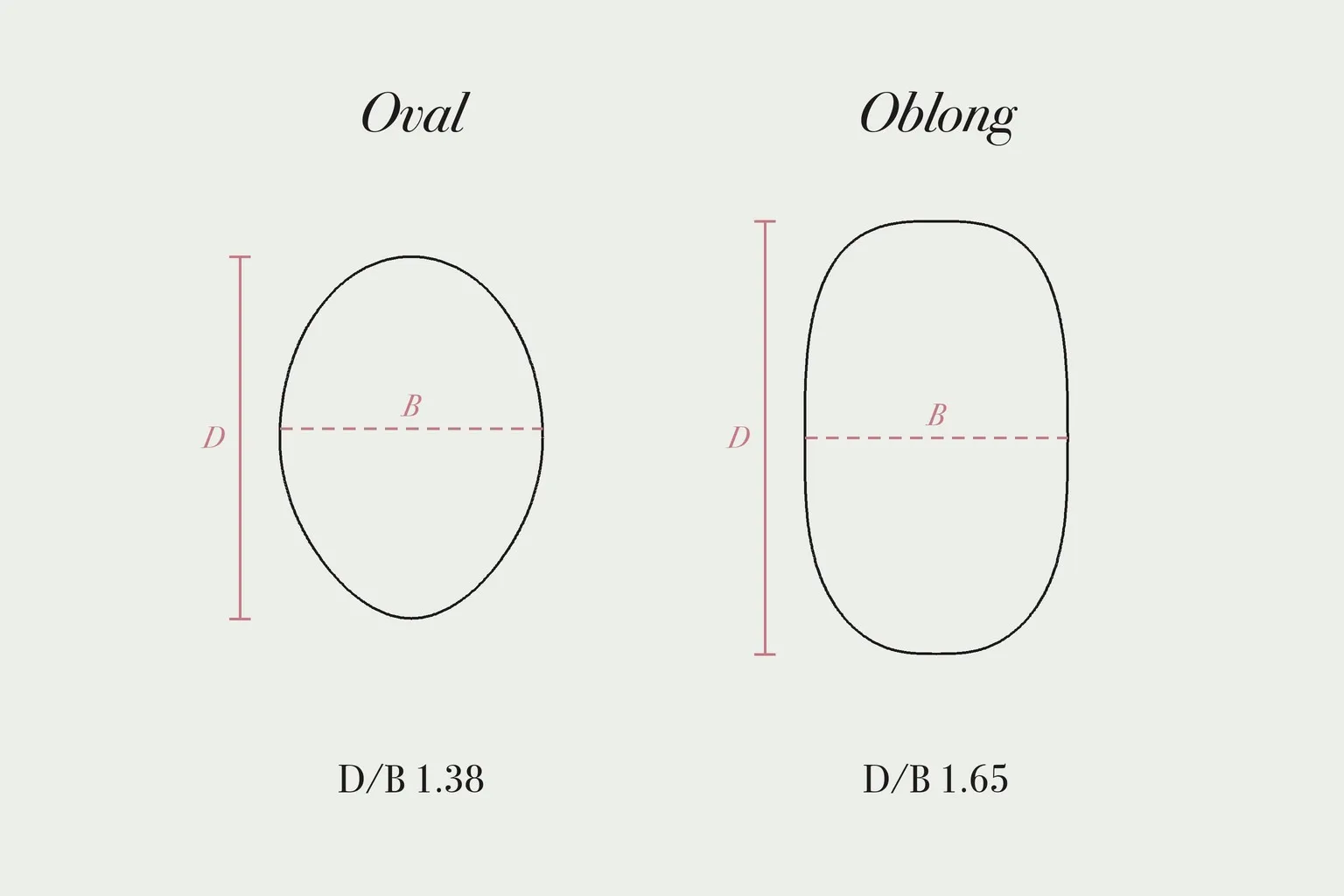
A D/B from 1.30 to 1.50 reads oval, above 1.50 oblong. Near that border the taper decides: an oval jaw narrows to roughly 0.75 to 0.88 of the cheekbones, while on an oblong face forehead and jaw stay close to the cheekbone width and the sides run nearly parallel. Take two faces with the forehead at 0.95 of the cheekbones, one with a tapering jaw (0.80) and one with straight sides (0.95):
| D/B | Tapering jaw | Straight sides |
|---|---|---|
| 1.40 | Oval 99, diamond 75 | Oval 69, oblong 66 |
| 1.45 | Oval 94, diamond 75 | Oblong 73, oval 64 |
| 1.50 | Oval 83, diamond 69 | Oblong 82, square 58 |
| 1.55 | Oval 72, oblong 67 | Oblong 91, square 57 |
| 1.60 | Oblong 73, oval 64 | Oblong 97, square 57 |
A tapering face stays oval up to about 1.55; a straight-sided one reads oblong from 1.45. So if your ratio is exactly 1.50, look at your jaw. A high forehead raises D and pushes the ratio up, but above a tapering jaw it still reads oval.
The aims then differ: an oval face needs no correction, while an oblong face gains from width at the sides, bangs and a strong top line in frames. The oval face shape and oblong face shape articles go through both.
Round or square?
Round and square faces share the same length window, 1.10 to 1.30, and both look compact. The difference is below the cheekbones: a square jaw is nearly as wide as the cheekbones and turns a visible corner, while a round one is narrower and curves.
The jaw ratio decides. A round jaw typically measures 0.80 to 0.92 of the cheekbones, a square one 0.90 to 1.00. Hold the length at 1.20 and the forehead at 0.95, and change only the jaw:
| C/B (jaw) | Round | Square | Reads |
|---|---|---|---|
| 0.86 | 97 | 69 | Round |
| 0.90 | 90 | 83 | Close call, round ahead |
| 0.92 | 83 | 91 | Close call, square ahead |
| 0.95 | 73 | 97 | Square |
The crossover lies between 0.90 and 0.92. A wider forehead pulls it slightly lower and a narrower one slightly higher, because the square forehead window sits wider than the round one.
The corner is the second check, and it takes 30 seconds:
- Trace it. Run a fingertip from just below your earlobe down and forward along the jawbone. A square jaw makes a clear turn, then runs fairly straight; a round one curves continuously.
- Lay a straight edge along it. Hold a ruler or a card against the underside of your jaw, from the corner toward the chin. A square jaw follows the edge for a few centimeters; a round one curves away almost at once.
- Look at the outline. In a straight-on photo taken at eye level from arm’s length or more, look only below the ears: corners or a curve?
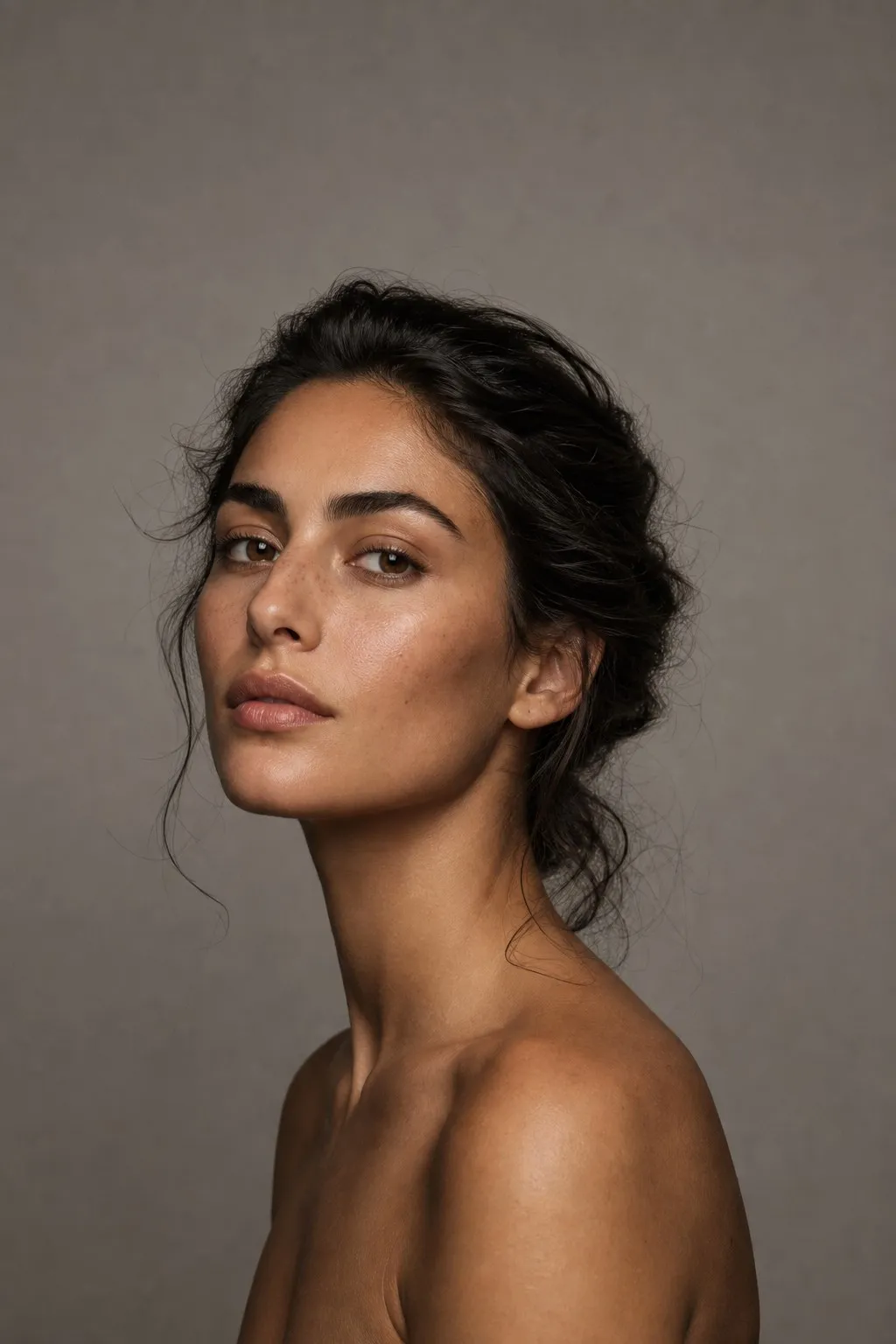
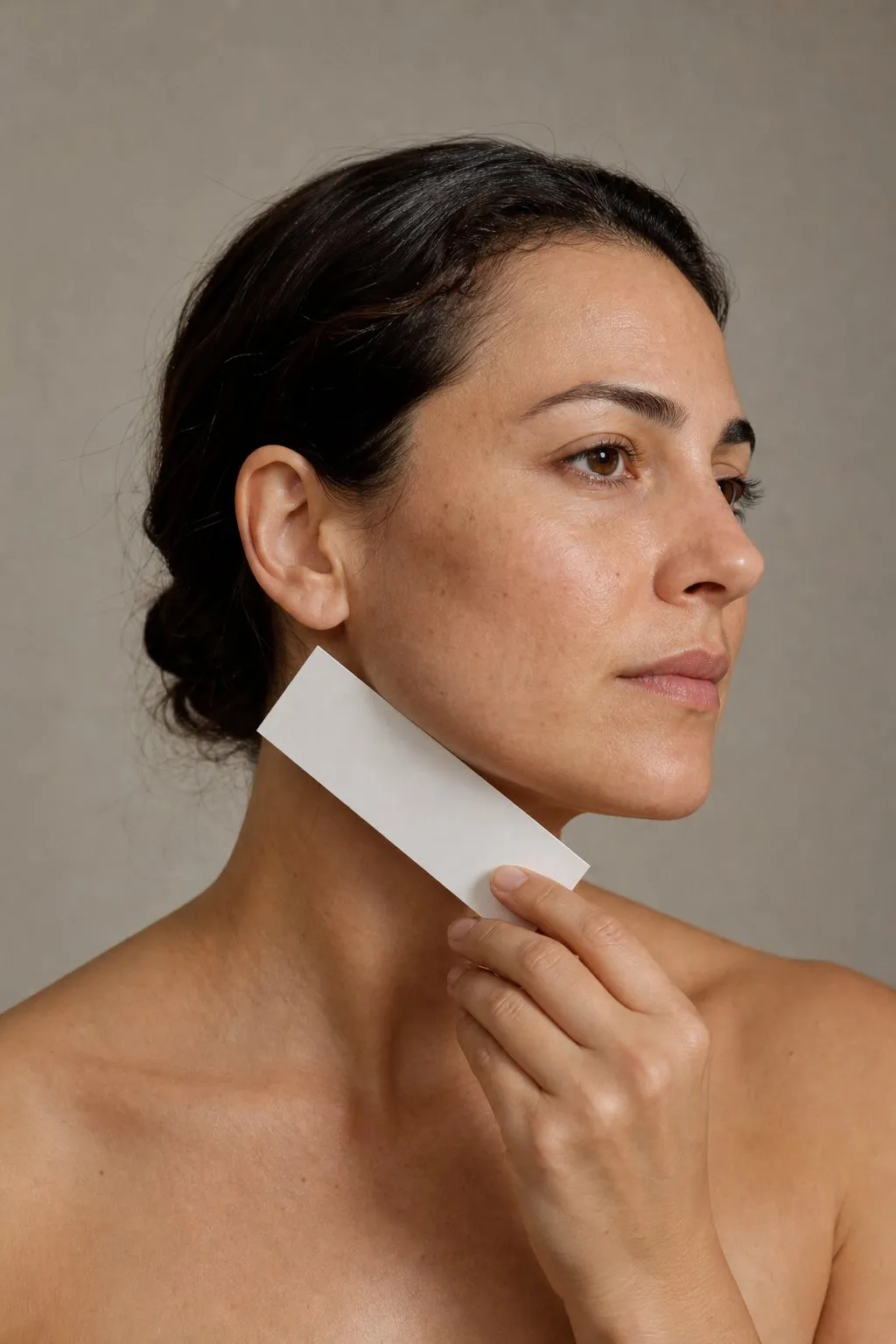
If the ratio and the corner disagree, say a jaw at 0.92 with a soft curve, you sit on the border some people call soft square, and both sets of advice apply. Soft tissue can also blur a corner the bone has.
Neither shape wants a heavy line at its widest point: a round face gains from added length, a square face from hems kept off the jaw. See the round face shape and square face shape. The 2.25-inch short-hair test, which measures how far the jaw drops below the ear, is in what suits your face shape.
Heart or diamond?
Heart and diamond faces both narrow to a fine chin, both have narrow jaw windows and both are moderately long. Seen from the chin up they look the same, so everything depends on the forehead.
Divide forehead by cheekbones. At 1.00 or above, the forehead is the widest point: heart. At about 0.88 or below, the cheekbones stand out, with the face narrowing above and below them: diamond. Keep the jaw at 0.75 and the length at 1.40, and change only the forehead:
| A/B (forehead) | Top result | Runner-up |
|---|---|---|
| 0.78 | Diamond 94 | Heart 72 |
| 0.86 | Diamond 92 | Oval 72, heart 72 |
| 0.90 | Diamond 83 | Oval 81 |
| 0.94 | Oval 86 | Heart 76, diamond 76 |
| 0.98 | Heart 83 | Oval 81 |
| 1.06 | Heart 97 | Diamond 72 |
The table shows what most charts leave out: between heart and diamond lies oval. With a forehead at about 0.90 to 0.98 of the cheekbones, a narrow jaw is simply the oval taper. Two full examples:
- Heart: forehead 13.5 cm, cheekbones 13 cm, jaw 9.5 cm, length 18 cm. Ratios 1.04, 0.73 and 1.38. Heart 98, diamond 67.
- Diamond: forehead 11 cm, cheekbones 14 cm, jaw 10.5 cm, length 20 cm. Ratios 0.79, 0.75 and 1.43. Diamond 96, heart 70.
Both shapes gain from some fullness at the jaw and chin. The difference is at the top: a heart face keeps it light, while a diamond face adds width there with bangs or a deep side part. See the heart face shape and diamond face shape, and the oval face shape if you landed in between.
Square or oblong?
Square and oblong faces can have identical widths: forehead, cheekbones and jaw close together, sometimes with a sharp corner at the jaw, which is why some charts call the long version rectangle. Length separates them. Square runs from 1.10 to 1.30, oblong from 1.50 to 1.75. With the forehead at 0.96 and the jaw at 0.94 of the cheekbones:
| D/B (length) | Top result | Runner-up |
|---|---|---|
| 1.20 | Square 98 | Round 74 |
| 1.30 | Square 82 | Oblong 61, triangle 61 |
| 1.37 | Oval 67 | Square 67 (a tie) |
| 1.41 | Oval 69 | Oblong 68 |
| 1.44 | Oblong 73 | Oval 66 |
| 1.52 | Oblong 87 | Square 58 |
Between the two windows lies a band, from about 1.30 to 1.50, where neither shape fits well. Oval rises there because its length window covers exactly that band, even though this jaw does not taper. A face in the band is what people call a long square or a short rectangle.
Both shapes have a wide jaw, so a hard horizontal such as a blunt hem stays off it. A square face is short and can take a little height at the crown; an oblong face is long, so it takes width and bangs instead. In the band between, take the jaw rule from square and the bangs from oblong. If your jaw clearly narrows below the cheekbones, the real question is oval or oblong.
Triangle (pear) face shape
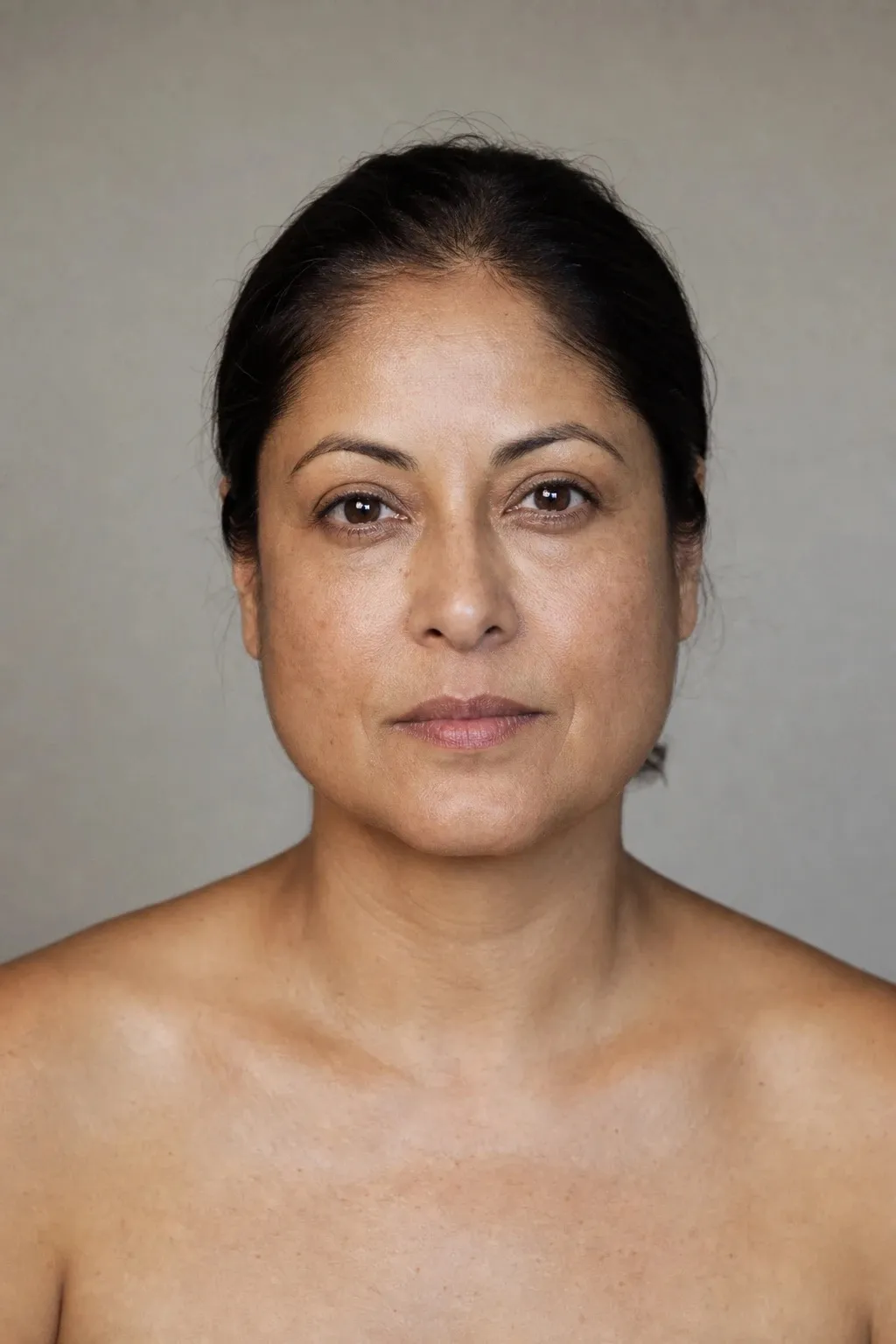
A triangle face, also called pear-shaped, is narrowest at the forehead and widens toward the jaw, which matches the cheekbones or exceeds them. It is the only one of the seven without an article of its own, so all of it is here.
How to tell a triangle face
Widest point: the jaw. Triangle has the only jaw window in the chart that runs past 1.00, starting at 0.95.
The forehead decides. A wide jaw alone does not make a triangle; square faces have one too. What sets this shape apart is a forehead clearly narrower than both other widths, with its window ending at 0.90. Pin the hair back first: hair over the temples makes a forehead measure narrower than it is and can push a square face toward triangle on paper.
Length: mid-scale. A triangle face sits in about the same length band as oval, so the widths identify the shape and the length mostly decides the runner-up.
A typical triangle face measures forehead 11 cm, cheekbones 13 cm, jaw 13 cm and length 17 cm. The ratios are 0.85, 1.00 and 1.31, and the calculator scores it 99 for triangle, 48 for diamond and 46 for square.
Triangle, square or diamond?
Two neighbors share half of the triangle profile, and a third is its mirror image.
Square has the same wide jaw but a forehead close to the cheekbones; the crossover sits at a forehead of about 0.90. On a short face (D/B 1.20) with the jaw exactly as wide as the cheekbones, a forehead at 0.88 scores triangle 78, square 67; at 0.90, 74 to 72; at 0.92, square leads 76 to 69. Length tips close cases: the square window stops at 1.30 and triangle runs to 1.45, so a longer face with a wide jaw leans triangle.
Diamond shares the narrow forehead, but its jaw is narrow too. Start from the typical face above and narrow only the jaw:
| Jaw | Ratios (A/B, C/B, D/B) | Top three |
|---|---|---|
| 13 cm | 0.85, 1.00, 1.31 | Triangle 99, diamond 48, square 46 |
| 11.5 cm | 0.85, 0.88, 1.31 | Triangle 69, round 66, diamond 60 |
| 11 cm | 0.85, 0.85, 1.31 | Diamond 70, round 68, triangle 66 |
At a jaw of 11 cm, four shapes, oval included at 65, land within five points of each other. That face is a genuine close call, so read the triangle advice next to the diamond article.
Heart is the same outline upside down, widest at the forehead with the narrow end at the chin. The advice for one is the advice for the other turned over, so the heart face shape article is a useful cross-check.
Hair, glasses and earrings
The jaw already carries the width, so a good cut moves the volume up. Fullness at the crown and temples widens the narrow forehead, and layers that start around the cheekbones keep the lower half quiet. Bangs help too: a blunt fringe or curtain bangs put a line across the forehead, the one place where a horizontal adds width usefully. What works against the shape is a horizontal at the jaw, such as a blunt, chin-length bob with full sides. Take the hem below the jaw instead, as a lob does, and keep the sides close there; short hair follows the same logic, with height on top and a close fit at the jaw.
Frames sit at the brow line, which makes them the simplest way to widen the top of the face. Choose frames that carry their weight in the upper half (browline, cat-eye or trapezoid shapes wider at the top) with a total width close to your cheekbone measurement. Frames heavier at the bottom, as many aviators are, pull the eye toward the jaw and suit only with a strong top bar.
Earrings reverse the heart advice: shapes narrow at the bottom, such as slim drops, inverted triangles and studs, rather than chandeliers that flare at the jaw. Boat and off-the-shoulder necklines add width at the shoulders, which balances a wide jaw from below, and a slightly longer, fuller brow adds visual weight above it. Bangs, bob lengths and frame sizes for every shape are compared in what suits your face shape, and brow mapping is in the eye shape chart.
Facial thirds and fifths
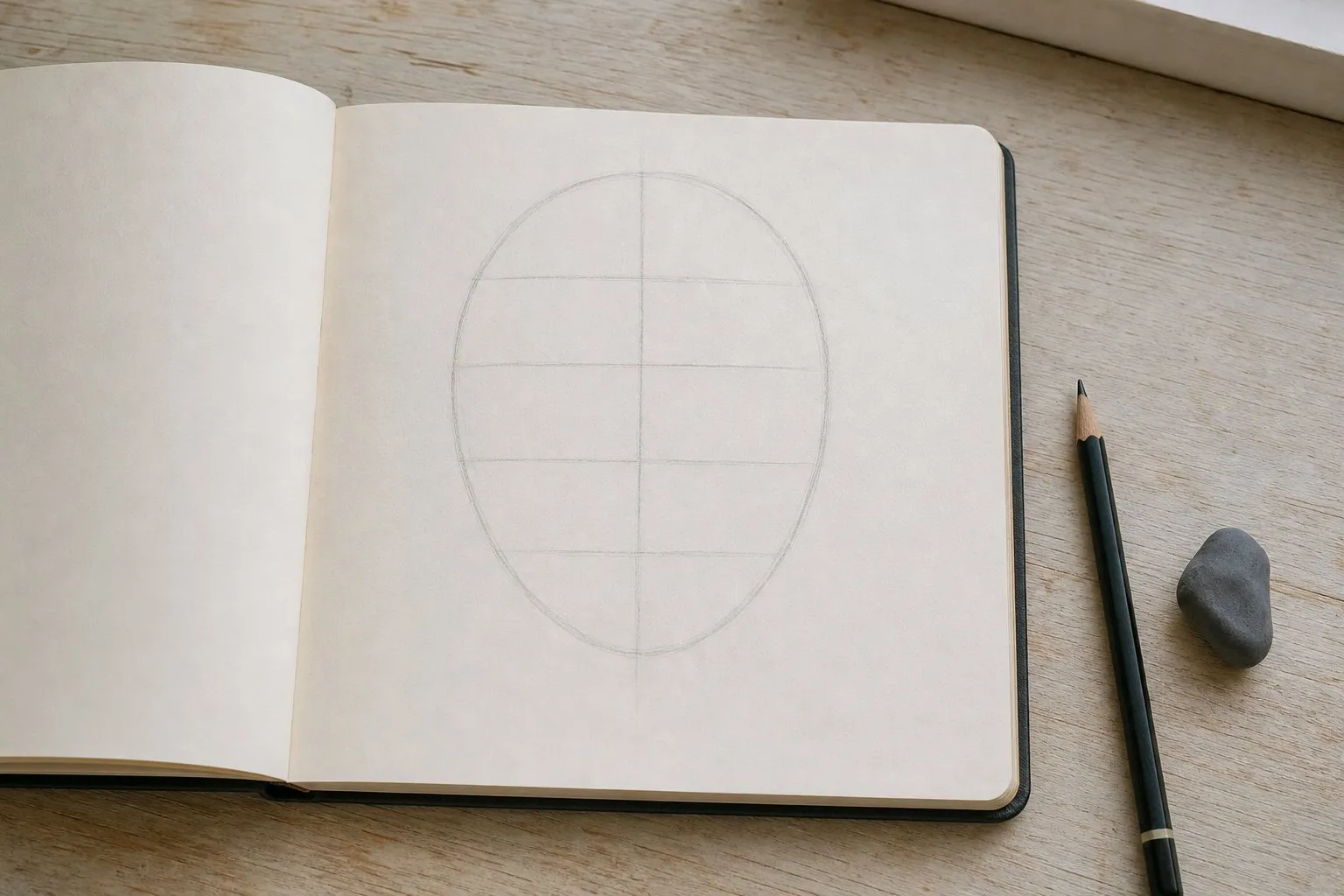
Face shape describes the outline; facial thirds and fifths describe what happens inside it, three bands from top to bottom and five from side to side. They come from old drawing canons, and almost no real face matches them. Used as a map, they explain why a fringe, a frame bridge or a brow starting point works for you. Used as a score, they mean nothing.
Thirds divide the face at three lines:
- Upper third: from the hairline to the point between your brows.
- Middle third: from between the brows to the base of the nose.
- Lower third: from the base of the nose to the bottom of the chin.
Fifths, the rule of fifths, divide the face width at eye level into five parts: from the side of the face to the outer corner of the eye, the eye itself, the gap between the eyes, the other eye, and from its outer corner to the other side. The canon makes each fifth one eye wide.
How to measure thirds and fifths
Use the mirror and ruler as for the outline, or a photo taken straight on at eye level from at least arm’s length; a phone held close distorts the middle of the face. For thirds, measure the three vertical segments from your natural hairline. For fifths, measure the width of one eye from corner to corner, the gap between your eyes and the full face width at eye level. Only the comparisons matter: which third is longest, and whether the gap between your eyes is more or less than one eye width.
What the map tells you
| If you find | What it explains |
|---|---|
| A long upper third (high forehead) | A fringe suits you: it shortens that segment |
| A short upper third (low forehead) | Heavy bangs crowd the brows; height at the crown works better |
| A long middle third | Frames with a lower bridge or a stronger top line sit well |
| A long lower third | Hair with some width at chin level balances it |
| A gap between the eyes wider than one eye | Brows that start a little further in and a darker frame bridge balance it |
| A gap narrower than one eye | A lighter or clear bridge and brows that start slightly further out open it |
None of these is a correction. Each row says what a styling choice does to a segment, so you can decide whether you want that effect. Bangs and frame bridges by shape are in what suits your face shape, brow starting points in the eye shape chart.
The golden ratio is not a score
In 1985, Leslie Farkas and colleagues measured young white North American adults against the classical canons, and the canons turned out to be the exception rather than the rule. Farkas went on to compile measured norms for the head and face in place of drawn ideals.
The golden ratio claim is weaker still. Golden-ratio face tests compare distances on a face with about 1.618, and a widely cited template for it is Marquardt’s mask. A 2008 analysis in Aesthetic Plastic Surgery found that mask closest to a narrow group of fashion models and ill-suited to many populations. A face does not get a grade from its proportions, and this site does not give one.
Symmetry
Measure both sides of your face and you will find differences. A 1981 anthropometric study of healthy adults found asymmetry very common and usually mild, with the largest differences in the upper third of the face. A symmetry percentage is no grade either; it only confirms that two sides differ, which is true of every face.
For styling, asymmetry often explains why one side part looks better than the other, why glasses sit slightly tilted, or why one brow needs a different starting point. Mirrors, and many front cameras, flip your image, so the face you see every day is the reverse of the one others see.
Why quizzes say you fit every shape
If every quiz answers “what face shape am I?” differently, nothing is wrong with your face. Quizzes ask you to judge an outline by eye, with no numbers and often from a photo, and three things make that unreliable.
The questions have no thresholds. “Is your face longer than it is wide?” is true for nearly every adult face: every window in the chart starts at a D/B of 1.10 or more, so even round and square answer yes. “Is your jaw strong or soft?” depends on what you compare it with.
The shapes overlap. A face measuring 12 cm across the forehead, 13 across the cheekbones, 12 across the jaw and 16 long scores 84 for square and 83 for round. That face has no hidden true shape; it is both. Charts with five shapes, or more than seven, draw the borders in other places again.
The photo changes the face. A phone held close exaggerates whatever is nearest the lens. In one study, a selfie taken from about 12 inches made the base of the nose look around 30% wider than a portrait taken from 5 feet (Ward and colleagues, 2018), and the same perspective shrinks the sides of the face relative to the middle. A tipped chin shortens or lengthens the face in the picture, and near a border a few percent is enough to swap the result.
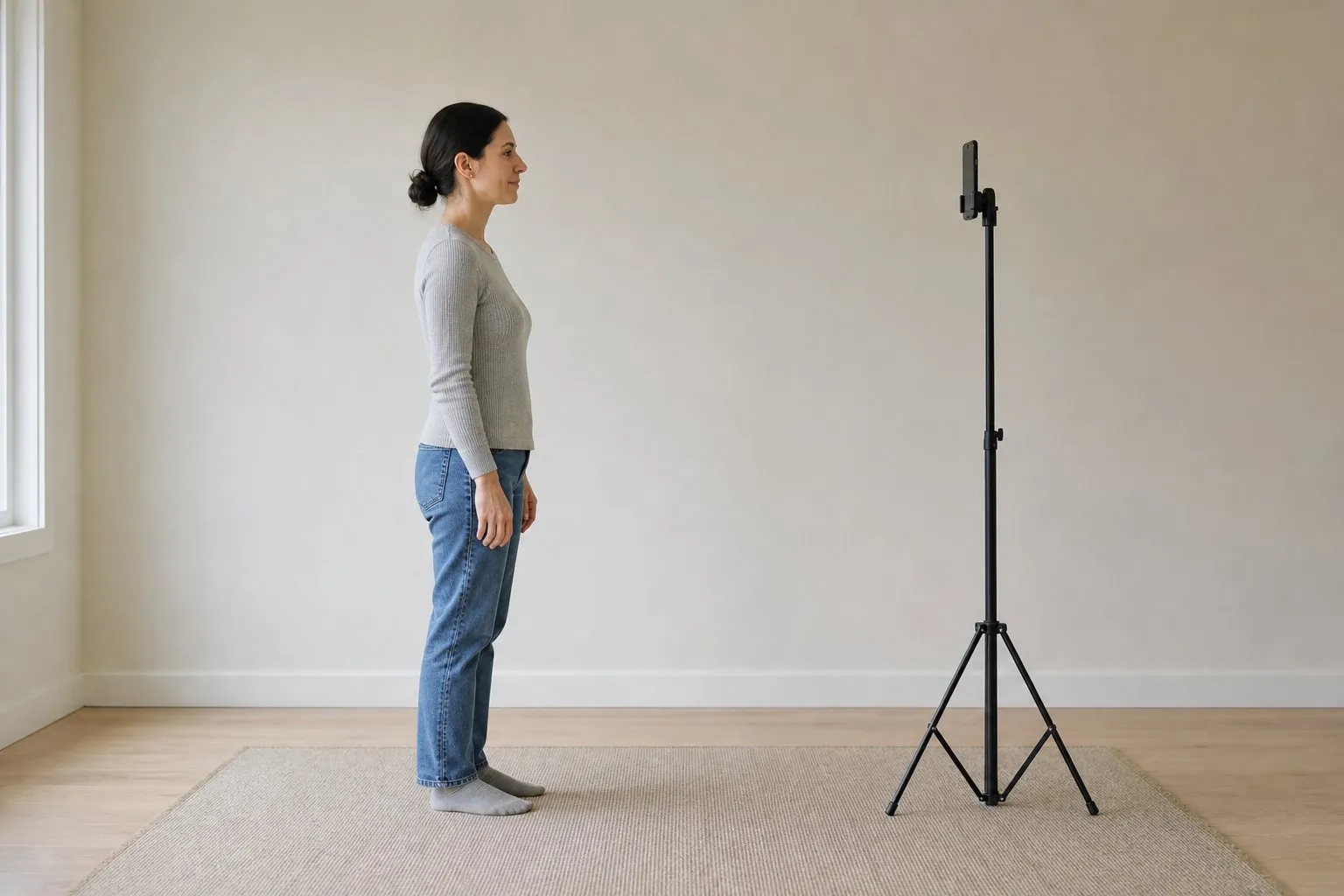
This is also why lists of famous faces disagree: built from photos taken at different angles and with different hairstyles, they file the same face under two or three shapes, and nobody measures. Treat such an example as a picture of a style, not proof of a shape. The same applies when an app or a chatbot reads your face from a picture: whatever it answers, the lens, the tilt and the hair were in the picture first. A ruler sidesteps all three, which is why the calculator asks for four numbers and no photo.
Does face shape change with age?
Your face shape changes with age, but less than it seems. The bones change slowly and in specific places, and the soft tissue over them shifts and settles, so the outline, especially along the jaw, reads softer and wider while a ruler across the bones may barely move.
Bone. The facial skeleton is not fixed in adulthood. A 2012 review by Bryan Mendelson and Chin-Ho Wong describes resorption in particular areas: the midface around the upper jaw, parts of the eye socket rim, the edges of the nasal opening and the lower jaw just in front of the jowl. The same review reports imaging data in which the angle of the jaw opened and the jawbone lost some height and length, while the width between the jaw angles did not change significantly.
Soft tissue. Facial fat sits in separate compartments rather than one even layer, as Rod Rohrich and Joel Pessa showed in a 2007 anatomy study, so the face does not age as one mass. Along the lower face, the jowl becomes more visible and the clean line from chin to ear breaks.
In the four measurements:
- A, forehead, changes little.
- B, cheekbones, can read slightly narrower if the cheeks flatten, which makes the face look a little longer and the jaw relatively wider.
- C, jaw, measured between the bony corners, often stays close to what it was. The soft outline below it is what widens.
- D, length, can shift with the hairline, so keep measuring from the original one.
Sometimes the numbers move enough to change the top result; more often they move a few points and the ranking shifts. The common drift is toward a fuller lower face: a heart or oval face can read closer to square, round or triangle, because the jaw looks wider next to the cheekbones. If the numbers barely changed but the mirror shows something different, both are true, and the outline you see is the one to style for.
Re-measure every few years, and after any large change in weight, which changes the fullness of the cheeks and jaw. Compare the new ratios with the old ones, not the raw numbers.
The most useful change is usually where a haircut ends. A cut that stops exactly at the jawline draws a horizontal across the area that has softened most, so let it end at the cheekbones or past the jaw, with soft layers from the cheekbones, some lift at the crown or a side part. A frame with a strong upper line keeps attention on the eyes, V-necks and open collars draw a vertical below the chin, and earrings work best ending above or below the jaw, not at it. Coloring shifts too, especially as hair turns gray; seasonal color analysis explained covers that side.
What to do with your result
Your shape is a starting point for hair, frames and the details around the face, and each has its own article:
- Your shape in full: oval, round, square, oblong, heart and diamond each have an article on what the shape changes for hair, glasses and more. Triangle is above.
- All shapes side by side: what suits your face shape compares bangs, where a bob should end, short hair, frame size, sunglasses, contour, earrings, necklines and necklace length.
- Brows: the eye shape chart maps brow shape and starting points.
If your result was a close call, read both shape articles and use the advice they share; where they differ, the pair sections above say which measurement to trust. Everything else on faces is in the face guides.