A face shape chart answers two questions, in this order: where is your face widest, and how long is it compared with its width? The seven shapes are the common combinations of those two answers. The chart below gives the range where each shape is most typical on three ratios, the same reference values the Face Shape Calculator uses, so you can place your own face with numbers instead of squinting at outlines.
These shapes are a styling framework, not an anatomical classification. They describe how a face reads at a glance, which is what glasses and haircuts change. The ranges are editorial reference values, not a medical standard.
What you need: four measurements and three ratios
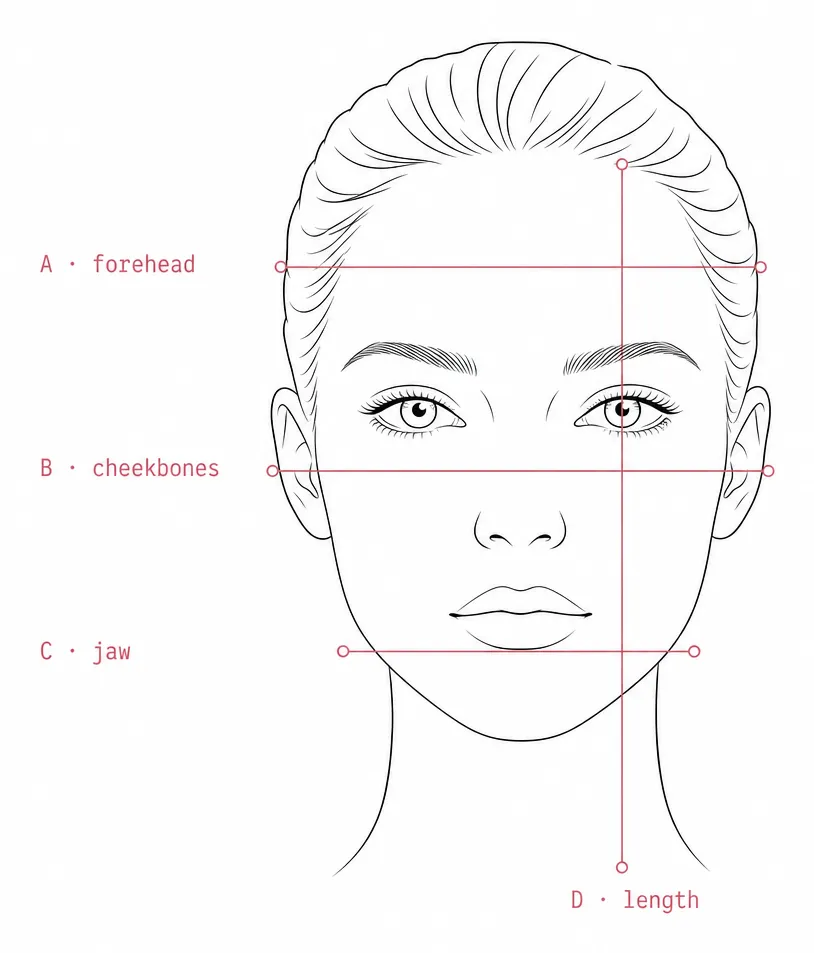
Take four straight measurements with your hair pulled back: A forehead, B cheekbones, C jaw and D face length from hairline to chin. The measuring guide shows where each line goes and the mistakes that skew it.
Then divide the other three by your cheekbone width:
- D/B, the length-to-width ratio: how long the face is for its width.
- A/B: the forehead compared with the cheekbones.
- C/B: the jaw compared with the cheekbones.
A ratio of 1.00 means the two widths are equal. Below 1.00, that part of the face is narrower than the cheekbones; above it, wider.
The face shape chart with measurements
| Shape | Widest point | D/B (length) | A/B (forehead) | C/B (jaw) |
|---|---|---|---|---|
| Oval | Cheekbones, gentle taper to the jaw | 1.30–1.50 | 0.88–1.00 | 0.75–0.88 |
| Round | Cheekbones, soft jaw | 1.10–1.30 | 0.86–0.98 | 0.80–0.92 |
| Square | Forehead, cheekbones and jaw nearly equal | 1.10–1.30 | 0.92–1.04 | 0.90–1.00 |
| Oblong | Nearly equal, top to bottom | 1.50–1.75 | 0.90–1.02 | 0.85–1.00 |
| Heart | Forehead | 1.25–1.50 | 1.00–1.12 | 0.65–0.80 |
| Diamond | Cheekbones, clearly | 1.30–1.55 | 0.75–0.88 | 0.70–0.85 |
| Triangle | Jaw, wider than the forehead | 1.20–1.45 | 0.78–0.90 | 0.95–1.08 |
Read each cell as the range where that shape is most typical, not as a border you cross. The ranges overlap on purpose: round and square share the same length range, and heart, diamond and oval overlap in length too. Where the length cannot separate two shapes, the widths do.
Step 1: find your widest point
Look at A/B and C/B together. They sort a face into one of five groups before length comes into it.
- Forehead wider than the cheekbones (A/B above 1.00) with a much narrower jaw: heart.
- Jaw as wide as the cheekbones or wider, forehead clearly narrower (C/B near or above 1.00, A/B below 0.90): triangle.
- Cheekbones clearly widest, forehead and jaw both well inside them (both ratios below about 0.88): diamond.
- Cheekbones widest, forehead close behind, jaw tapering: oval or round.
- All three widths close (A/B and C/B both around 0.90 or higher): square or oblong.
Step 2: let length settle the rest
Now use D/B. It splits the last two groups cleanly.
| D/B | Cheekbones widest, tapering jaw | All three widths close |
|---|---|---|
| 1.10 to 1.30 | Round | Square |
| 1.30 to 1.50 | Oval | Between oval and oblong |
| 1.50 to 1.75 | Oblong, unless the jaw tapers strongly | Oblong |
For heart, diamond and triangle, length matters less, because their widths already set them apart. Their typical D/B sits in the middle of the scale, from 1.20 to 1.55.
A worked example: A 12.5 cm, B 13.5 cm, C 11.5 cm, D 18.5 cm. The ratios are A/B 0.93, C/B 0.85 and D/B 1.37. Cheekbones are widest with a tapering jaw, and the length lands in the oval band. The calculator scores this face 92 for oval and 69 for round, its nearest neighbor.
The seven face shapes at a glance
Oval. Longer than wide, with the forehead a little narrower than the cheekbones and a jaw that tapers. Nothing needs correcting, but frame size and where a cut ends still matter. See the oval face shape guide.
Round. Length close to width, cheekbones widest, a soft jaw without a defined angle. Styling adds a vertical line. See the round face shape guide.
Square. Forehead, cheekbones and jaw nearly the same width, with a short face and a visible jaw angle. Styling works with the corners rather than against them. See the square face shape guide.
Oblong. Clearly longer than wide, with sides that run nearly parallel. Styling adds width and shortens the read. See the oblong face shape guide.
Heart. Widest at the forehead, narrowing to a fine chin. Styling keeps the top light and adds weight near the jaw. See the heart face shape guide.
Diamond. Cheekbones clearly wider than both forehead and jaw. Styling adds width above and below the cheekbone line. See the diamond face shape guide.
Triangle. The jaw is the widest part, or level with the cheekbones, while the forehead is clearly narrower, so the face widens downward. Some charts call it pear. It is the mirror image of the heart: volume and detail above the eye line balance it, and anything that ends in a horizontal line at the jaw, such as a chin-length blunt bob, adds to the width that is already there. Frames with a strong top line, such as browline or soft cat-eye shapes, bring weight up to the narrower forehead. A typical triangle face measures A 11, B 13, C 13 and D 17 cm: A/B 0.85, C/B 1.00, D/B 1.31.
When you sit between two shapes
The calculator does not use hard cutoffs. Each face gets a score for every shape based on how close its three ratios sit to the center of that shape’s ranges, with length weighted most (40%), then the jaw (35%) and the forehead (25%). The shape with the highest score is your result, and the full ranking shows how close the second one is. A gap under 10 points means you share traits of both.
That happens often, because real faces are continuous. A face measuring A 12, B 13, C 12 and D 16 cm scores 84 for square and 83 for round: the length fits both, and the jaw sits right where the two ranges meet. The neighbor pairs that cause most confusion each have their own guide: round vs oval, round vs square, heart vs diamond and oval vs oblong. If every quiz you have tried gave a different answer, why face shape quizzes confuse you explains where the disagreement comes from.