Face shape is a ratio, not a guess. Two numbers do most of the work: how long your face is compared with its width, and where the widest point sits. Everything else follows from those, from the frames that suit you to where a haircut should end.
You need a mirror, a rigid ruler (or a soft tape measure), a pen and two minutes. Pull your hair back off your face and look straight ahead.
The four measurements
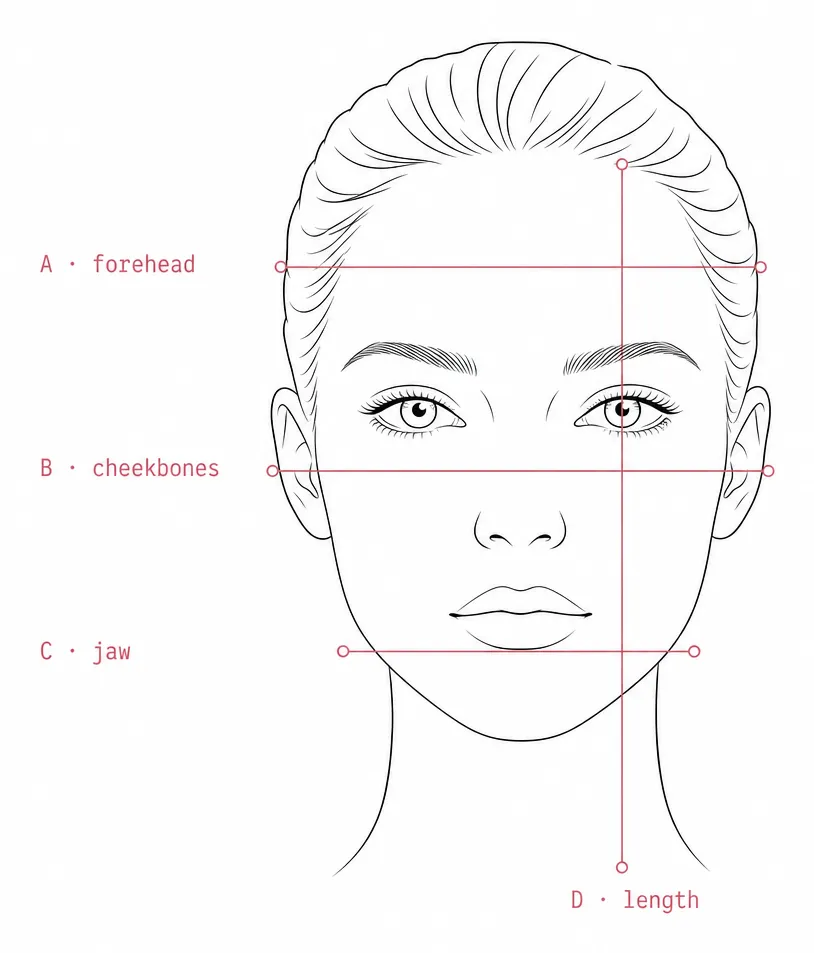
A · Forehead width. Measure across your forehead at its widest point, usually about halfway between your eyebrows and your hairline.
B · Cheekbone width. Find the most prominent points of your cheekbones, just below the outer corners of your eyes, and measure straight across.
C · Jaw width. Feel for the angle of your jaw below each ear. Measure straight across from one angle to the other.
D · Face length. Measure from the centre of your hairline down to the bottom of your chin. If your hairline has receded, use where it used to be.
Measure across, not around. A tape that follows the curve of your cheeks measures your skin, not your silhouette.
The mistakes that skew the result
- Wrapping the tape. For the three widths, hold the ruler flat in front of your face. A tape pressed against the cheeks can add a centimetre or more.
- Tilting your head. Tipping the chin up shortens the face; tipping it down lengthens it. Keep your eyes level with the mirror.
- Measuring the hair, not the face. Volume at the temples or a fringe hides the forehead edge. Pin everything back.
- Smiling. A smile widens the cheeks and changes the jaw line. Keep a relaxed, neutral expression.
How to read your numbers
Divide face length by cheekbone width (D ÷ B). Then compare forehead and jaw with the cheekbones (A ÷ B and C ÷ B).
| What you see | What it suggests |
|---|---|
| D ÷ B above 1.5 | Oblong: clearly longer than wide |
| D ÷ B between 1.3 and 1.5, jaw narrower than cheekbones | Oval |
| D ÷ B below 1.3, soft jaw | Round |
| D ÷ B below 1.3, forehead, cheekbones and jaw nearly equal | Square |
| Forehead widest, narrow chin | Heart |
| Cheekbones clearly widest, narrow forehead and jaw | Diamond |
| Jaw wider than forehead | Triangle |
Most faces sit between two shapes. That is normal, and it is why the Face Shape Calculator shows a full ranking and the margin between the top two, rather than a single label.
What to do with the result
Your face shape is the starting point for three decisions: frames, hair and brows. Each guide on this site opens on your variant once you have saved a result. Start with oval vs oblong if your face is longer than it is wide, or with hairstyles for a round face if it is close to square in proportion.