Body shape is about proportion, not size. Two people with very different measurements can share a shape, and one person can change size without changing shape at all. Three circumference measurements and one look in the mirror are all you need.
What you need
A soft tape measure, a mirror, close-fitting underwear and two minutes. Stand straight with your feet together and your arms relaxed. Keep the tape level with the floor all the way round; a mirror helps you check the back.
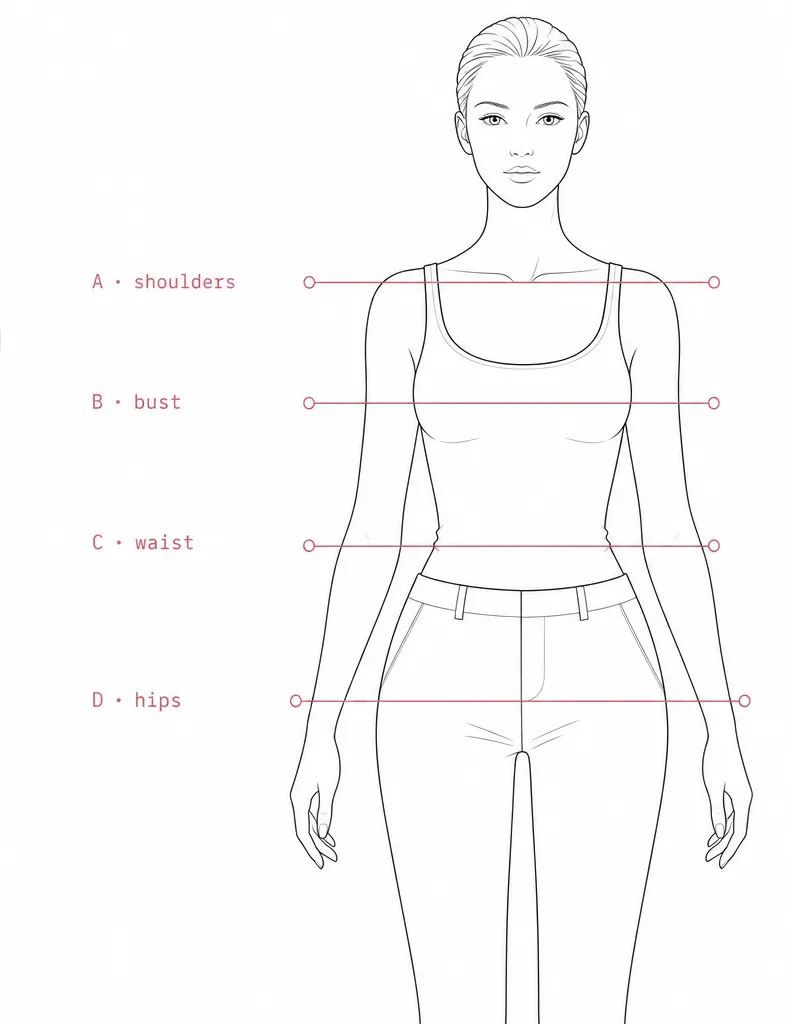
The measurements
A · Shoulders (look, don’t measure). In the mirror, compare the width of your shoulders with the width of your hips. Are they wider, about the same, or narrower? Tape measurements alone miss this, and it matters for tops and jackets.
B · Bust. Measure around the fullest part of your bust, with the tape level across your back. Wear a bra that doesn’t flatten or push up.
C · Waist. Measure around your natural waist, the narrowest part of your torso. Breathe out normally and measure at the end of the breath, without pulling your stomach in. This follows the protocol health professionals use, which takes the reading at the end of a normal exhalation.
D · Hips. Measure around the widest part of your hips and seat. Check it in the mirror from the side: the tape should cross the fullest point of the buttocks.
Snug, level, and at the end of a normal breath. Those three rules remove most measuring errors.
Reading the numbers
Two ratios describe most of your shape:
- Bust ÷ hips. Close to 1.00 means balanced top and bottom. Below about 0.95, your hips are wider; above about 1.05, your bust is wider.
- Waist ÷ hips. The lower the number, the more defined your waist. Around 0.70 is a clearly defined waist; above about 0.85 the waist is close to the hips.
| Bust ÷ hips | Waist ÷ hips | Likely shape |
|---|---|---|
| About 1.00 | 0.75 or lower | Hourglass |
| Below 0.95 | Around 0.75 | Pear |
| About 1.00 | About 0.80–0.85 | Rectangle |
| Above 1.05 | Any | Inverted triangle |
| Any | 0.90 or higher | Apple |
The Body Shape Calculator does the arithmetic, factors in your shoulder check and shows how close the call is between neighbouring shapes.
A note on the numbers
Body shape categories come from apparel fitting, where they help designers grade patterns. Research such as the FFIT study of female figures sorted body scans into shape groups for exactly this reason. They describe how clothes will hang on you. They are not a measure of health, and none of them is a better shape than another.